

Key Takeaways
Why Vulnerable Road Users Demand Special Attention
When a collision involves a vehicle and a pedestrian or cyclist, the physics are deeply uneven. A person on foot or on a bike has no crumple zone, no airbag, and no seatbelt. Even a low-speed impact - one that would leave two vehicles with minor fender damage - can cause life-altering or fatal injuries to an unprotected road user.
According to the National Highway Traffic Safety Administration (NHTSA), pedestrians and cyclists together account for a significant and disproportionate share of U.S. traffic fatalities relative to their road presence. This isn't a coincidence; it reflects a structural vulnerability that every driver should internalize before pulling out of the driveway.
If you're building your foundational driving habits, the new driver's complete introduction to road safety covers the scanning and awareness fundamentals that apply directly here. Treating cyclists and pedestrians as predictable but fragile participants - not obstacles - is the mindset shift that makes safer roads possible.
76%
Pedestrian fatalities occurring in non-intersection locations
According to NHTSA data, a majority of pedestrian deaths occur at non-intersection locations, underscoring the need for driver vigilance everywhere - not just at crosswalks.
~1,000
Cyclists killed in U.S. traffic crashes annually
NHTSA reports approximately 1,000 cyclist fatalities per year in the United States, a figure that has remained stubbornly elevated despite road safety campaigns.
Best Practices for Sharing the Road
The following practices are grounded in defensive driving principles and reflect guidance from road safety researchers and traffic engineers. They apply in urban neighborhoods, suburban arterials, and rural roads alike.
Give cyclists at least three feet of passing clearance - more when possible.
Many states mandate a minimum three-foot buffer when passing cyclists, but even where it isn't law, it's sound practice. Cyclists can swerve to avoid road hazards - potholes, debris, or car doors - with little warning. A close pass leaves no margin for either party.
Check for cyclists before opening your car door (the 'Dutch Reach' method).
Dooring - opening a car door into the path of an approaching cyclist - is a leading cause of urban cycling injuries. The Dutch Reach involves using your far hand to open the door, which naturally rotates your body toward oncoming traffic and cyclists.
Reduce speed in areas with high pedestrian activity, even when the posted limit allows more.
Posted speed limits represent a legal maximum, not a safety guarantee. School zones, residential streets, and commercial areas with foot traffic require speeds that give you time to react if a pedestrian steps off the curb unexpectedly.
Never pass a vehicle stopped at a crosswalk.
A stopped vehicle is often stopped because a pedestrian is crossing - one the following driver can't yet see. Passing it places you on a collision course with someone who reasonably assumes traffic has stopped for them.
Anticipate unpredictable movement from cyclists and pedestrians without assuming the worst.
Children, elderly pedestrians, and inexperienced cyclists may not move predictably. Rather than reacting to their movements in real time, slow down near schools, parks, and bus stops so that any deviation from expected behavior can be absorbed safely.
Quick Actions You Can Take Starting Today
Not every improvement requires relearning your driving habits from scratch. Several high-impact adjustments can be made immediately - before your next trip.
Understanding right-of-way is closely connected to pedestrian safety. Misjudging who has the right to proceed - especially at unmarked crosswalks - is a common source of conflict. Our breakdown of where drivers go wrong with merging and yielding covers these rules in detail.
Intersections, Crosswalks, and the Moments That Matter Most
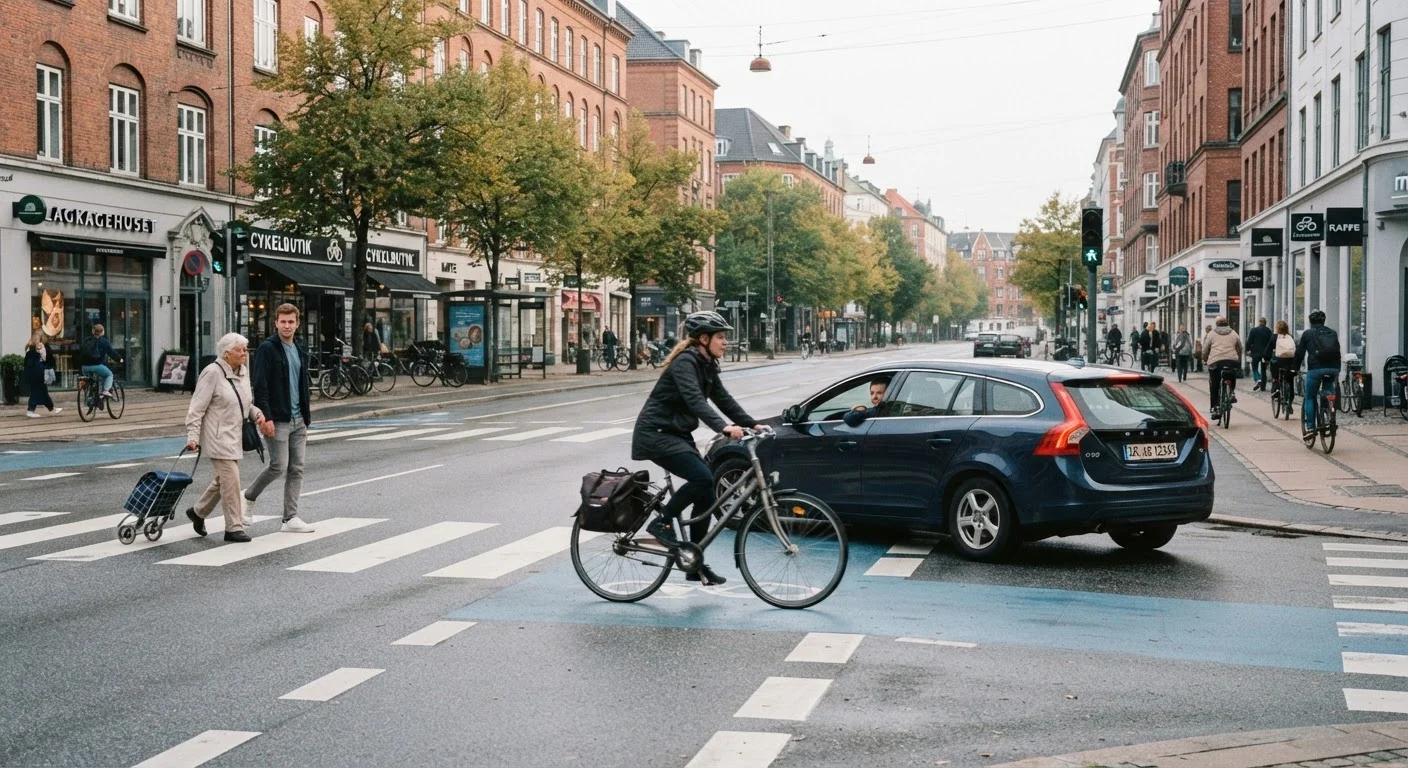
Most pedestrian and cyclist fatalities occur at or near intersections. The combination of turning vehicles, crossing pedestrians, and cyclists moving through the intersection simultaneously creates a high-conflict environment - especially when any driver is distracted or moving too fast.
Watch for the 'Second Pedestrian' at Crosswalks
When one pedestrian finishes crossing and you prepare to move, pause and check again. A second pedestrian - often moving more slowly or coming from a blind spot - may still be in the crosswalk. This two-second additional check before accelerating is one of the simplest ways to prevent an intersection collision.
Right-turn conflicts are particularly common. A driver checking for oncoming traffic from the left may roll forward into a crosswalk, striking a pedestrian or cyclist approaching from the right. The habit of completing a full stop and checking both directions before turning eliminates most of these close calls.
Distraction plays a significant role in intersection crashes. Even a momentary glance at a phone or infotainment screen can cause a driver to miss a cyclist entering the intersection. The connection between distraction and aggressive driving patterns is worth understanding - our piece on road rage and aggressive driving explores how stress behind the wheel compounds inattention.
Bike Lanes Do Not Eliminate Driver Responsibility
Dedicated bike infrastructure reduces conflict, but it doesn't eliminate it. Cyclists can still be struck by turning vehicles, doors, or drivers who drift into the lane. Treat a bike lane as occupied even when you can't yet see a cyclist - especially when turning right across one.
This article provides general driver education and is not a substitute for official traffic law guidance in your state. Laws governing pedestrian right-of-way, bike lane rules, and crosswalk requirements vary by jurisdiction. Consult your state's DMV or driver handbook for applicable regulations.