
Budgeting Methods Compared: Envelope, Zero-Based, Pay Yourself First, and More

Key Takeaways
Our Verdict
Each budgeting method solves a different financial problem. Zero-based budgeting suits detail-oriented planners; envelope budgeting helps overspenders rein in discretionary categories; Pay Yourself First accelerates savings goals; and the 50/30/20 rule offers a low-friction entry point. The strongest approach is often a hybrid that borrows structure from one method and flexibility from another.
| Best for | Recommended |
|---|---|
| Detail-oriented planners who want full control over every dollar | Zero-Based Budgeting |
| Those who overspend in specific categories like dining or entertainment | Envelope Budgeting |
| People focused on building savings or investing consistently | Pay Yourself First |
| Beginners looking for a simple, flexible framework | 50/30/20 Rule |
Why Your Budgeting Method Matters
A budget is only useful if it fits how you actually live and think about money. The method you choose shapes not just your numbers, but your relationship with spending, saving, and financial stress. Research in behavioral economics consistently shows that structure and automation significantly improve follow-through - yet the wrong structure can feel so burdensome that people abandon it within weeks.
This comparison breaks down four of the most widely used budgeting systems: zero-based budgeting, the envelope method, Pay Yourself First, and the 50/30/20 rule. For each, we examine the core mechanics, who it suits best, and where it tends to fall short. If you're curious how your tools should match your method, see our look at paper budgets, spreadsheets, and budgeting apps.
| Zero-Based | Envelope | Pay Yourself First | 50/30/20 Rule | |
|---|---|---|---|---|
| Core mechanism | Assign every dollar a job | Cash limits per category | Automate savings first | Fixed percentage splits |
| Best income type | Steady/predictable | Any income type | Steady or variable | Steady/predictable |
| Time commitment | High - monthly rebuild | Moderate - daily tracking | Low - set and automate | Low - periodic check-ins |
| Savings emphasis | Moderate - explicit line item | Low - not the focus | Very high - top priority | Moderate - 20% bucket |
| Spending control | Very high | Very high for discretionary | Low to moderate | Moderate |
| Beginner-friendly | Moderate | Moderate | High | Very high |
| Flexibility | Low - rigid by design | Low - hard category caps | High - discretionary flexible | Moderate - broad buckets |
Zero-Based Budgeting: Every Dollar Has a Job
Zero-based budgeting (ZBB) requires you to assign every dollar of income to a specific category - expenses, savings, or debt repayment - until your budget balance reaches zero. That doesn't mean spending everything; it means every dollar is purposefully allocated rather than left unaccounted.
Best for: People with consistent monthly income who want granular control and are willing to invest 30-60 minutes per month planning their finances. It works especially well for households trying to eliminate debt aggressively.
Limitations: ZBB demands ongoing upkeep. If your income varies month to month, it can be difficult to build an accurate baseline. For a deeper comparison of this method against percentage-based approaches, see Zero-Based Budgeting vs. the 50/30/20 Method.
Start with last month's actual spending
Before building a zero-based budget from scratch, pull three months of bank and credit card statements to see where your money actually goes. Estimated categories almost always understate spending on dining, subscriptions, and personal care. Real data creates a budget you can actually live within rather than one that looks good on paper but fails by week two.
Envelope Budgeting: Spending Limits You Can Touch
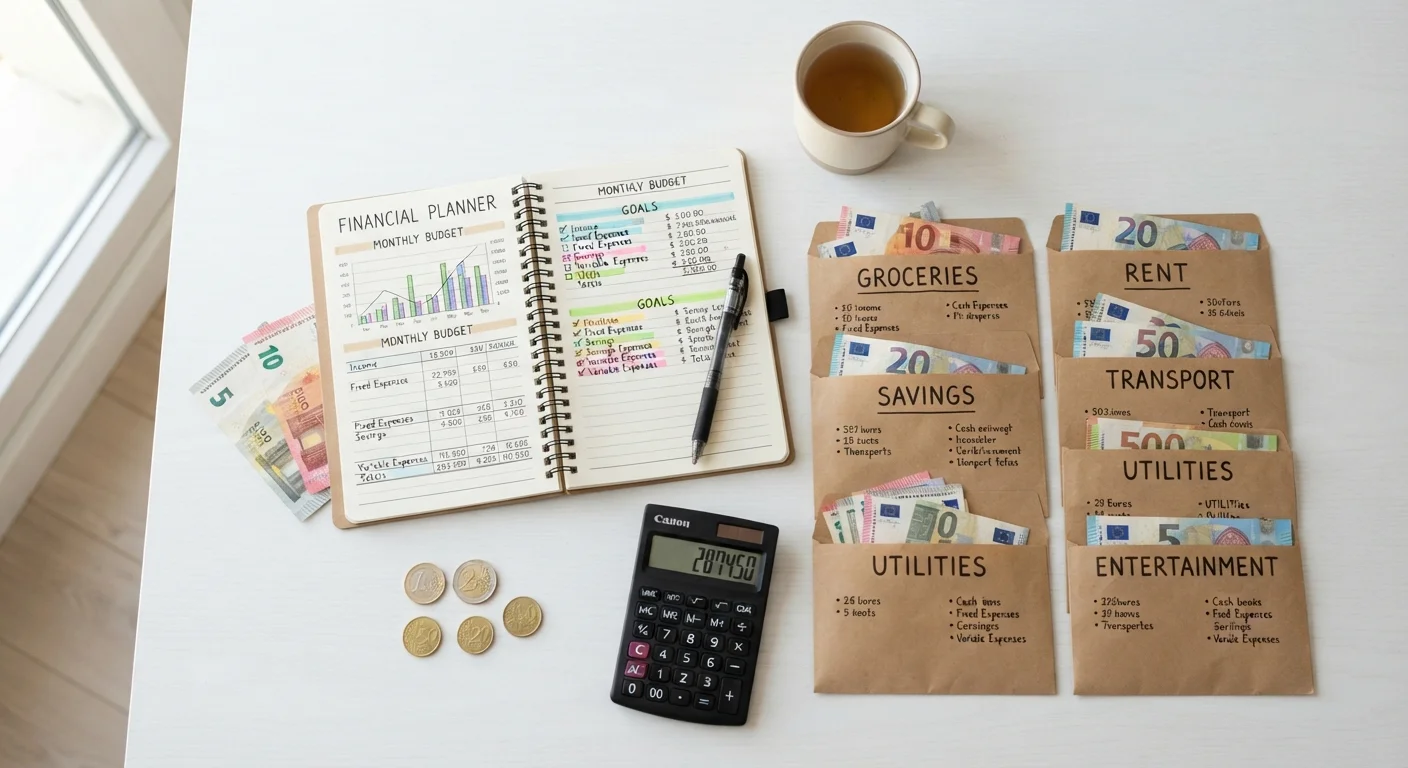
Originally a cash-based system, envelope budgeting divides your take-home pay into physical (or virtual) envelopes labeled by spending category - groceries, gas, dining out, entertainment. When an envelope is empty, spending in that category stops for the month.
Best for: People who overspend in specific discretionary categories and need a tangible constraint. The tactile friction of spending physical cash or watching a digital envelope deplete has a measurable psychological effect on impulse purchases.
Limitations: Managing cash envelopes is impractical for subscriptions, online purchases, and autopay bills. Digital envelope apps bridge this gap but require consistent manual entry to stay accurate. The psychological side of budgeting explains why this friction works - and when it backfires.
Don't raid one envelope to cover another
The envelope method only works if category limits are treated as firm. Routinely borrowing from the grocery envelope to cover dining out defeats the purpose of the system and masks the actual pattern causing overspending. If you consistently run short in one category, the right response is to revisit your allocation - not to blur the boundary between envelopes.
Pay Yourself First: Savings Before Everything Else
Pay Yourself First (PYF) flips the conventional budgeting sequence. Instead of saving whatever remains after expenses, you transfer a set amount to savings or investments the moment income arrives - then live on what's left. Automation is central to this method: scheduled transfers remove the temptation to spend first and save later.
Best for: Individuals whose primary goal is wealth accumulation, retirement funding, or building an emergency fund. It's also a strong fit for people who find detailed category tracking tedious but still want to make financial progress.
Limitations: PYF doesn't actively manage day-to-day discretionary spending. If your fixed costs are high relative to income, the remaining amount after savings may not stretch far enough without additional structure. Once savings habits are established, pairing PYF fundamentals with strategies from the Saving & Debt hub can accelerate debt elimination alongside wealth building.
The 50/30/20 Rule: A Percentage-Based Starting Point
The 50/30/20 rule divides after-tax income into three broad buckets: 50% for needs (housing, utilities, groceries), 30% for wants (dining, entertainment, travel), and 20% for savings and debt repayment. Its simplicity makes it one of the most commonly recommended frameworks for budgeting beginners.
Best for: Those new to budgeting who need a framework without a steep learning curve. It provides enough structure to prevent overspending without requiring line-item tracking.
Limitations: The fixed percentages don't reflect every cost-of-living reality. In high-cost cities, housing alone can consume well over 50% of income, making the framework difficult to apply without adjustment. It also offers no mechanism for prioritizing among competing savings goals. If you're building your first monthly plan, the step-by-step guide to setting up your first monthly budget can help you put this framework into practice. Freelancers and gig workers may find a hybrid approach more workable - see our guide on budgeting on an irregular income.
74%
Americans living paycheck to paycheck
According to a 2023 report by LendingClub and PYMNTS, roughly three in four U.S. consumers report their income barely covers monthly expenses.
32%
Adults with a detailed written budget
Gallup research has found that only about one-third of American adults report maintaining a detailed household budget.
This article is for general informational and educational purposes only and does not constitute personalized financial advice. Consult a qualified financial professional before making decisions specific to your situation.