

Key Takeaways
Why Short Workouts Are Worth Your Time
Most Americans know they should move more - yet surveys consistently show that time is the single biggest barrier cited for skipping exercise. The good news: you don't need to carve out a full hour to make meaningful progress. Research published in exercise physiology literature supports the idea that accumulated physical activity - multiple shorter bouts spread through the day - provides measurable cardiovascular and metabolic benefits compared to a single long session.
The strategies below are designed for real schedules: demanding jobs, family obligations, long commutes, and genuine fatigue. Whether you're rebuilding your fitness from scratch or simply trying to stay active during a hectic season, these approaches give you a concrete starting point.
Stack Movement Onto Existing Habits
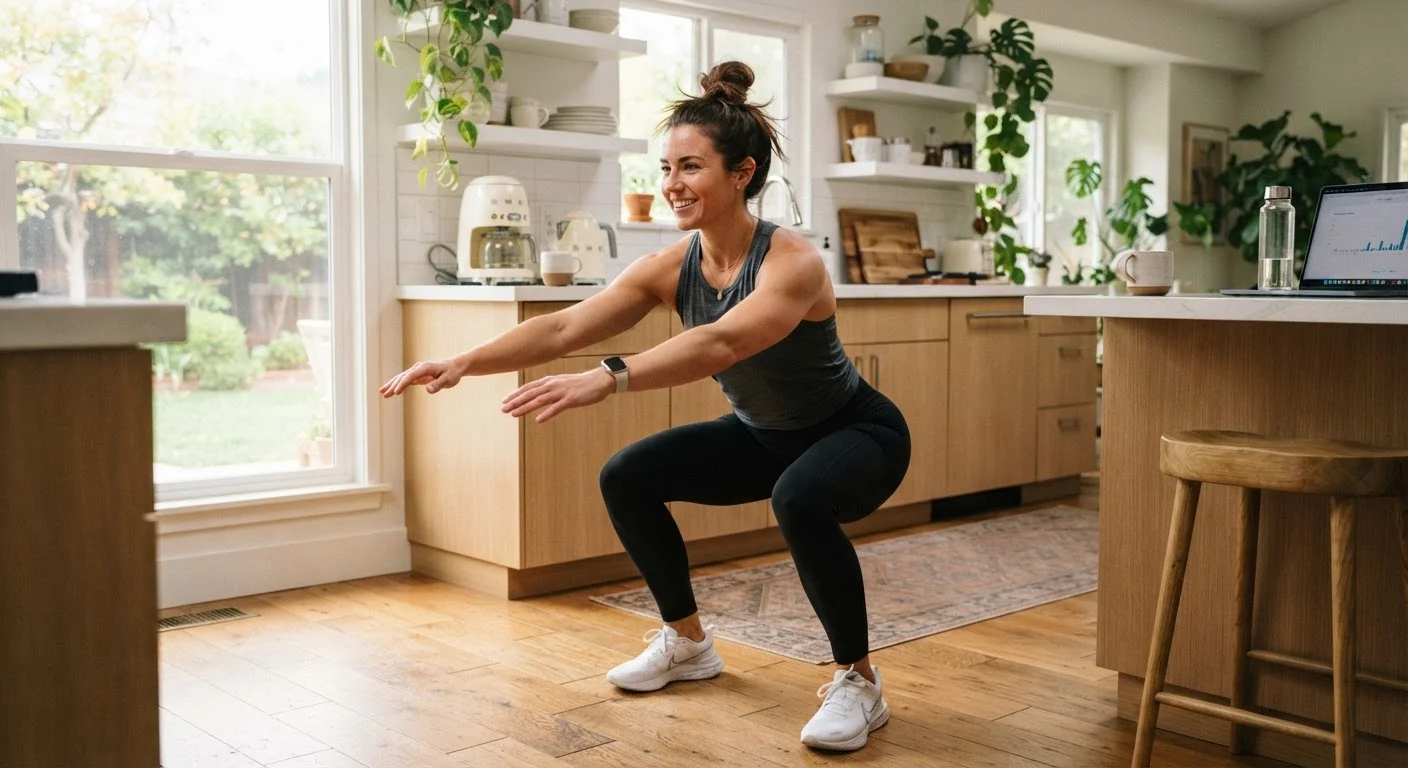
Habit-stacking means pairing a new behavior with something you already do automatically. Do ten bodyweight squats while the coffee brews. Add calf raises while brushing your teeth. Walk in place during a phone call you take every morning. These micro-sessions feel almost effortless because the trigger is already built into your day - you're just adding a layer on top of it.
The goal isn't exhaustion; it's repetition. Consistently attaching movement to anchored daily habits is one of the most reliable behavior-change strategies documented in psychological research on habit formation.
Pairing movement with existing habits removes the need for extra willpower or scheduling.
Use the 10-Minute Block Strategy
If a 30-minute workout feels impossible on most days, reframe the goal: three 10-minute sessions spread across morning, midday, and evening. A brisk walk before work, a set of push-ups and lunges at lunch, and an evening stretch routine each count independently - and they add up. Exercise guidelines from major public health organizations recognize that accumulated moderate-intensity activity provides benefits comparable to continuous sessions of the same total duration.
For structured guidance on building these blocks into a coherent week, a realistic weekly exercise schedule can help you map it out.
Three 10-minute sessions are a credible, research-supported alternative to one longer workout.
Rethink Your Commute and Transitions
Transportation and transitions between tasks are untapped movement opportunities. If you drive, park farther away and walk the remainder. If you use transit, stand rather than sit and get off one stop early. Between back-to-back video meetings, stand up and do a two-minute mobility circuit instead of scrolling your phone. These aren't dramatic changes, but accumulated over five days a week, they represent a meaningful increase in total daily activity.
Active commuting - cycling or walking part or all of a route - has been associated in population studies with lower cardiovascular risk markers. Even partial substitution matters.
Active commuting and intentional transitions can quietly double your daily step count.
Optimize Your Workspace for Movement
Your physical environment either supports or discourages movement. Simple adjustments can shift that balance significantly. Set a recurring timer to stand and move for two minutes every hour. Keep resistance bands or a yoga mat visible in your workspace - out of sight often means out of mind. If your job allows it, take walking meetings instead of sitting ones; many people find they think more clearly while moving.
You don't need equipment to make this work. A clear floor space and your own bodyweight are sufficient for a functional routine, as explored in our comparison of home workouts versus gym workouts.
Visible equipment and scheduled movement reminders reduce friction and make exercise easier to start.
Lower the Minimum Threshold Deliberately
One of the most common patterns in exercise drop-off is an all-or-nothing mindset: if you can't do the full planned session, you skip it entirely. Counter this by defining a "minimum viable workout" - perhaps five minutes of stretching, a single set of exercises, or one short walk. The purpose isn't to get a complete workout; it's to maintain the habit and keep the neural pathway active during genuinely constrained days.
Researchers studying exercise adherence consistently find that lowering the barrier to entry - not raising motivation - is what keeps people active long-term. A five-minute session on a hard day beats zero every time.
A five-minute minimum keeps your routine alive on days when nothing else is possible.
Pair Movement With Something You Enjoy
If exercise feels like punishment, it's harder to sustain. Pairing movement with something genuinely enjoyable creates a positive feedback loop. Reserve a podcast series exclusively for walks. Listen to an audiobook only while doing household chores that involve movement. Use a favorite playlist as the soundtrack to a short bodyweight circuit. This technique - sometimes called "temptation bundling" in behavioral economics research - makes the activity itself more rewarding.
Enjoyment is a legitimate fitness variable. If you dread your current routine, that's useful information, not a character flaw. Exploring different formats - outdoor movement, group classes, dancing - is a practical adjustment, not giving up.
Pairing exercise with something you genuinely enjoy makes consistency far more sustainable.
Making It Last Beyond a Single Busy Week
Fitting movement into a tight schedule isn't a one-time problem to solve - it's an ongoing practice. Life will keep shifting: new projects, family changes, seasonal demands. Building flexibility into your approach matters as much as the tactics themselves. Sustaining activity through disruptions and low-motivation periods requires a different mindset than starting strong.
It also helps to remember that rest is part of the equation. Overloading every gap in your schedule with intense movement can backfire. Our article on rest days and recovery explains why deliberate downtime supports - rather than undermines - your progress.
Start Smaller Than You Think You Need To
When time is tight, the instinct is often to wait for a window large enough to do a "real" workout - and that window rarely comes. Starting with something almost embarrassingly small (a five-minute walk, two sets of an exercise) builds the habit infrastructure that longer sessions can eventually fill. Consistency across months creates more lasting fitness change than occasional intense efforts. Track your movement simply - even a tally mark on paper - to make the accumulation visible.
This article is for general informational purposes only and does not constitute medical or personal fitness advice. Consult a qualified healthcare professional before beginning any new exercise program, particularly if you have an existing health condition.