

Key Takeaways
Option A
Saturated Fat
The long-misunderstood dietary villain now under renewed scientific scrutiny.
Best for: Understanding which food sources and quantities current evidence considers higher-risk for cardiovascular health.
Option B
Unsaturated Fat
The broadly recommended fat type with strong heart-health backing.
Best for: Readers looking to prioritize fats that research consistently links to reduced cardiovascular risk.
If you want to actively support heart health through diet
Unsaturated Fat
Decades of research and major clinical guidelines consistently favor unsaturated fats - particularly omega-3s and monounsaturated fats - for cardiovascular protection.
If you're evaluating whether to cut all saturated fat entirely
Saturated Fat (in moderation, from whole-food sources)
Complete elimination isn't necessarily warranted; evidence suggests limiting intake and focusing on replacement foods - not simply reducing total fat - produces the best outcomes.
If you follow a Mediterranean or plant-forward eating pattern
Unsaturated Fat
Olive oil, nuts, seeds, and fatty fish are cornerstones of eating patterns most strongly associated with long-term cardiovascular and metabolic health.
How Dietary Fats Are Classified
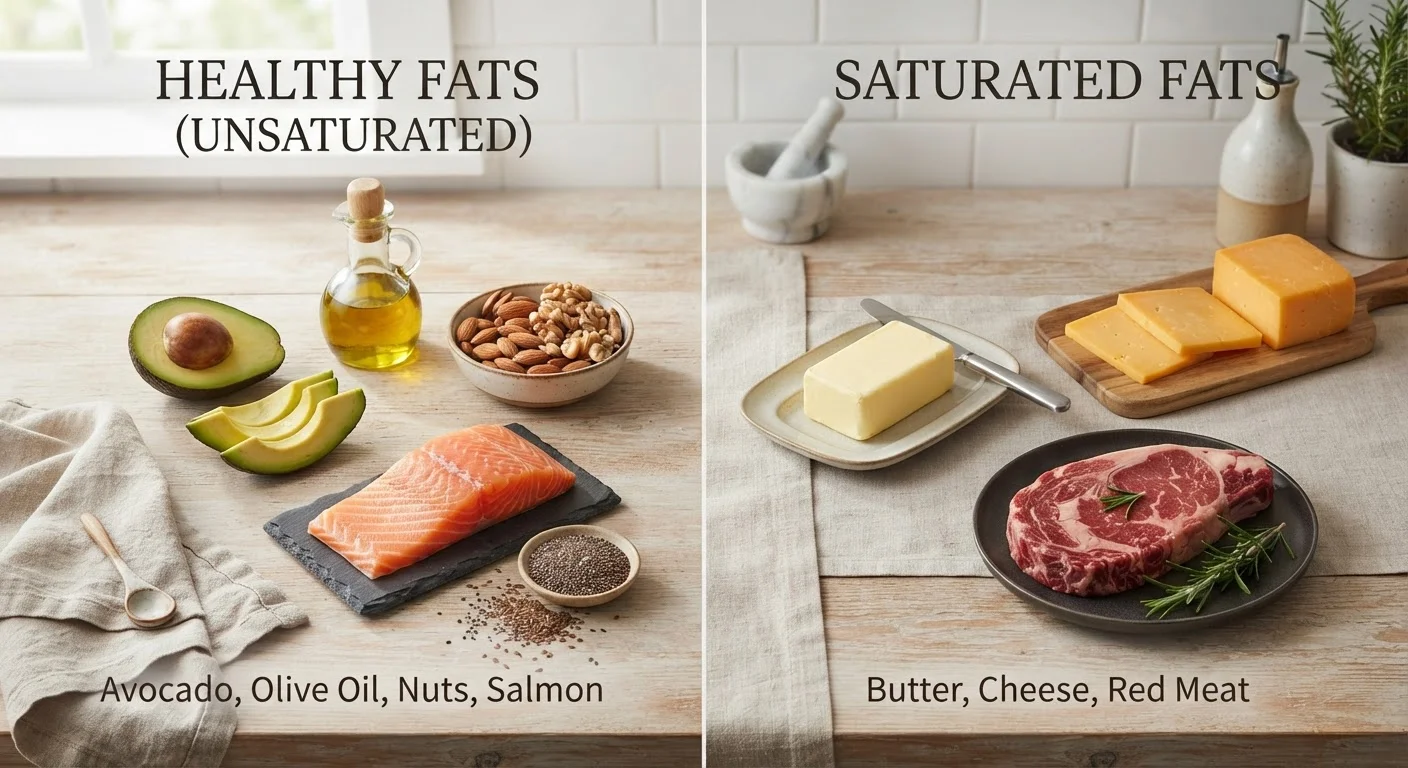
All dietary fats are made up of fatty acid chains, and their chemical structure determines how they behave in the body. Saturated fats have no double bonds between carbon atoms - their chains are fully "saturated" with hydrogen. This makes them solid at room temperature. Common sources include butter, full-fat dairy, red meat, coconut oil, and palm oil.
Unsaturated fats contain one or more double bonds. Monounsaturated fats (MUFAs) have a single double bond and are found in olive oil, avocados, and most nuts. Polyunsaturated fats (PUFAs) have multiple double bonds and include omega-3 fatty acids (found in fatty fish, flaxseed, and walnuts) and omega-6 fatty acids (found in vegetable oils and seeds).
There is also a third category worth noting: trans fats. Artificial trans fats - created by partially hydrogenating vegetable oils - have been largely removed from the U.S. food supply following regulatory action, as they were found to raise LDL cholesterol while lowering HDL. Small amounts of naturally occurring trans fats exist in some animal products and appear to behave differently from artificial versions.
What Research Says About Each Fat Type
The case against saturated fat has its roots in mid-20th-century epidemiology, and while it has faced some revisionist challenge, the scientific consensus has not fundamentally shifted. Saturated fat intake raises LDL cholesterol - often called "bad" cholesterol - and elevated LDL remains an established risk factor for atherosclerosis and cardiovascular disease, per the American Heart Association and the Dietary Guidelines for Americans.
However, the picture is more nuanced than a simple "fat is bad" narrative. Research published in journals including JAMA and The Lancet has highlighted that what you replace saturated fat with matters enormously. Swapping saturated fat for refined grains and added sugars does not reduce cardiovascular risk - and may worsen it. Replacing it with unsaturated fats, particularly PUFAs, does appear to lower risk.
| Criterion | Saturated Fat | Unsaturated Fat |
|---|---|---|
| Chemical structure | No double bonds; solid at room temp | One or more double bonds; liquid at room temp |
| Common food sources | Butter, red meat, full-fat dairy, coconut oil | Olive oil, avocado, nuts, fatty fish, seeds |
| Effect on LDL cholesterol | Raises LDL ("bad") cholesterol | Neutral to lowering effect on LDL |
| Effect on HDL cholesterol | May slightly raise HDL | Omega-3s may modestly raise HDL |
| Cardiovascular research consensus | Limit intake; replace with quality alternatives | Broadly favorable; especially omega-3 PUFAs |
| Dietary guideline stance (U.S.) | Limit to <10% of total daily calories | Encouraged as primary fat source |
Unsaturated fats, especially long-chain omega-3s (EPA and DHA from marine sources), have been associated with reduced triglycerides, lower inflammation, and improved endothelial function. Monounsaturated fats, prominent in the Mediterranean diet, are linked to favorable lipid profiles and reduced cardiovascular events in large observational studies.
For a broader look at how these fat types fit into full eating patterns, see our comparison of popular diet patterns.
<10%
Recommended daily cap for saturated fat
The 2020-2025 Dietary Guidelines for Americans advise keeping saturated fat below 10% of total daily caloric intake.
~28%
Reduction in cardiovascular events with PUFA swap
A meta-analysis in PLOS Medicine estimated replacing saturated fat with polyunsaturated fat was associated with roughly a 27-28% reduction in coronary heart disease events.
2x/week
Recommended fatty fish servings
The American Heart Association recommends eating fatty fish at least twice per week as a key source of heart-healthy omega-3 fatty acids.
Putting It Into Practice
Nutrition science rarely operates in clean categories, and fat intake is no exception. The goal is not to eliminate saturated fat entirely but to be intentional about proportions and food sources. Current U.S. dietary guidance generally suggests keeping saturated fat to less than 10% of total daily calories, with some cardiologist-facing guidelines recommending even lower thresholds for those with existing heart disease risk factors.
Practical shifts that align with the evidence include: favoring olive oil over butter for cooking, eating fatty fish (such as salmon or sardines) two or more times per week, incorporating nuts and seeds as snack staples, and choosing lean cuts of meat alongside more plant proteins. These aren't rigid rules - they're patterns backed by the preponderance of available research.
It's also worth questioning fat-related myths that persist in popular nutrition culture. Several long-standing diet misconceptions - including the idea that "low-fat" automatically means healthy - have been challenged by contemporary evidence.
Not All Saturated Fats Are Identical
Research increasingly distinguishes between individual saturated fatty acids. Stearic acid (found in dark chocolate and beef) appears to have a more neutral effect on LDL than palmitic or myristic acid. Food matrix also matters: the saturated fat in whole-food sources like yogurt behaves differently in metabolic studies than the same fat quantity from processed foods. This is an active area of research, and blanket rules about saturated fat are becoming more nuanced over time.
This article provides general nutrition information and education. It is not a substitute for personalized medical or dietary advice. Consult a registered dietitian or your healthcare provider before making significant changes to your diet, particularly if you have a diagnosed cardiovascular condition or other health concerns.