

Key Takeaways
How Reference Pricing Actually Works
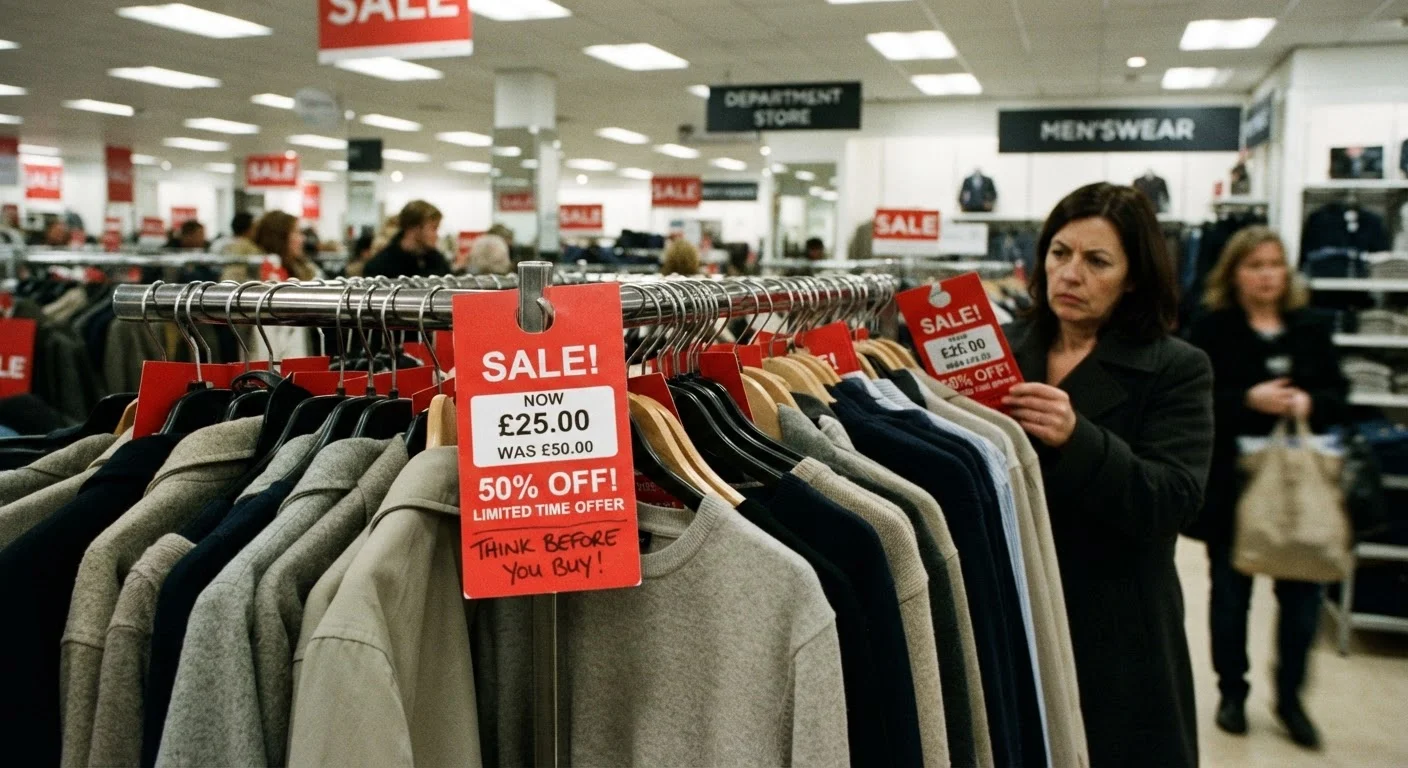
Every 'sale' tag carries two numbers: the crossed-out 'original' price and the reduced 'sale' price. The gap between them creates what behavioral economists call an anchor - a mental benchmark that makes the sale price feel like a bargain. But that anchor is only meaningful if the original price reflects what the item was genuinely sold for, consistently, over a real period of time.
In practice, that's frequently not the case. Some retailers set a high list price - sometimes called the manufacturer's suggested retail price (MSRP) - that few stores ever actually charge, then immediately discount from it. Others raise a price briefly before a promotional period so they can advertise a deeper percentage off. The result looks like savings; mathematically, it often isn't.
U.S. consumer protection law, enforced by the Federal Trade Commission (FTC) and mirrored in various state statutes, requires that a 'former price' used in a comparison must be a bona fide price at which the item was actually offered for a substantial period. But enforcement is inconsistent, and the definitions of 'substantial' leave room for interpretation. Understanding the mechanics is your first line of defense. To go deeper on the psychological levers behind these tactics, see how retailers use anchoring and urgency.
Common Myths About Sale Prices - Corrected
Shoppers carry a set of intuitive assumptions about discounts that retailers understand well - and sometimes exploit. The myth-fact pairs below address the most widespread misconceptions directly.
Myth
If a tag shows a crossed-out price, that's what the item normally costs.
Fact
The crossed-out price may be an MSRP that few retailers ever charged, or a price the item held for only a brief period.
Retailers are not required to prove that every item sold at its 'original' price in their specific store. MSRP figures are set by manufacturers and routinely exceed street prices. When a retailer strikes through an MSRP, the 'savings' advertised may never have been available to begin with. Look at what the item actually sells for across multiple retailers before treating any reference price as real.
Myth
A bigger percentage off always means a better deal.
Fact
Percentage discounts depend entirely on what the starting price was - inflated reference prices produce impressive-sounding percentages from thin air.
A 50%-off tag on an item whose reference price was artificially high may still result in a price above market rate. Conversely, a 10% discount off a consistently fair price can represent genuine value. Focus on the final price and how it compares across the market, not the magnitude of the markdown shown on the tag.
Myth
Sales during major shopping events like holidays always offer the deepest discounts of the year.
Fact
Research into major retail events consistently shows that a significant portion of 'deal' items are priced the same as - or higher than - they were weeks earlier.
High-profile shopping days generate enormous traffic, which reduces retailers' incentive to offer their sharpest discounts across the board. Selective categories - particularly consumer electronics at end-of-season - may see genuine reductions, but these coexist with hundreds of items whose prices are unchanged or marginally adjusted. Price history tools are especially useful during these periods.
Myth
Clearance means you're getting the lowest possible price on that item.
Fact
Clearance pricing moves inventory, but 'clearance' is not a regulated term and does not guarantee the price is competitive with other retailers.
An item on clearance at one store may sell at a lower everyday price at another. Clearance tags signal that a retailer wants to reduce stock - not that they've matched or beaten the market. Before assuming a clearance price is exceptional, check what comparable products cost elsewhere and whether the item is being discontinued for reasons that affect its usefulness to you.
Myth
If a sale is ending soon, it's worth buying immediately to avoid missing out.
Fact
Urgency messaging is a deliberate sales tactic; most 'limited-time' sales either repeat or are replaced by comparable promotions shortly after.
Countdown timers and 'ends tonight' banners activate loss aversion - a well-documented cognitive tendency to weight potential losses more heavily than equivalent gains. In retail, this pressure is routinely manufactured. If you weren't planning to buy an item before seeing the sale announcement, an arbitrary deadline is rarely a sound basis for the decision. Understanding urgency tactics can help you recognize this pattern before it affects your judgment.
How to Verify Whether a Deal Is Real
A few concrete habits separate confident shoppers from impulsive ones:
- Track prices before you need the item. Free browser extensions and price-history websites log historical pricing for major retailers, so you can see whether today's 'sale' price is actually lower than the item's typical selling price over the past 90 days.
- Question perpetual discounts. If a product has been 'on sale' every time you've visited a site or store, the sale price is effectively the real price. The crossed-out number is decorative.
- Compare unit prices, not sticker prices. A bulk package at 20% off can still cost more per ounce than a competitor's standard offering. Sale math only works when you're comparing equivalent quantities.
- Note the timing. Many categories follow predictable markdown cycles tied to inventory rotation and retail calendars. Purchasing outside of those cycles, even at a 'sale' price, may mean paying more than you would by waiting. Seasonal shopping patterns can help you plan purchases around genuine markdowns.
Beware of Perpetual 'Sales'
If an item is marked as on sale every time you encounter it - week after week, across multiple visits - the sale price is effectively the standard price. Using a price-tracking tool for at least 60-90 days before a major purchase gives you a factual baseline. Treat any discount that never seems to expire with the same skepticism you'd apply to an obviously inflated reference price.
Also watch for fees and add-ons that erode nominal savings - expedited shipping, required accessories, or service plans can quietly close the gap between a sale price and full retail. Hidden markups and convenience fees deserve equal scrutiny alongside the sticker price.