

| Stock (Equity) | A fractional ownership stake in a publicly traded company |
| Bond (Fixed Income) | A debt instrument that pays periodic interest and returns principal at maturity |
| Mutual Fund | A pooled vehicle holding a basket of stocks, bonds, or both |
| Stock Return Sources | Price appreciation and dividends |
| Bond Return Source | Coupon (interest) payments plus return of principal at maturity |
| Key Mutual Fund Cost to Watch | Expense ratio - annual fee as a percentage of assets under management |
| General Stock Risk Profile | Higher volatility; potential for significant gains or losses |
| General Bond Risk Profile | Lower volatility than stocks; subject to interest rate, credit, and inflation risk |
What These Three Asset Classes Actually Are
When most Americans begin their investment journey, they quickly encounter the same three terms: stocks, bonds, and mutual funds. These represent fundamentally different financial relationships - between you, the entities that need capital, and the broader market. Understanding what each one is and how it can generate (or lose) value is the essential first step. If you're entirely new to this topic, our beginner's introduction to investing covers the foundational vocabulary and mental frameworks worth knowing first.
This article is general financial education, not personalized investment advice. Consult a licensed financial adviser for decisions specific to your situation.
| Stock (Equity) | A fractional ownership stake in a publicly traded company |
| Bond (Fixed Income) | A debt instrument that pays periodic interest and returns principal at maturity |
| Mutual Fund | A pooled vehicle holding a basket of stocks, bonds, or both |
| Stock Return Sources | Price appreciation and dividends |
| Bond Return Source | Coupon (interest) payments plus return of principal at maturity |
| Key Mutual Fund Cost to Watch | Expense ratio - annual fee as a percentage of assets under management |
| General Stock Risk Profile | Higher volatility; potential for significant gains or losses |
| General Bond Risk Profile | Lower volatility than stocks; subject to interest rate, credit, and inflation risk |
Stocks and Bonds: Two Sides of the Market
Stocks: Buying Ownership
A stock - also called an equity or share - represents a fractional ownership stake in a publicly traded company. Returns can come through two channels: price appreciation (the stock's market value rising over time) and dividends (cash payments some companies distribute from profits). The trade-off is risk. Prices fluctuate with company performance, economic conditions, and investor sentiment, and a stock can lose substantial value. Historically, U.S. equities as a broad category have delivered growth over long time horizons, but past performance does not guarantee future results, and short-term losses are common.
Bonds: Lending for Interest
A bond is a debt instrument. When you purchase one, you lend money to the issuer - a federal, state, or local government, or a corporation - in exchange for periodic interest payments (the coupon) and the return of your principal at maturity. Bonds are generally more stable than stocks but carry their own risks: interest rate risk (bond prices move inversely to rates), credit risk (the issuer could default on payments), and inflation risk (fixed payments may lose real purchasing power over time). Because bond and stock prices have often moved in different directions, bonds have traditionally served a stabilizing role in blended portfolios.
Mutual Funds: A Vehicle, Not an Asset Class
A mutual fund is not an asset class on its own - it is a pooled investment vehicle that holds a collection of stocks, bonds, or both. When you invest in a mutual fund, you buy shares alongside thousands of other investors, gaining exposure to dozens or hundreds of underlying securities through a single purchase.
This structure offers two practical advantages. First, it provides built-in diversification - your money is spread across many holdings rather than concentrated in one or two. Second, it lowers the barrier to broad market participation without requiring you to select individual securities yourself. One key cost to monitor is the expense ratio - the annual fee expressed as a percentage of assets - which varies significantly across funds and compounds meaningfully over long time horizons. For a closer look at how passive index funds and actively managed funds differ in structure and cost, see our comparison of index funds and actively managed funds.
Stock (Equity)
A security representing fractional ownership in a company. Stockholders may benefit from price appreciation and, in some cases, dividend payments.
Bond
A fixed-income debt instrument in which an investor lends money to a government or corporate issuer in exchange for periodic interest payments and the return of principal at a specified maturity date.
Mutual Fund
A pooled investment vehicle that collects capital from multiple investors and deploys it across a portfolio of securities such as stocks, bonds, or other assets.
Dividend
A distribution of a portion of a company's earnings paid to shareholders, typically in cash on a regular schedule. Not all stocks pay dividends.
Coupon Rate
The annual interest rate a bond issuer promises to pay, expressed as a percentage of the bond's face (par) value.
Expense Ratio
The annual fee a mutual fund charges investors, expressed as a percentage of assets under management. It is deducted from fund assets and directly reduces net returns.
Asset Allocation
The distribution of a portfolio's investments across different asset classes - such as stocks, bonds, and cash - typically calibrated to an investor's goals, time horizon, and risk tolerance.
Volatility
The degree to which an investment's price fluctuates over a given period. Higher volatility generally indicates greater uncertainty and greater potential for loss as well as gain.
How the Three Work Together in a Portfolio
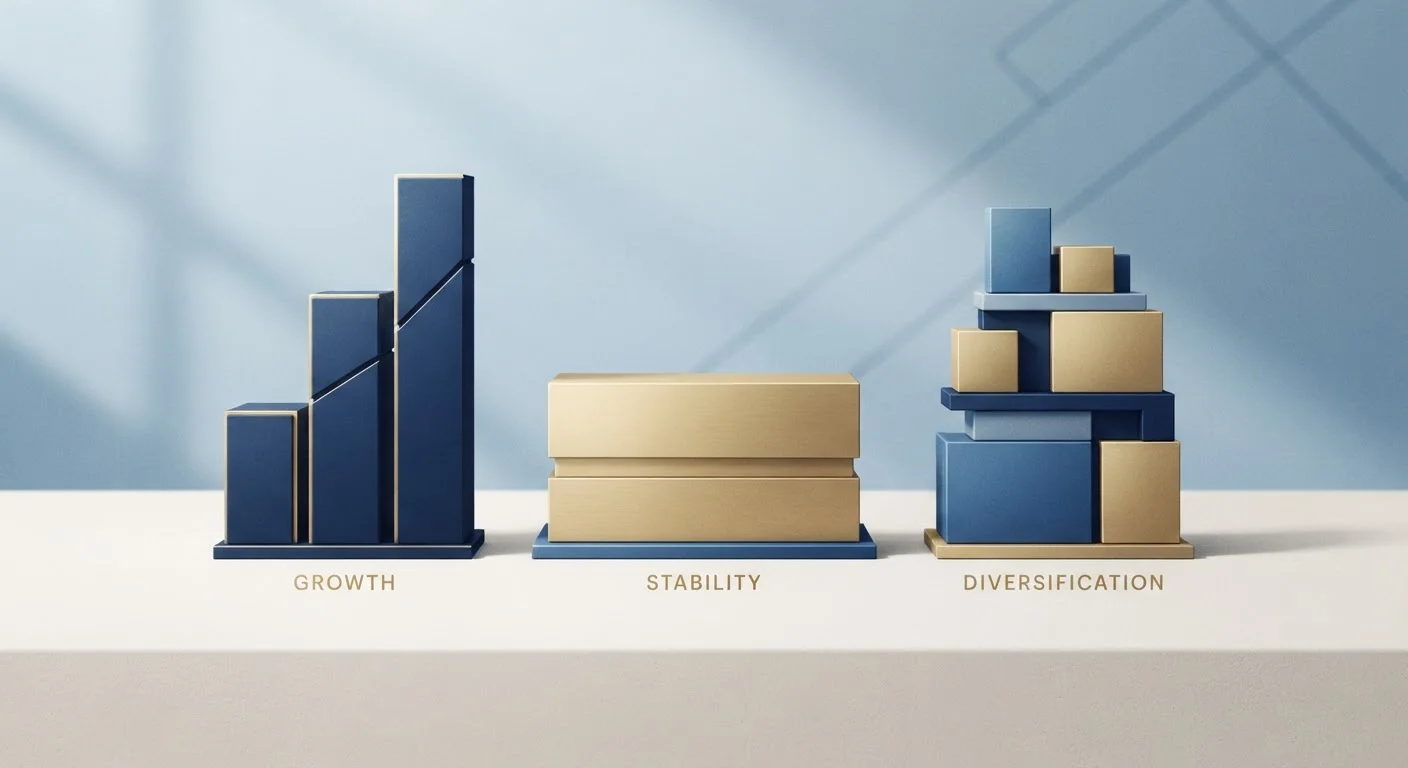
Most portfolios blend all three elements - stocks for growth potential, bonds for relative stability and income, and mutual funds as a practical vehicle for holding both - in proportions calibrated to an investor's time horizon and risk tolerance. A longer time horizon generally supports a larger equity allocation, since there is more time to weather market volatility. A shorter horizon or lower comfort with risk may favor a heavier bond weighting.
The right mix depends on factors no general article can determine: your income, goals, existing savings, timeline, and tax situation. Understanding diversification is a logical next step in thinking through how to balance these assets. Where you hold your investments also matters - the tax treatment inside a 401(k) or IRA can significantly affect long-term outcomes, and our guide to choosing the right account wrapper explores this further. A qualified financial adviser can help you apply these building blocks to your specific circumstances.