

Key Takeaways
Simple enough to implement in under an hour
Unlike zero-based budgeting, which requires assigning every dollar a job, the 50/30/20 rule only requires three calculations. This low barrier to entry makes it realistic for people who have never budgeted before.
Builds in guilt-free discretionary spending
Allocating an explicit 30% to wants removes the psychological penalty of spending on enjoyment. This reduces the all-or-nothing thinking that causes many budgets to collapse after one "bad" month.
Automatically scales with income changes
Because the rule uses percentages rather than fixed dollar amounts, it adjusts proportionally when income increases or decreases-no rebuilding the budget from scratch.
Anchors savings as a non-negotiable category
By designating 20% for saving and debt payoff from the outset, the framework treats financial security as structural rather than optional. This mirrors the "pay yourself first" principle supported by behavioral economists.
50% needs ceiling unrealistic in high-cost cities
Housing costs in many major metros routinely exceed 30% of income on their own, making the 50% needs target mathematically impossible for average earners without compromising other necessities.
Blends competing financial priorities in one bucket
Grouping emergency savings, retirement contributions, and debt repayment into a single 20% category ignores the fact that high-interest debt typically warrants priority over low-yield savings-a distinction the rule doesn't make.
30% wants allowance is too high for low incomes
Households earning at or near the median may find that after covering essential needs, 30% for discretionary spending is neither realistic nor responsible given limited financial cushions.
Doesn't account for irregular income
Freelancers, gig workers, and anyone with variable pay face significant challenges applying fixed percentages to income that fluctuates month to month, sometimes dramatically.
Needs vs. wants distinction is harder than it appears
Categorizing expenses like a gym membership, a work-from-home internet upgrade, or a car in a city with poor transit requires judgment calls the rule provides no guidance for.
Our Verdict
The 50/30/20 rule is a genuinely useful starting point for people who have never structured their spending before. It reduces decision fatigue by collapsing hundreds of spending choices into three buckets. Where it falls short is in its one-size-fits-all assumptions: housing markets, income levels, and debt loads vary too widely across American households for a single set of percentages to fit every situation.
Best for individuals with moderate, stable incomes who are new to budgeting and want a low-friction framework to establish spending discipline.
How the 50/30/20 Rule Actually Works
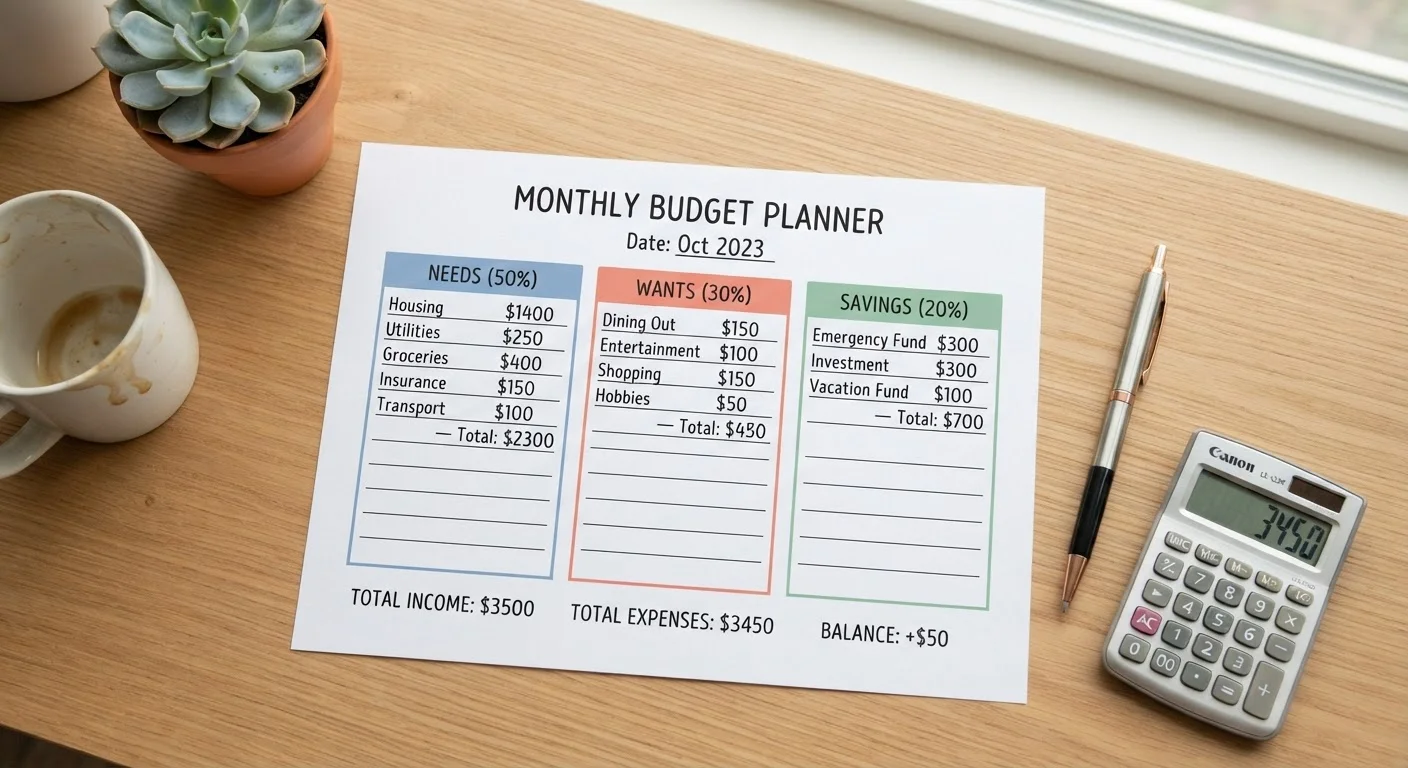
The 50/30/20 framework, widely attributed to Senator Elizabeth Warren and her daughter Amelia Warren Tyagi in their 2005 book All Your Worth, applies three fixed percentages to your monthly after-tax income. Fifty percent covers needs-housing, utilities, groceries, insurance, and minimum debt payments. Thirty percent covers wants-dining out, entertainment, subscriptions, and non-essential shopping. The remaining 20% goes toward savings and debt repayment beyond the minimums, including emergency funds, retirement accounts, and accelerated loan payoff.
The rule operates on after-tax (take-home) income, not gross income-an important distinction that many summaries overlook. If your household takes home $5,000 per month, the targets are: $2,500 for needs, $1,500 for wants, and $1,000 for savings and debt. For a deeper look at how this compares to a more granular approach, see how zero-based budgeting stacks up.
Simple enough to implement in under an hour
Unlike zero-based budgeting, which requires assigning every dollar a job, the 50/30/20 rule only requires three calculations. This low barrier to entry makes it realistic for people who have never budgeted before.
Builds in guilt-free discretionary spending
Allocating an explicit 30% to wants removes the psychological penalty of spending on enjoyment. This reduces the all-or-nothing thinking that causes many budgets to collapse after one "bad" month.
Automatically scales with income changes
Because the rule uses percentages rather than fixed dollar amounts, it adjusts proportionally when income increases or decreases-no rebuilding the budget from scratch.
Anchors savings as a non-negotiable category
By designating 20% for saving and debt payoff from the outset, the framework treats financial security as structural rather than optional. This mirrors the "pay yourself first" principle supported by behavioral economists.
Where This Framework Earns Its Reputation
The rule's staying power comes from a real behavioral insight: most people don't fail at budgeting because they lack discipline-they fail because the system demands too much cognitive effort. Tracking every dollar across dozens of categories is exhausting, and research in behavioral finance shows that complexity itself causes people to disengage.
By compressing all discretionary spending into a single 30% bucket, the framework eliminates the need to decide in advance whether a streaming service belongs in "entertainment" or "subscriptions." The broad categories also tolerate month-to-month variation naturally-a higher grocery bill one month can absorb a lower restaurant spend without triggering a budget failure.
~34%
Share of income spent on housing by renters
According to the U.S. Bureau of Labor Statistics Consumer Expenditure Survey, renters in many markets spend well above 30% of pre-tax income on housing alone, straining the 50% needs ceiling.
~57%
Americans living paycheck to paycheck
Multiple annual consumer finance surveys have consistently found that a majority of U.S. adults report having little to no financial cushion between income and monthly expenses, complicating the 20% savings target.
Where the Rule Breaks Down
The framework's most significant weakness is the 50% needs ceiling. In cities like New York, San Francisco, or Seattle, rent alone can consume 40-50% of a median earner's take-home pay-leaving almost nothing for other necessities before the budget even begins. The rule assumes a broadly middle-income lifestyle in a median-cost market, which describes far fewer American households than its widespread use would suggest.
The 20% savings-and-debt bucket also blends goals that are actually in tension. An emergency fund, a retirement contribution, and a credit card balance all deserve separate prioritization logic. Lumping them together can lead someone to split money equally between low-interest savings and high-interest debt-a financially costly choice. If you suspect your current budget structure has misalignments like this, these diagnostic signals can help you identify them early.
50% needs ceiling unrealistic in high-cost cities
Housing costs in many major metros routinely exceed 30% of income on their own, making the 50% needs target mathematically impossible for average earners without compromising other necessities.
Blends competing financial priorities in one bucket
Grouping emergency savings, retirement contributions, and debt repayment into a single 20% category ignores the fact that high-interest debt typically warrants priority over low-yield savings-a distinction the rule doesn't make.
30% wants allowance is too high for low incomes
Households earning at or near the median may find that after covering essential needs, 30% for discretionary spending is neither realistic nor responsible given limited financial cushions.
Doesn't account for irregular income
Freelancers, gig workers, and anyone with variable pay face significant challenges applying fixed percentages to income that fluctuates month to month, sometimes dramatically.
Needs vs. wants distinction is harder than it appears
Categorizing expenses like a gym membership, a work-from-home internet upgrade, or a car in a city with poor transit requires judgment calls the rule provides no guidance for.
Using It as a Framework, Not a Formula
The most practical approach is to treat the 50/30/20 percentages as a diagnostic benchmark rather than a hard target. Start by calculating what your current spending actually looks like across the three buckets. If needs are consuming 65% of take-home pay, that's a signal to investigate housing or transportation costs-not evidence that you've failed the rule.
Adjustments are legitimate and often necessary. A household aggressively paying down high-interest debt might shift to 50/15/35 temporarily. Someone in a low-cost market with a stable income might find that 40/30/30 better reflects their actual needs. The underlying logic-spend less than you earn, reserve a meaningful share for the future, and give yourself room for genuine enjoyment-remains sound regardless of the exact percentages.
Adjusting the Percentages Is Acceptable
There is nothing sacred about the specific 50/30/20 split. Financial planners often encourage households to modify the ratios based on their debt load, cost of living, and savings goals. The value of the framework is in the habit of categorizing spending-not in hitting any particular percentage. Treat the original numbers as a starting hypothesis, then revise based on what your actual data shows.
For a broader reality check on budgeting frameworks generally, common budgeting myths addresses several misconceptions that apply directly to percentage-based approaches like this one.
This article is for general informational and educational purposes only and does not constitute personalized financial advice. Consult a qualified financial professional for guidance tailored to your individual circumstances.