

Key Takeaways
Why These Myths Are More Dangerous Than They Look
Distracted driving is one of the leading contributors to traffic crashes in the United States, yet many drivers genuinely believe their habits are safe. These beliefs aren't born from carelessness - they come from widely repeated myths that feel intuitive and are rarely challenged. That's precisely what makes them so hazardous.
The misconceptions below persist because they contain a grain of plausibility. Hands-free really does free your hands. A quick glance really does only take a second. The problem is that driving safety depends on far more than your hands and eyes - and the science of attention tells a very different story than common sense suggests.
Understanding where these myths break down is a core part of defensive driving. It's also essential for anyone who wants to accurately assess their own risk behind the wheel rather than operate on false confidence.
Myth
Using a hands-free device means I'm driving just as safely as someone who isn't on the phone at all.
Fact
Hands-free calls still impose significant cognitive distraction that meaningfully impairs driving performance.
The hands-free myth is among the most consequential in road safety. While a hands-free setup does eliminate the manual act of holding a device, it does nothing to reduce the cognitive load of holding a conversation. Research from traffic safety organizations has consistently found that drivers engaged in phone conversations - handheld or hands-free - show slower reaction times, reduced awareness of hazards, and a narrowing of the visual field sometimes called inattention blindness. Your eyes can be on the road while your brain is effectively somewhere else.
Myth
A quick glance at my phone only takes a second - that's not enough time for anything to go wrong.
Fact
At 55 mph, a two-second glance means your vehicle has traveled approximately the length of a basketball court with no driver attention on the road.
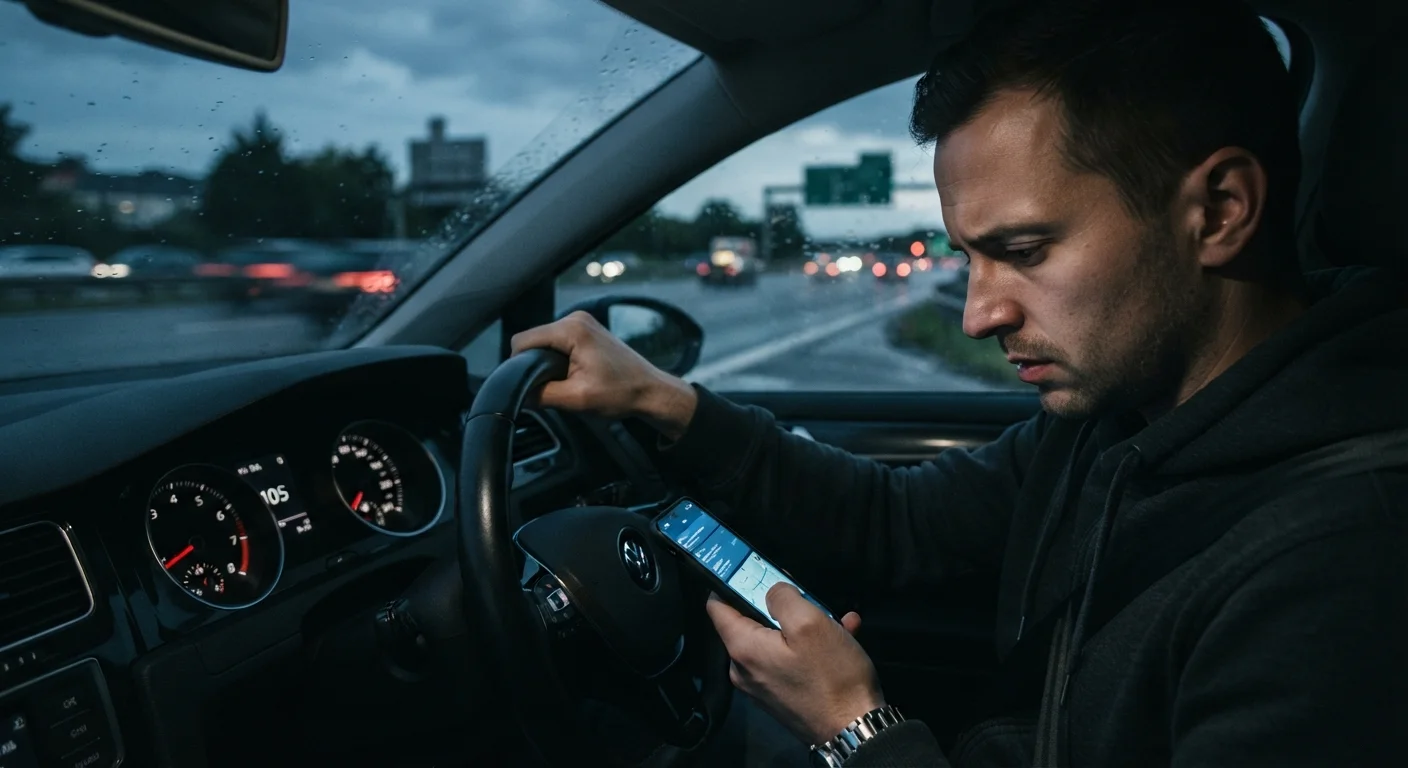
This myth treats time as the only variable, ignoring speed and traffic density. At highway speeds, vehicles cover enormous distances in fractions of a second. A typical text message takes about five seconds to read - during which a car traveling at 55 mph covers the equivalent of a football field. Traffic conditions can change entirely in that window. The National Highway Traffic Safety Administration (NHTSA) has long cited distraction from electronic devices as a major factor in fatal crashes, reinforcing that there is no such thing as a trivially short distraction at speed.
Myth
I'm good at multitasking, so driving while handling other tasks doesn't affect my performance.
Fact
Human brains do not truly multitask - they rapidly switch attention between tasks, and driving performance degrades during every switch.
The concept of multitasking is largely a myth in cognitive neuroscience. What people experience as multitasking is rapid task-switching, and each switch carries a cost: a brief lag in responsiveness and increased error rates. For driving - which demands continuous real-time processing of a complex, ever-changing environment - this switching overhead is genuinely dangerous. Studies have shown that even drivers who believe themselves skilled multitaskers perform worse in dual-task conditions. Confidence in one's multitasking ability has, in fact, been associated with greater phone use while driving, not safer behavior.
Myth
Voice-activated systems let me stay fully focused on driving while I send messages or get directions.
Fact
Voice-activated interfaces reduce manual and visual distraction but still impose measurable cognitive demand that affects hazard detection.
Voice technology has improved dramatically, and its manual and visual benefits are real - you're not looking away from the road or removing your hands from the wheel. However, research commissioned by organizations including the AAA Foundation for Traffic Safety has found that complex voice interactions (composing messages, executing multi-step commands) create significant cognitive distraction. Drivers using voice systems in studies showed delayed responses to road hazards even when their eyes remained forward. Voice-activated features are a meaningful improvement over handheld use, but they are not a zero-distraction solution.
Myth
I only use my phone at red lights or when traffic is stopped, so it's not really distracted driving.
Fact
Cognitive distraction persists for several seconds after a phone interaction ends, meaning your attention is still compromised when traffic begins moving.
Stopping at a red light does not create a safe window for phone use for two key reasons. First, intersections are among the highest-risk environments on any road - the moment traffic begins moving is precisely when full situational awareness is critical. Second, research has indicated that residual cognitive distraction - sometimes called an attention hangover - can persist for up to 27 seconds after a voice or device interaction ends. A driver who looks up from a phone as the light turns green may still be cognitively impaired for the first several seconds of movement through the intersection.
The Real Costs of Distraction - and What Drivers Can Do
Every myth about distracted driving has one thing in common: it underestimates the speed at which driving conditions change. A pedestrian stepping off a curb, a vehicle braking suddenly ahead, a patch of wet road - each of these requires an immediate, undivided response. Any cognitive resource spent elsewhere is a resource that can't be directed at the road.
~3,000
Distraction-related traffic deaths annually in the U.S.
The NHTSA consistently reports thousands of fatalities each year attributed to distracted driving across all road types.
5 sec
Average time eyes leave the road to read a text
NHTSA estimates that reading or sending a text takes a driver's eyes off the road for approximately five seconds on average.
~27 sec
Duration of residual cognitive distraction after phone use
AAA Foundation for Traffic Safety research found that cognitive distraction can persist for up to 27 seconds after a voice-based interaction ends.
Drivers who feel safe multitasking may also be placing outsized trust in vehicle technology. Features like automatic emergency braking and lane-keeping assist can reduce crash severity under some conditions, but as explained in our coverage of crash avoidance technology, these systems have real limits and are not designed to compensate for an inattentive driver.
The most effective change any driver can make is a behavioral one: phone out of reach, notifications silenced, and conversations reserved for when the car is parked. Fatigue compounds distraction risk significantly - a point explored in our guide on recognizing drowsy driving warning signs. Passengers also change the distraction equation; see how to manage that in our article on driving safely with passengers.
No Technology Replaces Undivided Attention
Advanced driver assistance systems - including automatic emergency braking and lane departure warnings - are designed to supplement an attentive driver, not substitute for one. If you are cognitively distracted, your reaction to a system alert will itself be delayed, reducing the safety benefit these features can provide. Do not rely on vehicle technology as a safety buffer for distracted driving habits.
This article is for general informational and educational purposes only. Always follow applicable traffic laws and consult official road safety resources for guidance specific to your state or jurisdiction.