

Key Takeaways
Reduces rear-end collision frequency and severity
IIHS research has consistently found that AEB-equipped vehicles are involved in fewer rear-end crashes. The technology gives drivers an additional response window they might otherwise not have.
Compensates for momentary driver inattention
Lane-keeping assist and forward collision warnings can catch brief lapses - a glance away from the road, for example - before they escalate into a dangerous situation.
Improves awareness in difficult-to-monitor zones
Blind-spot monitoring addresses a structural limitation of mirrors and human peripheral vision, providing consistent coverage in zones that are difficult to check reliably during lane changes.
Reduces driver fatigue on long highway trips
Adaptive cruise control's ability to maintain following distance automatically reduces the cognitive and physical load of monotonous highway driving, helping drivers stay more alert overall.
Low-speed reversing alerts prevent parking lot incidents
Rear cross-traffic alert systems help detect pedestrians and vehicles approaching from the side while reversing - a scenario where rearview cameras alone may have limited field of view.
Sensor performance degrades in adverse weather
Rain, snow, fog, and road spray can block or confuse cameras and radar arrays. Manufacturers commonly note that system capability is reduced in these conditions - exactly when crash risk is highest.
Lane assist fails without clear road markings
Faded lane paint, construction zones, and complex interchanges can cause lane-keeping systems to malfunction, issue erroneous alerts, or fail to activate when needed.
AEB has limited effectiveness at high speeds
At highway speeds, the physics of stopping distance mean AEB may reduce collision severity but cannot always prevent an impact entirely. Reaction and braking distances increase faster than many drivers expect.
Systems can generate false alerts, eroding driver trust
False positives - phantom braking events or unnecessary lane corrections - can prompt some drivers to disable safety features altogether, eliminating the benefit entirely.
Encourages automation complacency in some drivers
Research indicates that drivers with access to more advanced assistance systems sometimes reduce active scanning and monitoring behaviors, creating a net risk even when the technology is functioning as designed.
Coverage gaps leave some hazards undetected
Current systems are generally better at detecting large vehicles than cyclists, motorcyclists, or pedestrians in low-light conditions - categories that represent a significant share of serious collisions.
Our Verdict
Crash avoidance technology represents a genuine leap forward in vehicle safety, and the data supporting its effectiveness is real. However, these systems are driver-assistance tools, not autonomous safety nets - they have meaningful gaps in their detection capabilities, and they perform worst in exactly the conditions where accidents are most likely. Treating them as a supplement to skilled, attentive driving delivers real safety gains; treating them as a substitute does not.
Every driver benefits from understanding what these systems can and cannot do - but the information is especially critical for new drivers and anyone who commutes frequently in variable weather or heavy traffic.
What Crash Avoidance Technology Actually Does
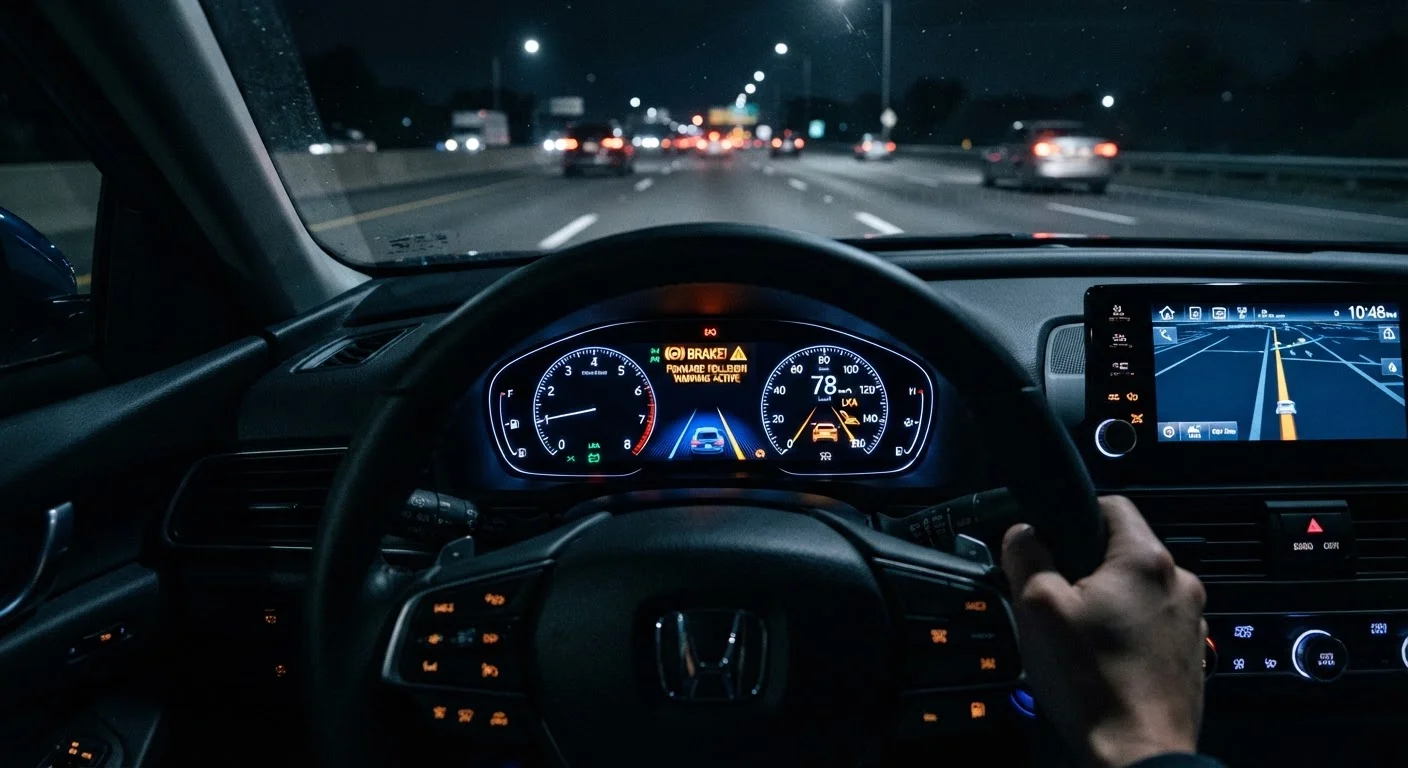
Modern vehicles increasingly come equipped with a suite of electronic safety systems designed to reduce the likelihood and severity of collisions. The most widely deployed include:
- Automatic Emergency Braking (AEB): Uses cameras or radar to detect an imminent collision with a vehicle or pedestrian ahead and applies the brakes if the driver does not respond in time.
- Lane-Keeping Assist (LKA): Monitors lane markings and either alerts the driver or applies gentle steering corrections when the vehicle drifts without a turn signal activated.
- Blind-Spot Monitoring (BSM): Uses rear-mounted sensors to detect vehicles in adjacent lanes and warns the driver - typically via a light in the mirror - when a lane change would be unsafe.
- Rear Cross-Traffic Alert: Warns drivers of approaching vehicles when reversing out of a parking space.
- Adaptive Cruise Control (ACC): Maintains a set following distance from the vehicle ahead, automatically adjusting speed.
These systems interact with your driving, but they operate within strict technical boundaries. Understanding those boundaries is what separates informed use from dangerous overreliance. For a grounding in foundational safe-driving principles, see our new driver's complete introduction to road safety habits.
The Real Benefits - Backed by Evidence
The safety gains from these technologies are not theoretical. Studies by the Insurance Institute for Highway Safety (IIHS) and similar organizations have found that AEB systems can significantly reduce rear-end crash rates, and that vehicles equipped with blind-spot monitoring show measurable reductions in lane-change collisions.
Reduces rear-end collision frequency and severity
IIHS research has consistently found that AEB-equipped vehicles are involved in fewer rear-end crashes. The technology gives drivers an additional response window they might otherwise not have.
Compensates for momentary driver inattention
Lane-keeping assist and forward collision warnings can catch brief lapses - a glance away from the road, for example - before they escalate into a dangerous situation.
Improves awareness in difficult-to-monitor zones
Blind-spot monitoring addresses a structural limitation of mirrors and human peripheral vision, providing consistent coverage in zones that are difficult to check reliably during lane changes.
Reduces driver fatigue on long highway trips
Adaptive cruise control's ability to maintain following distance automatically reduces the cognitive and physical load of monotonous highway driving, helping drivers stay more alert overall.
Low-speed reversing alerts prevent parking lot incidents
Rear cross-traffic alert systems help detect pedestrians and vehicles approaching from the side while reversing - a scenario where rearview cameras alone may have limited field of view.
These benefits are most pronounced in predictable, moderate-speed scenarios: highway driving in good weather, stop-and-go urban traffic, and low-speed parking maneuvers. In those conditions, the systems do much of what they promise.
~50%
Reduction in rear-end crashes with AEB
IIHS research has found that AEB systems can reduce police-reported rear-end crashes by approximately half in real-world driving conditions.
23%
Fewer lane-change crashes with blind-spot monitoring
According to IIHS data, vehicles equipped with blind-spot monitoring show a meaningful reduction in lane-change collisions compared to unequipped vehicles.
Where These Systems Fall Short
The limitations of crash avoidance technology are not edge cases - they are systematic gaps that drivers need to plan for.
Sensor performance degrades in adverse weather
Rain, snow, fog, and road spray can block or confuse cameras and radar arrays. Manufacturers commonly note that system capability is reduced in these conditions - exactly when crash risk is highest.
Lane assist fails without clear road markings
Faded lane paint, construction zones, and complex interchanges can cause lane-keeping systems to malfunction, issue erroneous alerts, or fail to activate when needed.
AEB has limited effectiveness at high speeds
At highway speeds, the physics of stopping distance mean AEB may reduce collision severity but cannot always prevent an impact entirely. Reaction and braking distances increase faster than many drivers expect.
Systems can generate false alerts, eroding driver trust
False positives - phantom braking events or unnecessary lane corrections - can prompt some drivers to disable safety features altogether, eliminating the benefit entirely.
Encourages automation complacency in some drivers
Research indicates that drivers with access to more advanced assistance systems sometimes reduce active scanning and monitoring behaviors, creating a net risk even when the technology is functioning as designed.
Coverage gaps leave some hazards undetected
Current systems are generally better at detecting large vehicles than cyclists, motorcyclists, or pedestrians in low-light conditions - categories that represent a significant share of serious collisions.
Sensor occlusion is a recurring issue. Cameras and radar can be blocked by accumulated snow, heavy rain, mud, or even road spray at highway speeds. Many manufacturers acknowledge that system performance is degraded in these conditions, which is precisely when driving is most dangerous. Stopping distances already increase dramatically in wet or icy conditions - a degraded AEB system adds further risk.
Lane-keeping assist depends on clearly visible road markings. Faded paint, construction zones, and roads with complex lane configurations can confuse the system or cause it to issue incorrect corrections. Similarly, blind-spot monitoring is calibrated for typical traffic speeds - in merging situations with fast-closing vehicles, the warning may come too late. Our article on merging and right-of-way covers why these moments are already high-risk.
Automation Complacency: The Invisible Risk
Perhaps the most underappreciated danger of advanced driver-assistance systems is behavioral: drivers who trust these technologies too much tend to reduce their own vigilance. Researchers refer to this as automation complacency - the gradual erosion of active attention when a system appears to be managing a task.
What 'Driver Assistance' Actually Means
Regulators and automakers classify even the most advanced packages - adaptive cruise, lane centering, and AEB combined - as Level 2 automation under the SAE International framework. This means the human driver remains legally and practically responsible for the vehicle at all times. No currently available consumer vehicle sold in the United States operates as a fully autonomous system. Drivers should not expect any assistance technology to manage the vehicle without sustained attention and readiness to intervene.
This matters because crash avoidance systems are designed to assist, not to substitute for, driver judgment. AEB does not steer around obstacles. Lane-keeping assist does not prevent you from drifting into another vehicle if road markings are absent. Blind-spot monitoring covers specific zones - not the entire area around your vehicle. Common distracted driving myths reveal how easily drivers overestimate the protection technology provides.
The solution is straightforward: use these systems as an additional layer of awareness, not a replacement for it. Defensive driving habits - scanning ahead, maintaining appropriate following distance, and anticipating the actions of other drivers - remain your primary safety tools. Technology augments those habits; it does not retire them.
This article is for general informational purposes only and does not constitute professional safety, legal, or mechanical advice. Consult your vehicle owner's manual and a qualified automotive professional for guidance specific to your vehicle's systems.