

Why Tracking Anything at All Makes Sense
Monitoring your fitness progress gives your effort structure. Without any reference points, it's easy to train inconsistently, plateau without noticing, or mistake busyness for actual progress. But the opposite extreme - obsessing over every number your wearable produces - can be equally counterproductive, turning exercise into an anxiety-inducing data audit rather than a sustainable habit.
The goal is selective tracking: focusing on metrics that genuinely reflect how your body is adapting and where your routine needs adjustment. See our guide to fitness plateaus for a deeper look at why progress sometimes stalls even when you're putting in the work.
Metrics Worth Tracking
These data points have a strong track record of reflecting meaningful physiological change or behavioral consistency:
- Resting heart rate (RHR). As cardiovascular fitness improves, the heart pumps more efficiently and RHR tends to drop. Tracking this over weeks - not days - provides a reliable signal of aerobic adaptation.
- Workout consistency (days per week or sessions per month). Adherence is the single strongest predictor of long-term outcomes. Logging whether you showed up is more actionable than most performance numbers.
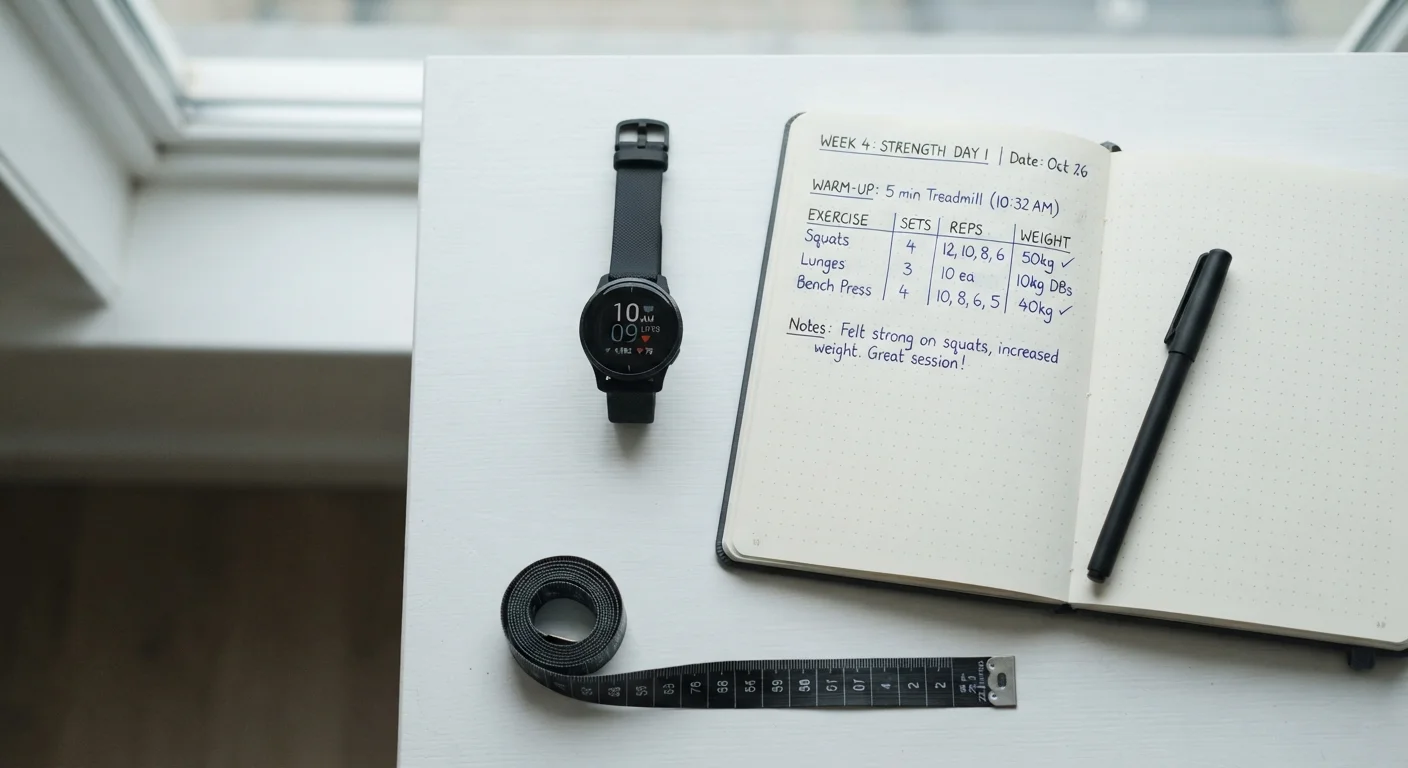
- Strength progression. Tracking the load and reps you can complete on key movements (such as a squat or push-up) gives concrete evidence of neuromuscular development.
- Sleep duration and quality. Recovery drives adaptation. Poor sleep undermines nearly every other metric you track. See why rest and recovery matter for more context.
- Perceived exertion over time. If the same workout feels significantly easier after six weeks, that's evidence of real fitness gain - no device required.
Resting Heart Rate (RHR)
The number of times your heart beats per minute while at complete rest. A lower RHR generally indicates better cardiovascular efficiency and aerobic fitness.
Perceived Exertion
A self-reported scale of how hard exercise feels during a session. It's a practical, device-free way to gauge workout intensity and track fitness improvements over time.
DOMS
Delayed Onset Muscle Soreness - the aching sensation felt 24-72 hours after unfamiliar or intense exercise. It reflects tissue novelty rather than workout quality or effectiveness.
Progressive Overload
The principle of gradually increasing the demands placed on the body - through heavier weight, more reps, or greater intensity - to continue stimulating adaptation and improvement.
Metrics That Often Mislead
Some numbers feel informative but routinely send people in the wrong direction:
- Daily step counts in isolation. Steps are a reasonable activity proxy, but 10,000 steps of slow shuffling is not equivalent to 6,000 steps that include a brisk walk or stairs. Context matters more than the raw number.
- Calories burned (as reported by wearables). Research consistently shows these estimates carry significant error margins - sometimes 20-40% off from actual expenditure. Using them to justify eating more can quietly undermine a nutrition strategy.
- Body weight day-to-day. Daily scale readings are dominated by fluid shifts, digestive contents, and hormonal fluctuations - not fat or muscle change. Weekly averages are far more signal, far less noise. This connects directly to why the scale stopping is rarely the full story.
- Muscle soreness as a proxy for effort. Soreness reflects tissue novelty, not training quality. As this breakdown of DOMS explains, the absence of soreness after a workout does not mean it was ineffective.
A Note on Wearable Accuracy
Consumer fitness trackers and smartwatches are useful motivational tools, but their physiological measurements - especially calorie burn and SpO2 - are estimates, not clinical readings. Heart rate data from optical wrist sensors is generally more reliable than calorie or sleep-stage data, but still benefits from being viewed as a trend rather than a precise number. Use wearable data directionally, not as ground truth.
Building a Practical Tracking Habit
A good tracking system is simple enough that you'll actually maintain it. Consider logging just three things consistently: whether you exercised, how it felt, and one performance marker (a weight lifted, a distance covered, or a time completed). Review trends monthly rather than daily to avoid overreacting to normal variation.
Think of fitness tracking the way thoughtful budgeters approach their finances - a few meaningful categories watched closely beat an overwhelming list of numbers that never get acted on. For a parallel take on selective tracking, see which spending categories are actually worth watching.
Whether you train at home or in a gym (see an honest comparison of both settings), the metrics that matter most remain the same: consistency, progressive challenge, and adequate recovery.
This article is for general informational and educational purposes only and is not medical or professional fitness advice. Consult a qualified healthcare provider before starting or significantly changing a fitness program, particularly if you have existing health conditions.