

Key Takeaways
Option A
Home Workouts
The convenient, low-barrier option that fits around your life.
Best for: People who value flexibility, privacy, and want to eliminate commute time from their fitness routine.
Option B
Gym Workouts
The structured, equipment-rich environment built for focused training.
Best for: People who benefit from dedicated space, varied equipment, and the motivational pull of a fitness-focused setting.
If you have an unpredictable schedule or travel frequently
Home Workouts
Bodyweight and minimal-equipment routines require no commute and can be done in almost any space, making consistency far easier when life is variable.
If you're working toward strength or muscle-building goals
Gym Workouts
Progressive overload - the key driver of strength gains - is easier to achieve with access to a full range of weights and resistance machines.
If budget is a primary concern
Home Workouts
A modest investment in a mat, resistance bands, and a pair of adjustable dumbbells can cover years of training with no recurring cost.
If you struggle with motivation and accountability
Gym Workouts
A dedicated fitness environment, group classes, and the social presence of others exercising nearby can reinforce consistent habits.
If you want the most flexibility long-term
Home Workouts
As life changes - family demands, relocations, work shifts - a home routine adapts more easily than one anchored to a specific facility.
What Each Setting Actually Offers
The debate between home and gym workouts tends to get oversimplified. In reality, both environments are genuinely capable of supporting fitness - but they do so in different ways, and those differences matter depending on who you are and how you live.
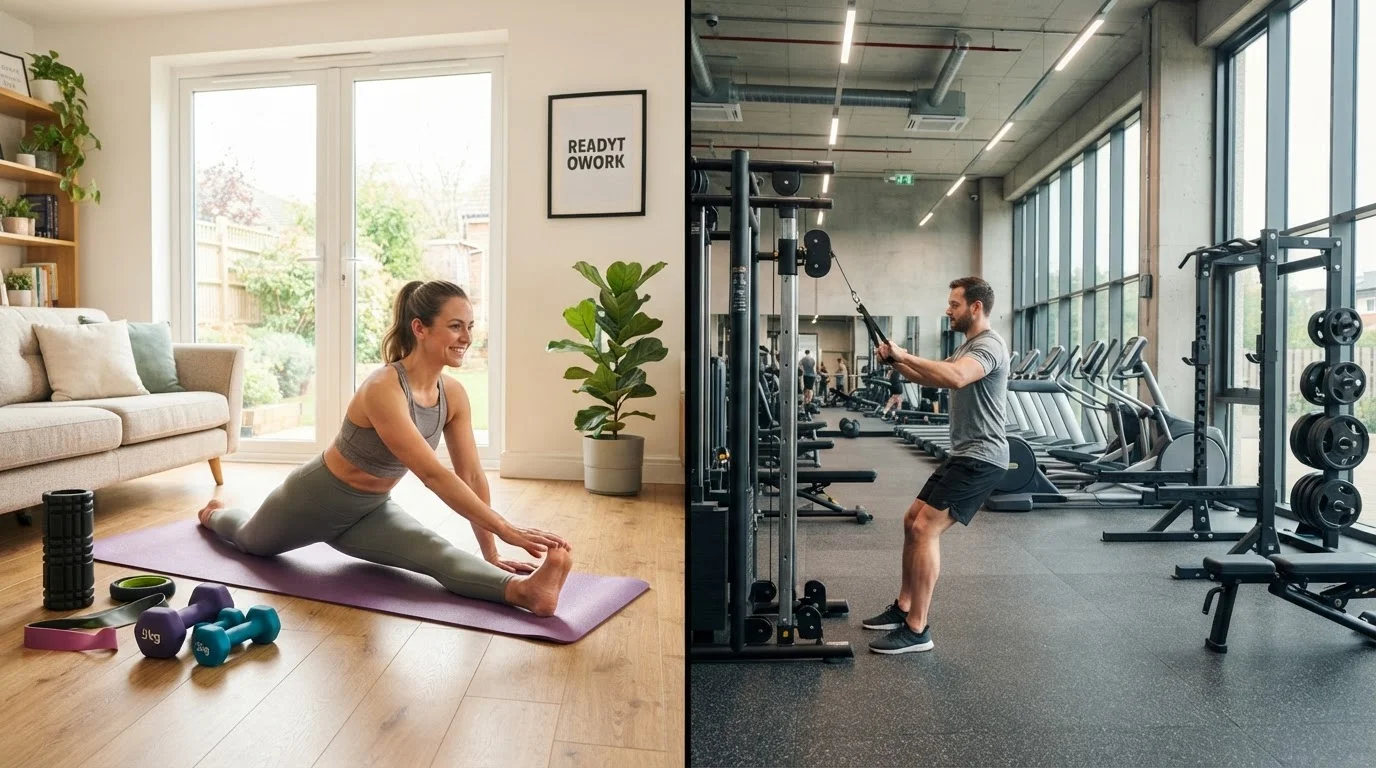
Home workouts have expanded dramatically in practicality over the past decade. Bodyweight training (push-ups, lunges, planks, squats) requires no equipment whatsoever. Resistance bands, a yoga mat, and a set of adjustable dumbbells now cover a wide range of training goals at a one-time cost. The absence of a commute is a concrete time advantage - for someone fitting exercise around work and family, 30 minutes at home beats 30 minutes at the gym plus 40 minutes of travel.
Gym workouts offer something harder to replicate at home: a purpose-built environment. Barbells, cable machines, squat racks, cardio equipment, and open floor space allow for training variety and progression that requires significant investment to recreate domestically. Many gyms also offer group fitness classes, which provide both structure and social accountability - factors research consistently links to adherence over time.
| Criterion | Home Workouts | Gym Workouts |
|---|---|---|
| Upfront cost | Low to moderate (equipment optional) | Low (membership fee applies) |
| Ongoing cost | None after equipment purchase | Monthly or annual membership |
| Equipment variety | Limited by space and budget | Broad range available |
| Commute required | None | Yes - varies by location |
| Privacy | Complete | Shared public space |
| Accountability | Self-directed | Classes and social environment available |
| Flexibility of schedule | Any time, any day | Subject to gym hours and crowding |
| Strength training progression | Possible with investment | Easier with full weight range |
The Real Barriers Each Setting Creates
Every training environment comes with friction. Understanding it honestly is what allows people to build routines that actually last.
At home, the primary challenges are motivation and environment management. Without a designated space, workouts compete with household distractions. Without external accountability, it's easy to postpone sessions. Many people also underestimate the mental discipline required to train effectively in the same space where they rest, work, or care for family. For fitting movement into a busy day, home setups are efficient - but they don't eliminate the need for intentional planning.
At the gym, the friction is logistical. Membership fees represent an ongoing financial commitment. Travel time is real and compounds across a week. Peak-hour crowding can interrupt planned workouts. Some people also find gym environments intimidating, particularly when starting out - a barrier that's rarely discussed but genuinely affects whether people show up consistently.
~$58/mo
Average US gym membership cost
According to fitness industry survey data, American gym members pay roughly $40-$70 per month on average, depending on facility type and location.
~30%
Gym members who rarely attend
Industry estimates consistently suggest a significant portion of gym members use their membership infrequently - highlighting that access alone doesn't ensure consistency.
Neither barrier is insurmountable, but ignoring them leads to routines that stall. Building a realistic weekly schedule requires accounting for the specific obstacles your setting introduces, not just the benefits it promises.
Matching Your Setting to Your Goals
Fitness goals vary substantially, and the environment that supports one goal well may be less suited to another.
Cardiovascular fitness is achievable in either setting. Running, cycling, and jumping rope work outdoors or at home. Treadmills, rowing machines, and ellipticals are gym staples, but they're also available for home purchase - space and budget permitting. For a deeper look at how cardio fits alongside other training, weighing cardio against strength training offers useful context.
Strength and muscle development benefit from progressive overload - gradually increasing resistance over time. Home setups can support this with adjustable weights and bands, but gyms provide a broader resistance range and specialized equipment that makes progression more systematic. If building significant strength is a primary goal, a gym environment tends to have a practical edge.
Flexibility and mobility work equally well in both settings. Yoga, stretching, and mobility drills require minimal equipment and space, making them among the most accessible forms of home training.
It's also worth noting that aerobic and anaerobic exercise each place different demands on your body - and understanding that distinction can help you decide which equipment and environment will serve your specific training mix.
Hybrid Approaches Are Worth Considering
Many people find that combining both settings works better than committing exclusively to one. A gym visit two or three times a week for strength work, paired with home sessions for mobility or cardio, can offer the benefits of each environment while reducing the drawbacks of both. There is no rule requiring you to choose only one.
This article is for general informational purposes only and does not constitute medical or fitness advice. Consult a qualified healthcare or fitness professional before beginning a new exercise program, especially if you have any health conditions or concerns.