

Key Takeaways
The 50/30/20 Rule
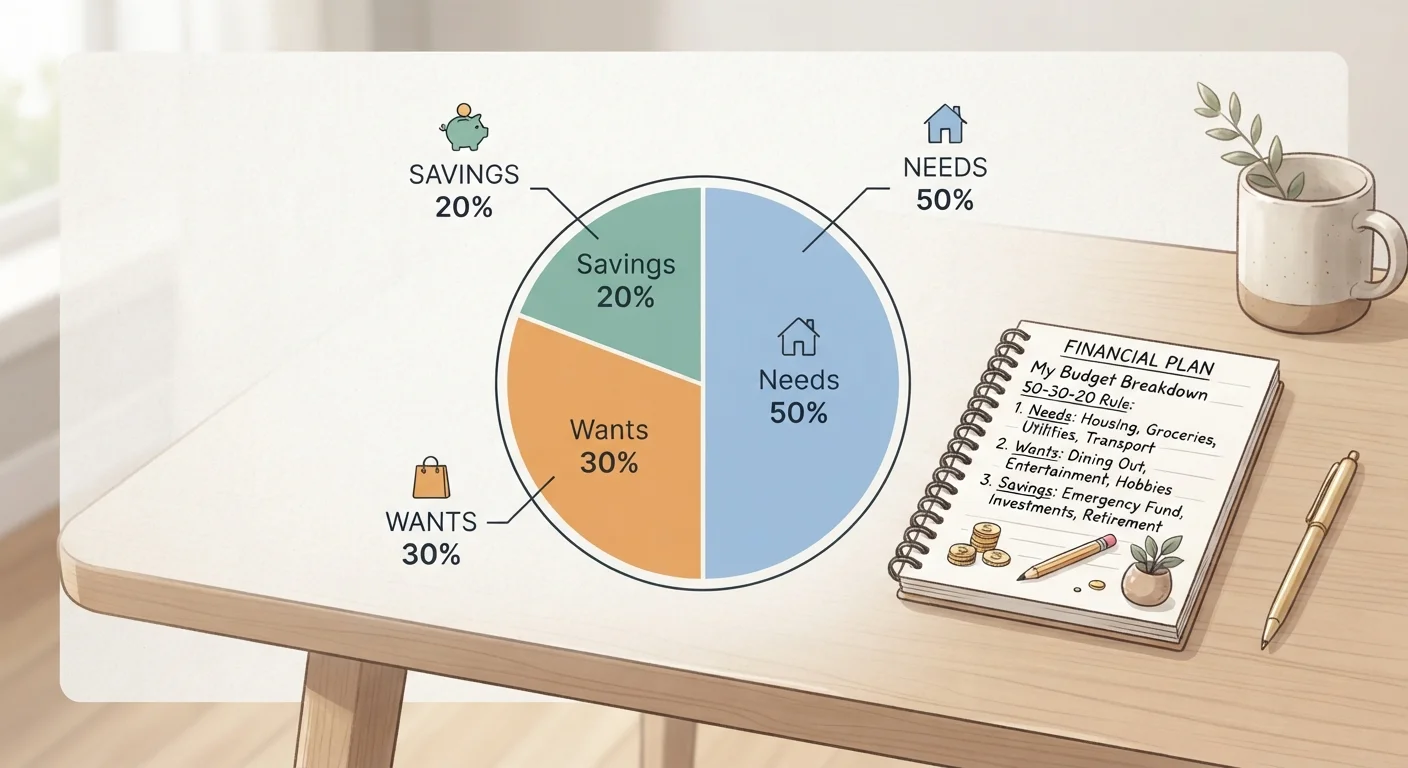
The 50/30/20 rule is a percentage-based budgeting framework that divides your after-tax income into three categories: 50% toward needs, 30% toward wants, and 20% toward savings and debt repayment. It provides a simple structure for managing money without tracking every individual transaction. The goal is to keep spending proportional and ensure savings are built into the plan from the start.
The framework is applied to net income (take-home pay after taxes and mandatory deductions), not gross income. This distinction matters significantly when calculating actual dollar amounts for each category.
How the Three Categories Work
The 50/30/20 rule organizes your monthly take-home pay into three buckets, each with a distinct purpose and target percentage.
50% - Needs
This half of your income covers essential, non-negotiable expenses: housing costs, utilities, groceries, basic transportation, health insurance premiums, and minimum payments on any outstanding debts. The defining characteristic of a need is that failing to pay it would directly harm your health, safety, or financial standing.
30% - Wants
Wants are discretionary expenses - things you choose to spend on but could live without. Dining out, streaming subscriptions, gym memberships, vacations, and clothing beyond the basics all fall here. This category is not frivolous; it acknowledges that a sustainable budget must leave room for the quality-of-life spending that keeps people motivated and financially consistent.
20% - Savings and Debt Repayment
The final slice is directed toward your financial future. This includes contributions to an emergency fund, retirement accounts such as a 401(k) or IRA, other investment vehicles, and accelerated payments on high-interest debt. Minimum debt payments technically belong in the needs category; any payment above that minimum is treated as a savings-equivalent use of money.
Start With a Three-Month Spending Audit
Before adjusting your budget to match the 50/30/20 targets, review your last three months of actual spending. Categorize each transaction as a need, want, or savings contribution and calculate the percentage each category represents. This baseline makes the gap between your current habits and the target percentages concrete and specific - which makes it far easier to act on.
For a broader comparison of budgeting approaches, see our overview of budgeting methods.
Applying the Rule to Your Income
The math is straightforward. Start with your monthly net income - the amount deposited into your account after taxes, Social Security, and Medicare deductions. Multiply that figure by 0.50, 0.30, and 0.20 to get the dollar ceiling for each category.
50%
Recommended share for essential needs
The 50/30/20 framework, as described in 'All Your Worth' by Elizabeth Warren and Amelia Warren Tyagi, designates half of after-tax income to unavoidable living costs.
20%
Target allocation for savings and debt repayment
The framework dedicates one-fifth of net income to building financial security, covering emergency funds, retirement contributions, and above-minimum debt payments.
~33%
Median housing cost share for U.S. renters
According to U.S. Census Bureau data, median gross rent represents roughly a third of renter household income, illustrating how housing alone can strain the 50% needs ceiling.
For example, a household bringing home $4,500 per month after taxes would target: $2,250 for needs, $1,350 for wants, and $900 for savings and debt repayment. These are ceilings to work within, not floors to reach.
Once you have the figures, compare them against your current actual spending by reviewing two to three months of bank and credit card statements. Most people find their needs are close to target but their wants category has been running significantly over - which is precisely what the framework is designed to surface.
For practical guidance on running this calculation and organizing the results, the first monthly budget walkthrough covers the process step by step.
When the Rule Fits - and When It Doesn't
The 50/30/20 framework works best for earners with stable monthly income and moderate living costs. Its simplicity is its primary advantage: it requires no complicated spreadsheets and tolerates imprecise tracking.
However, it has real limitations worth understanding before committing to it as your primary framework:
- High-cost cities: Rent alone can consume more than 50% of take-home pay in markets like New York, San Francisco, or Boston. In these cases, the wants percentage must absorb the difference, or the percentages need to be recalibrated entirely.
- Variable income: Freelancers or gig workers with fluctuating monthly earnings may find percentage targets harder to apply consistently. Using an average monthly income figure, or applying the rule to each paycheck separately, can help.
- High-debt situations: If aggressive debt repayment is the primary financial goal, the 20% savings allocation may need to expand at the expense of the wants category until balances are reduced.
The Rule Applies to After-Tax Income Only
A common mistake is applying the 50/30/20 percentages to gross (pre-tax) salary. Because taxes, Social Security, and employer-sponsored benefit deductions are taken before your paycheck arrives, your actual spending decisions only involve net income. Using gross income overstates how much is available and can make the budget appear more comfortable than it really is.
The framework is also worth revisiting as income changes. A percentage-based approach that worked well at one income level may feel overly loose or unnecessarily tight after a significant raise or income drop. For an honest look at its trade-offs, see what the 50/30/20 rule gets right and wrong.
If you are simultaneously managing debt and trying to build savings, the framework for saving while in debt offers practical guidance for navigating that trade-off within or alongside this rule.
This article is for general informational and educational purposes only and does not constitute personalized financial advice. Consult a qualified financial professional for guidance tailored to your specific circumstances.