

Key Takeaways
Can reduce overall interest rate paid
If you qualify for a loan rate lower than your existing debts' average APR, you may pay less interest over the repayment period - assuming the term is not significantly extended.
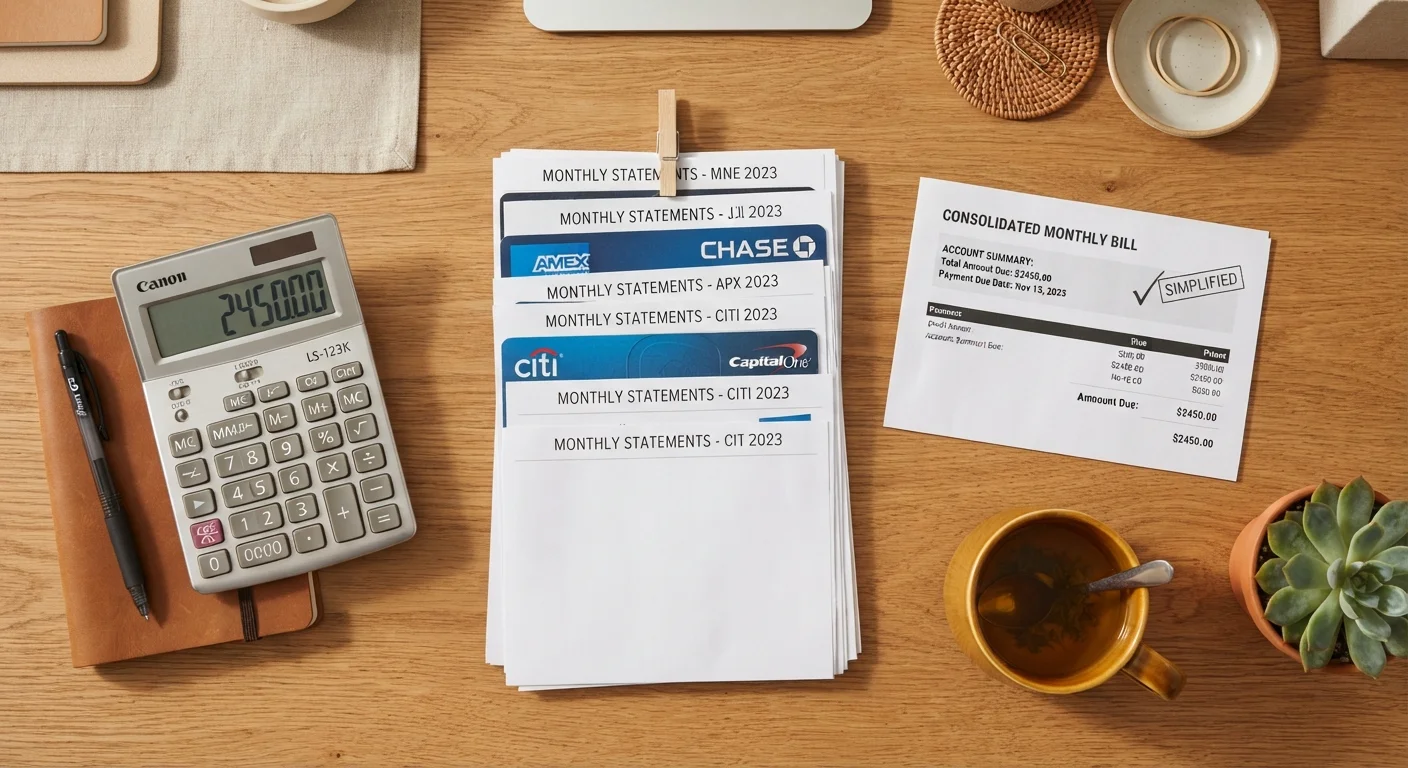
Simplifies repayment to one monthly payment
Managing five credit card due dates increases the likelihood of a missed payment. One consolidated payment reduces that administrative burden and makes budgeting more predictable.
Fixed repayment timeline adds structure
Unlike revolving credit card debt, which has no defined end date, a consolidation loan typically comes with a set payoff date - providing a clear finish line.
May lower monthly cash-flow pressure
A lower required monthly payment can free up cash for essentials or an emergency fund, though this benefit must be weighed against potential increases in total interest paid.
Can protect credit if it prevents missed payments
Staying current on a consolidated loan is easier when payments are simplified; on-time payments are the single largest factor in most credit scoring models.
Lower payment can mean higher total cost
Extending your repayment term reduces monthly obligations but increases the total interest paid over time. A borrower saving $150 per month could easily pay thousands more over a longer loan.
Does not address underlying spending patterns
Consolidation restructures debt but doesn't change the behavior that created it. Without a budget adjustment, many borrowers accumulate new balances on the cards they just paid off.
Qualification depends on creditworthiness
The most attractive consolidation rates are available only to borrowers with strong credit. Those with poor or fair credit may receive rates that are comparable to - or worse than - their existing debts.
Fees can erode the interest savings
Origination fees on personal loans (often 1-8% of the loan amount), balance transfer fees, or closing costs on home equity products can significantly reduce net savings.
Secured consolidation puts assets at risk
Using home equity to consolidate unsecured credit card debt converts that debt to a secured obligation - meaning your home can be at risk if you default.
Temporary credit score dip from hard inquiry
Applying for a consolidation loan generates a hard credit inquiry, which can lower your score by a few points in the short term - a factor worth considering if you plan to apply for other credit soon.
Our Verdict
Debt consolidation is a legitimate tool that can reduce interest costs and simplify repayment - but only when the terms genuinely improve on what you already owe and you have addressed the habits that led to the debt. It is not a shortcut to being debt-free, and the wrong loan structure can cost more in the long run.
Best for borrowers carrying multiple high-interest debts who qualify for a meaningfully lower rate and are committed to not accumulating new balances during repayment.
What Debt Consolidation Actually Does
Debt consolidation is the process of combining multiple debts - typically credit cards, medical bills, or personal loans - into a single new loan or credit product. The goal is usually to secure a lower interest rate, reduce the number of monthly payments, or both. Common vehicles include personal consolidation loans, balance transfer credit cards (which may offer a low or 0% introductory period), and home equity loans or lines of credit.
What consolidation does not do is erase what you owe. The underlying balance remains; only the structure changes. Understanding that distinction is the foundation of any honest evaluation. To understand why high-interest balances grow so quickly in the first place, see how high-interest debt compounds.
The Potential Benefits
When the conditions are right, consolidation offers real, measurable advantages.
Can reduce overall interest rate paid
If you qualify for a loan rate lower than your existing debts' average APR, you may pay less interest over the repayment period - assuming the term is not significantly extended.
Simplifies repayment to one monthly payment
Managing five credit card due dates increases the likelihood of a missed payment. One consolidated payment reduces that administrative burden and makes budgeting more predictable.
Fixed repayment timeline adds structure
Unlike revolving credit card debt, which has no defined end date, a consolidation loan typically comes with a set payoff date - providing a clear finish line.
May lower monthly cash-flow pressure
A lower required monthly payment can free up cash for essentials or an emergency fund, though this benefit must be weighed against potential increases in total interest paid.
Can protect credit if it prevents missed payments
Staying current on a consolidated loan is easier when payments are simplified; on-time payments are the single largest factor in most credit scoring models.
A single monthly payment reduces administrative complexity - missed payments often happen not because of lack of funds but because of multiple due dates. Consolidation eliminates that friction. For readers weighing this alongside building savings, a realistic framework for saving while in debt can help you think through both goals at once.
The Real Risks
The disadvantages of consolidation are just as real as the benefits, and they are frequently underweighted in popular coverage.
Lower payment can mean higher total cost
Extending your repayment term reduces monthly obligations but increases the total interest paid over time. A borrower saving $150 per month could easily pay thousands more over a longer loan.
Does not address underlying spending patterns
Consolidation restructures debt but doesn't change the behavior that created it. Without a budget adjustment, many borrowers accumulate new balances on the cards they just paid off.
Qualification depends on creditworthiness
The most attractive consolidation rates are available only to borrowers with strong credit. Those with poor or fair credit may receive rates that are comparable to - or worse than - their existing debts.
Fees can erode the interest savings
Origination fees on personal loans (often 1-8% of the loan amount), balance transfer fees, or closing costs on home equity products can significantly reduce net savings.
Secured consolidation puts assets at risk
Using home equity to consolidate unsecured credit card debt converts that debt to a secured obligation - meaning your home can be at risk if you default.
Temporary credit score dip from hard inquiry
Applying for a consolidation loan generates a hard credit inquiry, which can lower your score by a few points in the short term - a factor worth considering if you plan to apply for other credit soon.
Student Loan Consolidation Follows Different Rules
Federal student loan consolidation is a separate program with its own eligibility rules, interest rate calculations, and implications for income-driven repayment plans and forgiveness programs. Mixing federal student loans into a private consolidation loan can permanently eliminate federal protections. For a factual overview of federal options, see student loan repayment plans in the U.S..
Even borrowers who consolidate successfully can find themselves in deeper trouble if they continue using the credit lines they just paid off. Discipline after consolidation matters as much as the rate you secure.
Key Numbers to Run Before You Decide
Before pursuing consolidation, compare total repayment cost - not just monthly payment. A lower payment stretched over a longer term often means paying significantly more interest in aggregate. Ask for the loan's APR, the total repayment amount, and any origination or prepayment fees.
20%+
Average credit card APR in recent years
The Federal Reserve has reported average credit card interest rates exceeding 20% in recent periods, illustrating why rate reduction through consolidation can matter significantly.
1-8%
Typical personal loan origination fee range
Many lenders charge an upfront origination fee deducted from or added to the loan amount, which reduces the net benefit of any interest rate savings.
35%
Weight of payment history in FICO scoring
According to FICO, payment history is the single largest component of a credit score, underscoring why consistently on-time payments - whether consolidated or not - matter most.
Also review how consolidation will affect your credit. Applying for a new loan triggers a hard inquiry, which can cause a temporary score dip. However, if consolidation meaningfully lowers your credit utilization ratio, the medium-term effect on your score may be positive. The real cost of carrying a credit card balance illustrates concretely how interest accumulates when balances persist.
Alternatives Worth Considering
Consolidation is one tool, not the only one. Depending on your situation, other approaches may serve you better - or complement consolidation.
- Debt avalanche or snowball methods: Structured payoff strategies that don't require a new loan. See the debt avalanche vs. debt snowball for a side-by-side comparison.
- Nonprofit credit counseling: Accredited agencies can negotiate directly with creditors on your behalf through a debt management plan, sometimes achieving lower rates without a new loan.
- Using savings strategically: If you hold high-yield savings at a rate lower than your debt's interest rate, it may make sense to partially pay down balances - though this warrants careful thought. A decision checklist before dipping into savings can help structure that thinking.
This article is for general informational purposes only and does not constitute personalized financial, legal, or tax advice. Readers should consult a qualified, licensed financial professional before making decisions about their own debt situations.