

Key Takeaways
Option A
Debt Avalanche
The mathematically optimal, interest-minimizing approach.
Best for: People who are disciplined, motivated by numbers, and want to minimize total interest paid over time.
Option B
Debt Snowball
The psychologically rewarding, momentum-building method.
Best for: People who need early wins to stay motivated and benefit from a structured, encouraging repayment rhythm.
If you want to pay the least possible in total interest
Debt Avalanche
Targeting high-interest debt first limits the compounding effect, saving you more money in the long run compared to any other sequencing.
If you struggle to stay motivated without visible progress
Debt Snowball
Closing out smaller accounts quickly delivers a sense of accomplishment that can sustain your commitment through a long repayment journey.
If your highest-interest debt also happens to be your smallest balance
Debt Avalanche
When the two methods converge on the same account, you get both the psychological win and the interest savings simultaneously.
If you have irregular or unpredictable income
Debt Snowball
Eliminating smaller debts reduces your monthly minimum obligation faster, giving you more cash-flow flexibility during lean months.
How Each Strategy Works
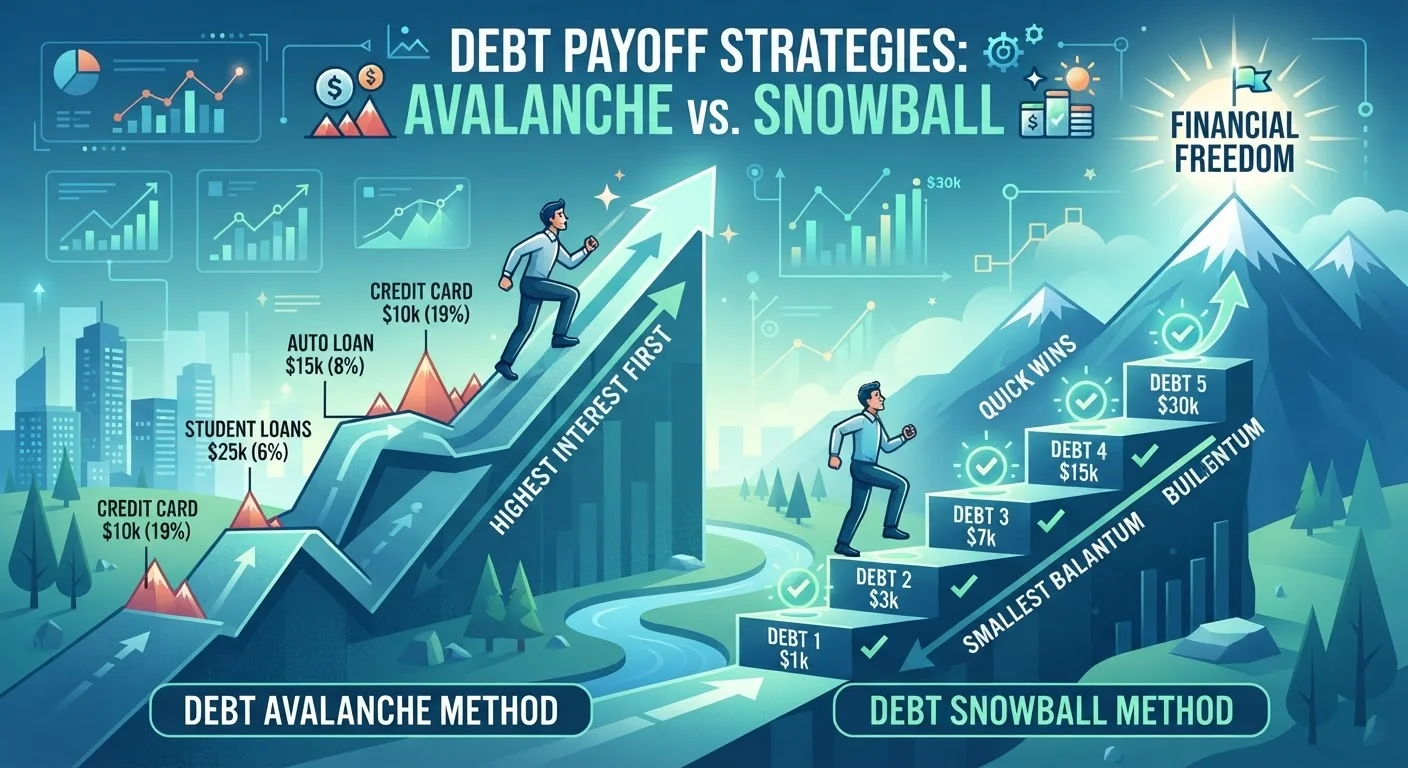
Both the debt avalanche and the debt snowball share the same foundational mechanic: you make minimum payments on every account you owe, then direct any extra money toward one designated priority debt. The difference lies entirely in which debt gets that extra attention first.
With the debt avalanche, you rank your debts from highest to lowest annual percentage rate (APR) and attack the top of that list first. Once the highest-rate debt is gone, you roll what you were paying on it into the next highest-rate account - creating an ever-larger payment over time. Because interest is the core driver of how debt grows, eliminating high-rate balances early limits the compounding damage. For a deeper look at how that compounding works against you, see our article on high-interest debt and compounding.
With the debt snowball, you rank debts from smallest to largest balance - ignoring interest rates entirely - and pay off the smallest first. Each eliminated account frees up its minimum payment, which then rolls into the next. The method, popularized by financial educators as a behavioral tool, is designed to deliver early wins that keep you engaged.
| Criterion | Debt Avalanche | Debt Snowball |
|---|---|---|
| Payoff order | Highest interest rate first | Smallest balance first |
| Total interest paid | Lower (mathematically optimal) | Potentially higher |
| Time to first paid-off account | Longer (if high-rate debt is large) | Faster (early wins built in) |
| Motivational design | Math-driven, discipline required | Behavior-driven, momentum focused |
| Best debt profile fit | Wide spread in interest rates | Many small accounts or similar rates |
| Cash-flow flexibility | Slower minimum reduction | Faster reduction of minimum obligations |
The Real Cost Difference
In pure dollar terms, the avalanche typically wins. When you carry high-APR debt - credit cards, for instance, which often carry rates well above 20% - every month you don't address that balance, interest accrues and compounds. The snowball may leave those expensive balances untouched for longer while you retire smaller, lower-rate accounts, meaning you pay more in total interest over the life of your debt.
However, the gap in total cost between the two methods narrows considerably when your debts have similar interest rates, or when your smallest balances happen to be your most expensive ones. In those scenarios, the two approaches may produce nearly identical outcomes - making the psychological dimension the deciding factor.
20%+
Typical credit card APR in the U.S.
The Federal Reserve has reported average credit card interest rates exceeding 20% in recent years, underscoring the cost of leaving high-rate balances unaddressed.
~$6,000
Median credit card balance per U.S. household
According to Federal Reserve data, many American households carry revolving credit card debt that compounds monthly at high rates.
33%
Adults who cite motivation as top debt barrier
Surveys by nonprofit financial wellness organizations consistently find that sustaining motivation - not knowledge - is the primary obstacle to debt repayment for a significant share of borrowers.
It's also worth noting that neither method operates in a vacuum. A realistic payoff plan should account for your emergency fund, monthly expenses, and any irregular income patterns. Our guide on managing debt on an irregular income addresses how to adapt these strategies when your cash flow isn't predictable.
Psychology Matters as Much as Math
Research in behavioral economics consistently shows that people are more likely to follow through on financial plans that feel achievable. A strategy that is mathematically superior but emotionally unsustainable will underperform one you actually stick with. This is the strongest case for the snowball: it is engineered around human motivation rather than interest rate optimization.
Clearing a small balance in the first few weeks can reduce the feeling of being overwhelmed and reinforce the identity of someone who is making real progress. For people carrying five or more accounts, this sense of momentum is not trivial - it's often what separates those who complete a payoff plan from those who abandon it mid-way.
If you're still deciding how to structure your overall financial picture - including whether to prioritize debt payoff over saving - our debt vs. savings decision checklist can help you think through the trade-offs systematically.
Both Methods Require Minimum Payments on All Debts
Regardless of which strategy you choose, you must continue making at least the minimum required payment on every account every month. Skipping minimums on non-priority debts leads to late fees, penalty APRs, and credit score damage - all of which work against your payoff plan. The extra funds above minimums are what you redirect to your chosen priority debt.
Choosing the Right Method for Your Situation
There is no single correct answer. Choosing between the avalanche and snowball comes down to an honest assessment of your debt profile and your own behavioral patterns. Ask yourself:
- Do I have one or two debts with dramatically higher interest rates than the rest? Avalanche is likely the stronger fit.
- Am I prone to losing motivation when progress feels slow? Snowball may keep you on track.
- Are my smaller balances also my highest-rate debts? Either method works; start wherever feels right.
- Is my income variable month to month? Snowball's faster reduction of minimum obligations may provide useful flexibility.
Some people adopt a hybrid: they use the snowball to eliminate one or two small accounts quickly, then switch to avalanche sequencing for the remaining, larger balances. This blends motivational traction with long-run efficiency.
For a broader framework on escaping debt over time, our complete guide to the debt cycle walks through the structural and psychological forces that keep people in debt - and the methods proven to break those patterns.
If your debt situation is complex - involving student loans, multiple creditors, or potential consolidation - consider reviewing debt consolidation trade-offs before committing to a sequencing strategy. A licensed financial adviser or nonprofit credit counselor can help you map a plan tailored to your specific accounts and income.
This article is for general informational and educational purposes only and does not constitute personalized financial, legal, or tax advice. Please consult a qualified financial professional before making decisions about your own debt repayment strategy.