

Key Takeaways
Stopping Distance
Stopping distance is the total distance a vehicle travels from the moment a driver perceives a hazard to the point the vehicle comes to a complete stop. It is made up of two parts: the distance covered during the driver's reaction time and the distance covered while the brakes are actively slowing the vehicle. Both components grow significantly as speed increases.
Braking distance increases with the square of speed - doubling your speed roughly quadruples the distance needed to stop, following the kinetic energy formula KE = ½mv².
Two Components, One Critical Number
Every time you brake, two separate distances add up to determine whether you stop in time. The first is reaction distance - how far your car travels while your brain processes a hazard and your foot moves to the brake pedal. The second is braking distance - how far the car continues to travel once the brakes are applied.
At 30 mph, an average driver with a 1.5-second reaction time covers roughly 66 feet before braking even begins. Add the braking distance and total stopping distance on dry pavement approaches around 120 feet. At 60 mph, that reaction distance alone exceeds 130 feet - and total stopping distance can reach 300 feet or more. That is nearly the length of a football field.
Understanding both components is the foundation of defensive driving - anticipating hazards early enough that physics works in your favor.
~300 ft
Total stopping distance at 60 mph on dry pavement
This figure combines reaction distance and braking distance for an average driver under standard conditions, per driver education guidelines used across the US.
4×
Increase in braking distance when speed doubles
This relationship follows directly from kinetic energy physics (KE = ½mv²), meaning braking distance scales with the square of velocity.
50%+
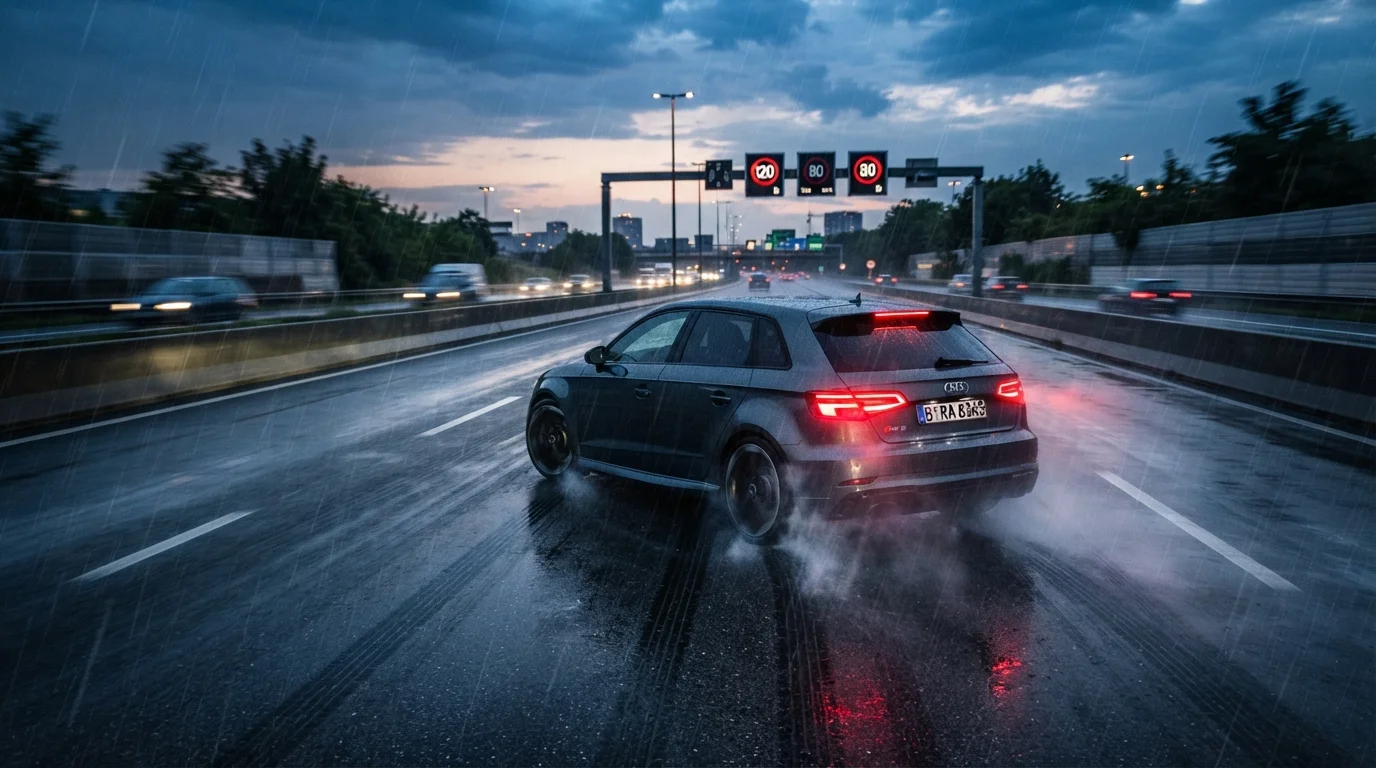
Increase in stopping distance on wet roads
Wet asphalt significantly reduces tire-to-road friction, with stopping distances commonly increasing by half or more compared to dry conditions.
Why Speed Has a Disproportionate Effect
Most drivers think of speed and stopping distance as having a simple linear relationship - go twice as fast, need twice as much room. The physics tells a different story. Kinetic energy, the energy a moving vehicle must dissipate to stop, equals one-half the vehicle's mass multiplied by the square of its velocity. Double the speed and you quadruple the kinetic energy that brakes must overcome.
This is why the gap between a 45 mph stop and a 65 mph stop feels so dramatic in practice. It is also why small speed reductions in hazardous conditions - even dropping from 55 mph to 45 mph - can meaningfully cut the distance needed to stop. Posted speed limits represent a legal ceiling, not always a safe speed - real-world conditions frequently demand driving well below them.
“Speed kills not because of the speed itself, but because of the energy involved. A small increase in speed produces a large increase in the force of impact and the distance required to stop - drivers consistently underestimate this relationship.”
— Road Safety Foundation, Independent road safety research organization
Road Conditions and Tire Grip
Braking distance figures quoted in driver handbooks almost always assume dry, well-maintained asphalt and tires in good condition. Real roads are rarely so forgiving. Friction between tire and road - the technical term is the coefficient of friction - drops substantially when surfaces are wet, icy, or contaminated with gravel, leaves, or spilled fuel.
On wet pavement, stopping distances commonly increase by 50% or more. On packed snow or ice, that multiplier can reach three to ten times the dry-road figure. This means a car that stops in 180 feet on dry asphalt at 50 mph may need 500 feet or more on ice - an entirely different mental model for following distances.
Tire health is just as consequential. Worn tread cannot channel water effectively, dramatically reducing wet-weather grip. Brake pad condition matters equally - degraded pads mean less clamping force and longer stops. For a full picture of weather-related driving adjustments, see our guide on driving in rain, fog, and snow.
Check Your Tires Before Winter Driving
Before temperatures drop, inspect your tires for tread depth and proper inflation. Insert a quarter into a tread groove - if you can see the top of the head, tread is getting low. Underinflated or worn tires dramatically increase wet and icy stopping distances, where the margin between safe and unsafe is smallest.
What Drivers Can Actually Control
The science of stopping distances points directly to several habits every driver can adopt. Following distance is the single most effective buffer - the three-second rule (or more at highway speeds) creates the time your reaction distance consumes. Speed management in adverse conditions is equally critical: entering a curve or approaching an intersection even 10 mph slower makes a measurable difference in outcome.
Vehicle maintenance plays a real role too. Keeping tires properly inflated and replacing them before tread depth becomes critically low preserves the grip that braking depends on. Modern driver-assistance systems - including automatic emergency braking - can help, but as our explainer on crash avoidance technology explains, these systems have real limits and work best as a supplement to attentive driving, not a substitute for it.
Ultimately, stopping distance is not an abstract physics problem - it is the gap between a near miss and a collision. The more clearly drivers understand that gap, the better equipped they are to keep it on their side.
Reaction Time Varies Significantly
The 1.5-second average reaction time used in most stopping-distance calculations assumes an alert, sober driver in normal conditions. Fatigue, distraction, alcohol, or certain medications can extend reaction time considerably - adding dozens of additional feet of travel before braking begins. Conditions that impair alertness have a direct, measurable effect on total stopping distance.