

Key Takeaways
The Real Danger Behind Following Too Closely
Rear-end collisions are among the most common crash types on American roads, and inadequate following distance is a primary contributing factor in a large share of them. Yet tailgating remains one of the most normalized risky behaviors behind the wheel - many drivers do it without realizing they're doing it at all.
The core problem is physics. At 60 mph, a typical passenger vehicle travels approximately 88 feet every second. That means reaction time alone - the roughly 1.5 seconds it takes most drivers to perceive a hazard and begin braking - eats up over 130 feet before the brakes even engage. Add actual braking distance and the margin for error shrinks fast. When you're following a vehicle too closely, you've already lost the ability to stop in time before the situation registers as a threat.
For a deeper look at how anticipating hazards fits into overall safe driving, see our guide to defensive driving.
Your Stopping Distance Is Longer Than You Think
At 65 mph, total stopping distance for a typical passenger vehicle - perception time plus braking - can exceed 300 feet under ideal conditions. In rain or with any driver distraction, that number climbs further. If the vehicle ahead stops suddenly and you're within 100 feet, physics has already made the collision nearly unavoidable. No amount of skill recovers distance that isn't there.
Common Tailgating Mistakes - and How to Break Them
Understanding the specific errors drivers make around following distance helps turn abstract awareness into changed behavior. Here are the most frequent mistakes:
Using a one- or two-second gap as a default at all speeds.
Why it happens: Many drivers learned a two-second rule years ago and apply it regardless of speed, forgetting that braking distance grows sharply as speed increases.
Assuming the car ahead will stop smoothly and predictably.
Why it happens: Drivers unconsciously model the vehicle ahead as behaving like their own - forgetting that a fully loaded truck or a car with worn brakes stops very differently.
Closing the gap to prevent other cars from merging.
Why it happens: In congested traffic, drivers instinctively shrink the space ahead to avoid being 'cut off,' treating following distance as something to defend rather than a safety buffer.
Relying on automatic emergency braking to close the gap for you.
Why it happens: Drivers aware their vehicle has AEB sometimes feel it justifies less conscious attention to following distance, treating the system as a substitute rather than a last resort.
Tailgating slow drivers as a form of pressure to speed up or move over.
Why it happens: Frustration with slower traffic is a real trigger. Drivers may believe following closely signals their displeasure or prompts lane changes, even if it rarely works.
It's also worth noting that crash avoidance systems have real limits. Automatic emergency braking, for instance, may not react fast enough in every scenario to compensate for an insufficient gap. Our article on crash avoidance technology explains exactly where these systems fall short.
Conditions That Make Your Default Following Distance Dangerously Short
The standard three-second rule is a starting point for dry pavement and alert driving. Many conditions demand significantly more space:
- Rain and wet roads: Wet pavement can more than double stopping distance. At highway speeds in rain, a four- to five-second gap is more appropriate.
- Night driving: Reduced visibility means hazards appear later, compressing the time available to react.
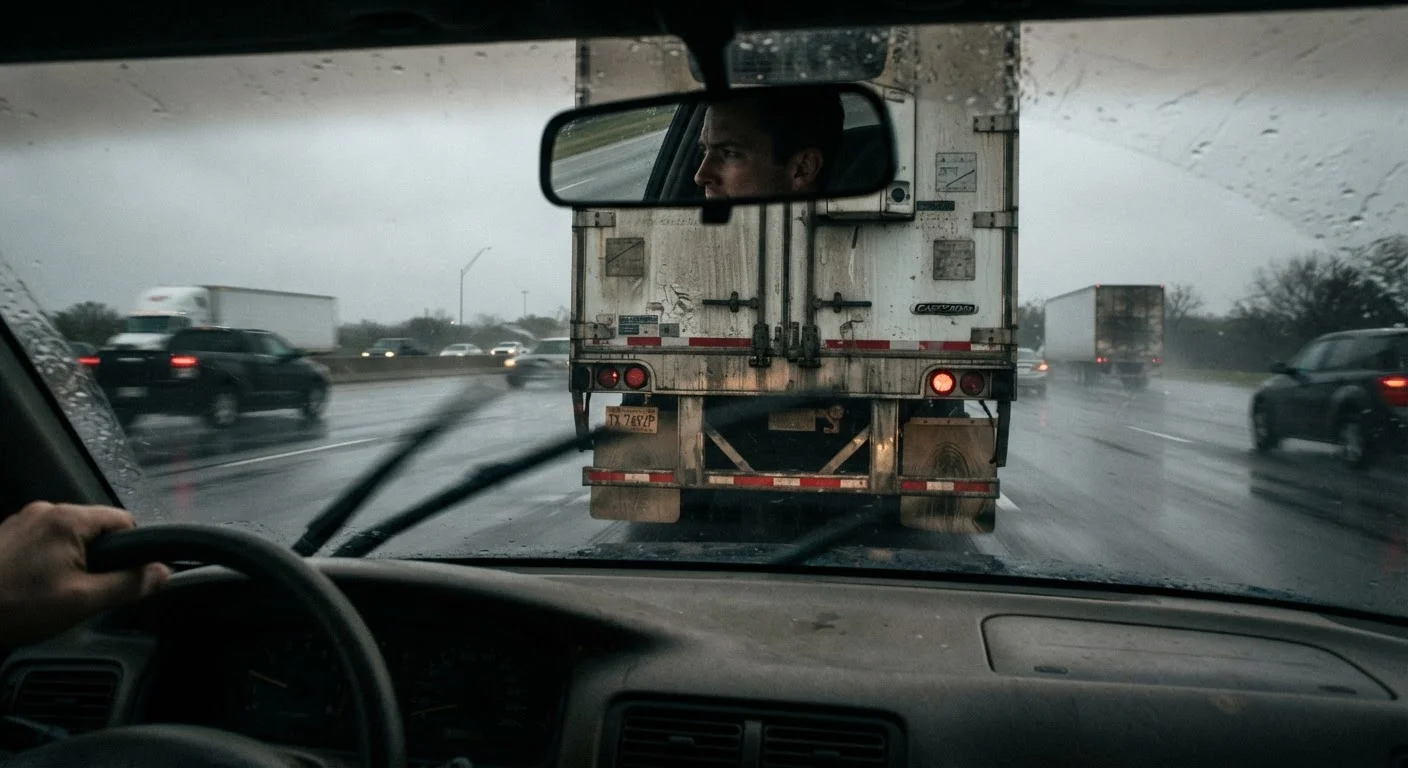
- Heavy vehicles: Following a semi-truck or SUV blocks your sightlines further down the road. Increasing your gap gives you a longer view ahead.
- High speeds: Braking distance increases exponentially with speed, not linearly. The gap that felt adequate at 45 mph is nowhere near enough at 75 mph.
- Fatigue: Tired drivers have reaction times closer to impaired drivers. A larger buffer compensates - though rest remains the real solution.
Speed itself compounds every other risk factor. Our article on safe speeds vs. posted speed limits explains why driving at the legal maximum is not always the appropriate choice.
Don't Let Good Weather Create Overconfidence
Clear skies and dry pavement can make a too-short following distance feel safe - right up until it isn't. Road conditions can change quickly: a sudden debris obstacle, a tire blowout in the vehicle ahead, or a driver braking hard for an unseen hazard. Keeping a proper gap on a sunny day is just as important as in a storm, because emergencies don't announce themselves.
Building a Habit That Sticks
Changing following distance behavior requires more than knowing the rule - it requires building a consistent, almost automatic habit. A practical approach: pick a fixed object on the roadside (a sign, a bridge post) and count the seconds between when the vehicle ahead passes it and when you do. If you hit three seconds easily with room to spare, your gap is reasonable. If you find yourself barely reaching two, close the gap to zero first, then rebuild gradually.
Tailgating is sometimes rooted in impatience or frustration with slower traffic. Recognizing those emotional triggers is part of the fix. If another driver's pace genuinely requires a lane change, make it - don't use pressure as a substitute for decision-making. And if you're being tailgated yourself, resist the urge to brake-check; instead, create extra space ahead of you so you can brake gradually and reduce your own risk.
Safe following distance is one piece of a broader defensive mindset. For how other driver habits affect your risk profile, explore our article on driving safely with passengers.
~29%
Share of all crashes that are rear-end collisions
According to NHTSA data, rear-end crashes consistently represent roughly one in four to one in three of all reported collisions on U.S. roads.
1.5 sec
Average driver perception-reaction time
Research cited in driver education literature consistently places typical perception-reaction time between 1.5 and 2.5 seconds, before braking even begins.