

Key Takeaways
Safe Speed vs. Speed Limit
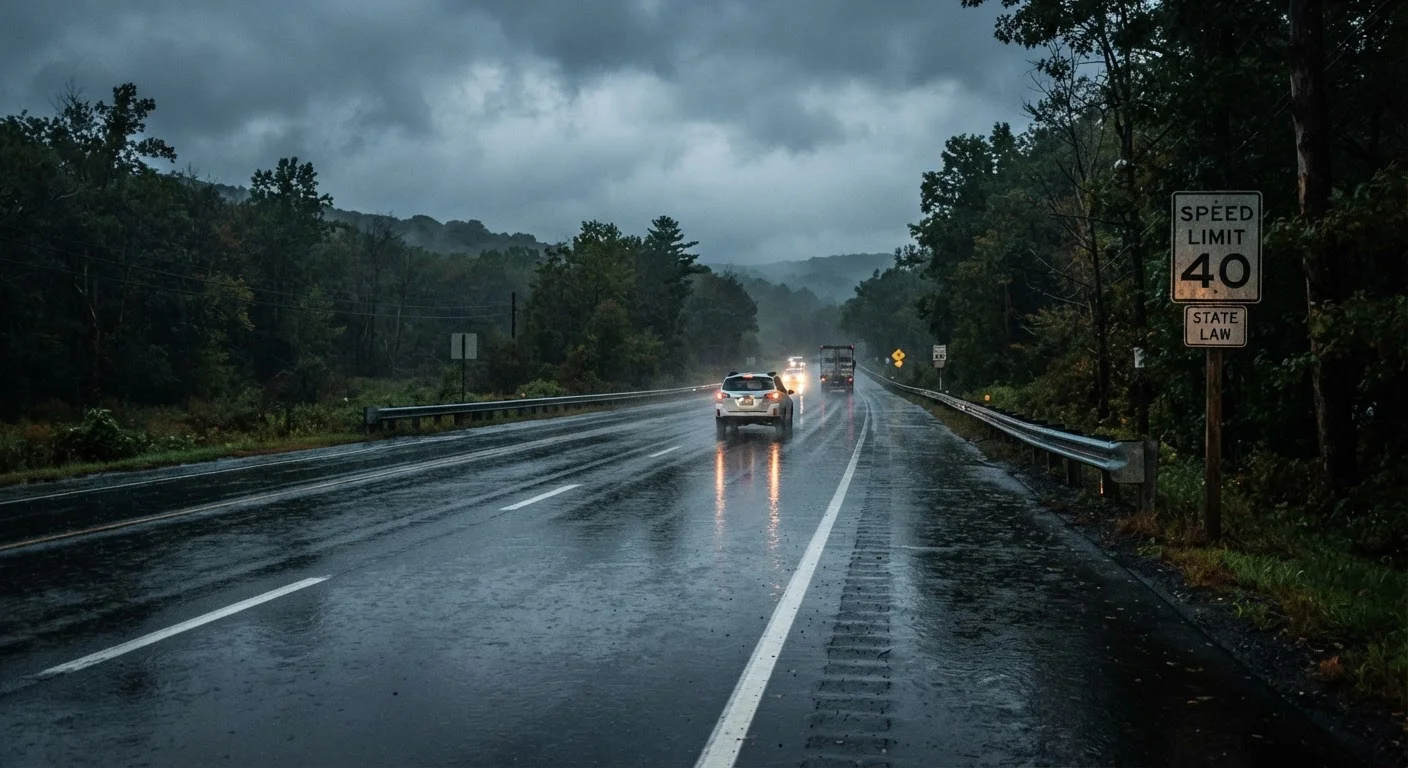
A posted speed limit is the legal maximum a driver may travel under normal conditions - it is not a guaranteed safe speed in every situation. A safe speed is the pace at which a driver can maintain control, react to hazards, and stop within the visible distance ahead, given the actual conditions present. These two numbers are often identical on a clear, dry day but can diverge sharply in fog, rain, heavy traffic, or roadwork zones.
Most U.S. states codify this under 'basic speed laws,' which require drivers to travel at a speed 'reasonable and prudent' for conditions, regardless of the posted limit.
What Speed Limits Actually Measure
Speed limit signs communicate the legal maximum speed permitted under normal, favorable conditions - typically dry pavement, good visibility, and light traffic. Traffic engineers generally derive these numbers from studies of how drivers naturally behave on a given road, not from a precise calculation of every possible hazard a driver might encounter.
This means the posted number carries an implicit assumption: conditions are ordinary. When they aren't - and conditions change constantly - the limit becomes a ceiling, not a target. Understanding this distinction is the starting point for genuinely safe driving.
“Speed limits are set for ideal conditions. The responsibility for adjusting to actual conditions - fog, rain, traffic - always falls on the driver. The sign can't do that for you.”
— NHTSA Traffic Safety Communications, U.S. National Highway Traffic Safety Administration guidance materials
Why Conditions Change the Equation
Several factors routinely lower the safe speed well below what the sign says:
- Wet or icy roads: Traction drops sharply on wet pavement and nearly disappears on ice. Because stopping distance grows with the square of speed, even modest reductions in speed yield significant safety gains. See how speed affects stopping distance for a closer look at the physics involved.
- Reduced visibility: Fog, heavy rain, or nighttime driving shrinks the distance over which you can identify and react to hazards. A rule of thumb: you should be able to stop within the distance you can clearly see.
- Roadwork and narrow lanes: Construction zones shift lane positions, introduce workers and equipment near traffic, and often feature uneven surfaces that reduce vehicle stability at speed.
- Heavy traffic or frequent stops: Dense urban traffic demands faster reaction times and closer attention. City and highway driving carry different risk profiles, and adjusting speed for congestion is central to both.
~29%
Fatal crashes involving speeding
According to the National Highway Traffic Safety Administration (NHTSA), speeding is a contributing factor in roughly 29% of all traffic fatalities in the United States.
50%+
Increase in stopping distance on wet roads
Wet pavement can increase stopping distance by more than 50% compared to dry conditions, depending on speed, tires, and road surface.
4x
Energy increase when speed doubles
Because kinetic energy increases with the square of velocity, doubling your speed quadruples the energy that must be absorbed in a stop or collision.
The Legal Dimension: Basic Speed Laws
Most U.S. states have enacted what's commonly called a basic speed law - a requirement that drivers travel at a speed that is reasonable and prudent for actual conditions, independent of the posted limit. Under this framework, a driver who strikes another vehicle while traveling at exactly the speed limit in a blizzard may still be found legally at fault, because conditions clearly called for a lower speed.
This legal concept reinforces what common sense already suggests: the sign on the roadside cannot anticipate every scenario. Responsibility for matching speed to conditions rests with the driver, not the sign.
Practical Rule for Reduced Visibility
When visibility drops significantly - due to fog, heavy rain, or nightfall - reduce your speed so you can stop within the distance you can clearly see ahead. This is sometimes called 'driving within your headlights' and is a cornerstone of safe nighttime and low-visibility driving. If conditions are severe enough to make safe travel impossible, pulling off the road entirely is a legitimate option.
Defensive Driving and Speed Management
Defensive driving treats speed as a tool to be adjusted continuously, not a fixed setting. A few practical principles help translate this into daily habits:
- Use following distance as a gauge: If you cannot maintain a safe cushion at the current speed, you're likely going too fast for conditions. Rear-end collisions remain among the most common crash types - the risks of following too closely are easy to underestimate.
- Read the environment, not just the sign: School zones, neighborhood streets, and sharp curves are all contexts where the limit may still exceed what's safe given pedestrians, sightlines, or road geometry.
- Slow earlier, not later: Braking at the last moment at high speed dramatically extends stopping distance. Gradual, anticipatory speed reduction is consistently more effective and puts less stress on braking systems.
Speed management is ultimately about maintaining control and options. The more speed a driver carries into an uncertain situation, the fewer choices remain available when something unexpected happens.