

Key Takeaways
Unit Pricing
Unit pricing is the cost of a product broken down to a standard measure - such as per ounce, per pound, per count, or per fluid ounce. It's displayed on the shelf tag alongside the total price and lets you compare products of different sizes on an equal footing. Instead of guessing whether the 18-oz box is a better deal than the 12-oz box, unit pricing does the math for you.
Most U.S. states require unit pricing disclosure on grocery shelf labels under state consumer protection regulations, though the specific unit of measure used can vary by retailer and product category.
Why the Total Price Tag Is the Wrong Number to Focus On
When most shoppers scan a grocery shelf, they compare the number printed largest on the tag - the total price. A $3.49 box feels cheaper than a $4.99 box. But if the $3.49 box holds 12 ounces and the $4.99 box holds 24 ounces, you're paying more per ounce with the smaller one. You haven't saved anything; you've just bought less product for a comparable spend.
This is exactly the gap unit pricing closes. By reducing every product to a cost per standard measure, it strips away the distraction of package size and lets you evaluate what you're actually getting for your money. It's one of the most concrete tools available for keeping a grocery budget honest - and it costs nothing to use.
Retailers understand that package size and shelf placement shape perception. A product positioned at eye level in a larger box can feel like the better value even when the math says otherwise. Understanding unit pricing helps you sidestep these cues. For a deeper look at how shelf psychology influences your choices, see how sale pricing tactics work.
~30%
Shoppers who regularly check unit prices
Consumer research consistently shows that a minority of grocery shoppers use unit pricing as a primary comparison tool, despite broad label availability.
Up to 50%
Potential per-unit cost difference between sizes
Across common grocery categories, the unit price gap between the smallest and largest available package sizes can be substantial, though it varies widely by product and retailer.
How to Read a Unit Price Label
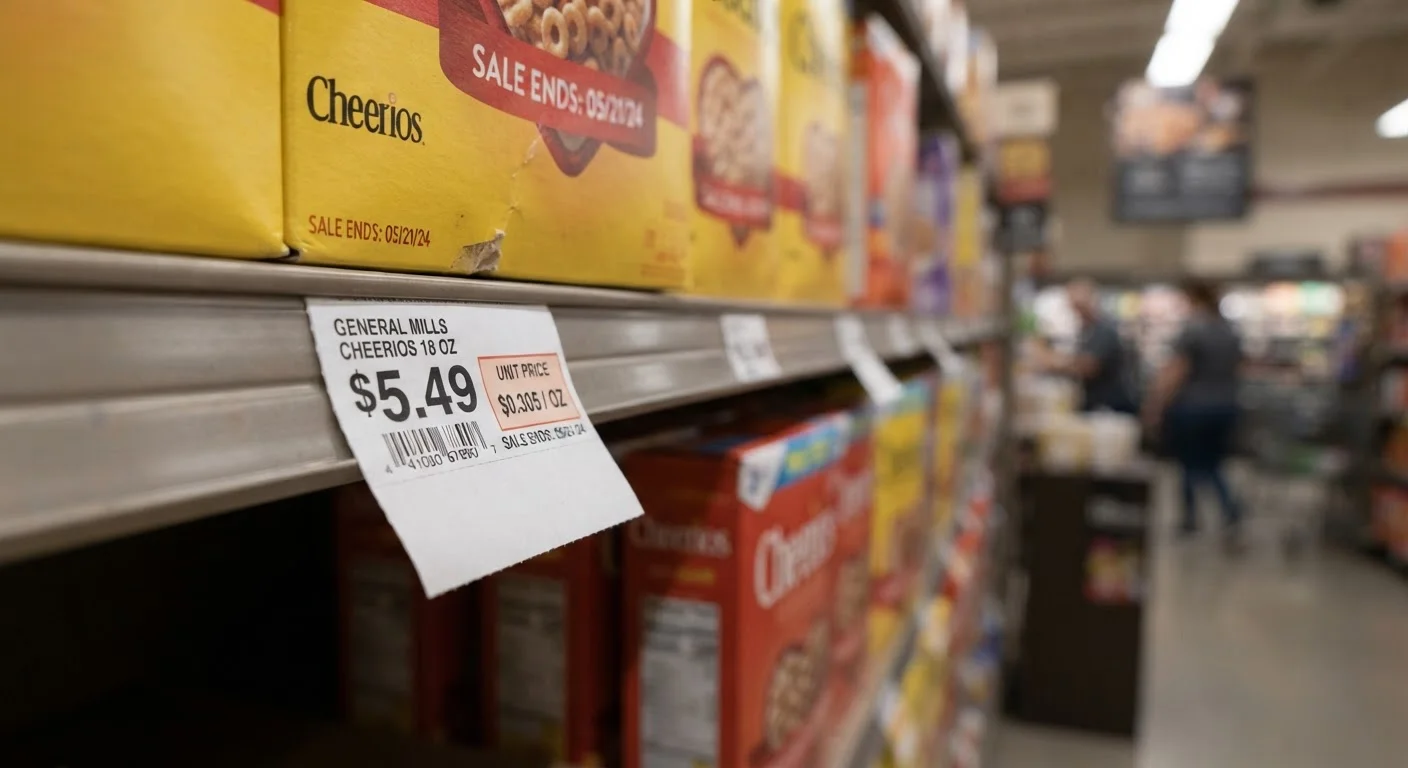
A standard U.S. grocery shelf tag typically contains: the product name, the total retail price (large font), and the unit price (smaller font, often in the upper corner). The unit price will read something like $0.29/oz or $1.14/lb or $0.08/ct (per count).
To use it effectively:
- Identify the unit of measure. Confirm both products you're comparing use the same unit - ounces vs. ounces, not ounces vs. pounds.
- Look at unit price only. Ignore total price entirely during the comparison step.
- Lower unit price wins - assuming quality and format are equivalent for your needs.
Use Your Phone as a Backup Calculator
If unit prices are displayed in different units or the label is hard to read, open your phone's calculator and divide the total price by the total weight or count. The result is your own unit price - just as reliable as the shelf tag and useful when labels are missing or inconsistent.
One practical wrinkle: some shelf tags list unit price per 100g while others use per ounce. This happens when a store stocks both domestic and imported products. If you spot mixed units, use your phone's calculator: divide total price by total weight in a consistent unit to get your own comparison figure.
Unit pricing becomes especially powerful when evaluating store brands against name brands. Because the quality gap is often smaller than shoppers assume, the unit price difference frequently reflects branding cost more than product difference. What you're actually paying for with name brands breaks this down in detail.
Common Situations Where Unit Pricing Changes the Decision
Unit pricing isn't just for comparing two boxes of pasta. It applies across a wide range of everyday shopping decisions:
Bulk purchases: Warehouse stores are built around the assumption that bigger always means cheaper per unit. Often it does - but not universally. Perishables, items you rarely use, and products with short shelf lives can end up costing more overall even if the unit price is lower. When bulk buying actually saves money covers which categories genuinely benefit.
Convenience packaging: Single-serve portions, pre-cut produce, and individually wrapped snacks almost always carry a significant unit price premium. That cost is real and worth knowing, even if the convenience is sometimes worth it. The real cost of convenience packaging puts numbers around this trade-off.
Unit pricing also connects directly to how you build a grocery budget. If you're tracking spending by category, knowing your cost-per-unit on staples gives you a reliable baseline. Budgeting basics offers a framework for putting that into practice.
Limitations to Keep in Mind
Unit pricing is a powerful tool, but it has real limits that are worth acknowledging:
- Quality isn't captured. Two products can share an identical unit price but differ meaningfully in concentration, quality, or formulation. A cleaning product that requires twice the amount per use effectively costs twice as much in practice, regardless of the shelf tag.
- Unit measures aren't always standardized. As noted, different products on the same shelf may be priced in different units. Retailers aren't always required to harmonize these, so cross-category comparisons take more effort.
- Sales can complicate the picture. A sale price on a smaller size might temporarily undercut the unit price of a larger size. Check the sale tag's unit price, not just the discount percentage.
- Waste matters. If you buy a larger size to get a lower unit price but don't use all of it before expiration, the effective cost per used unit rises. Factor realistic usage into the decision.
Concentration Matters for Liquid Products
For products like dish soap, laundry detergent, or juice concentrate, unit price alone doesn't tell the full story. A concentrated formula may have a higher unit price per ounce but require far less per use, making it effectively cheaper. Check the label for dilution or dosage instructions before treating unit price as the final word.
Used with these caveats in mind, unit pricing remains one of the most straightforward, bias-free ways to evaluate grocery value. It requires no app, no membership, and no coupon - just a quick glance at the number already printed on the shelf.