

Key Takeaways
Option A
Name Brands
The familiar, heavily marketed standard.
Best for: Consumers who prioritize consistency, brand loyalty, or specific formulations not replicated elsewhere.
Option B
Store Brands
The private-label value alternative.
Best for: Budget-conscious shoppers who want comparable quality without paying for national advertising.
If you want to cut grocery bills without sacrificing quality
Store Brands
Pantry staples like flour, sugar, canned vegetables, and dried pasta are almost always equivalent in formulation - the savings are real and consistent.
If you rely on over-the-counter medications
Store Brands
Generic OTC drugs are required by the FDA to contain the same active ingredients and dosage as their name-brand counterparts.
If the specific formulation or flavor profile is important to you
Name Brands
Some name-brand products use proprietary blends, unique processing methods, or flavor profiles that private-label versions don't fully replicate.
If you're shopping for baby formula or infant products
Name Brands
While store-brand formulas meet FDA standards, parents may prefer to consult a pediatrician before switching, as formulation details can vary.
If you're managing a household budget across multiple categories
Store Brands
Selectively switching high-consumption staples to store brands can produce meaningful annual savings without noticeable quality trade-offs.
Where the Price Difference Actually Comes From
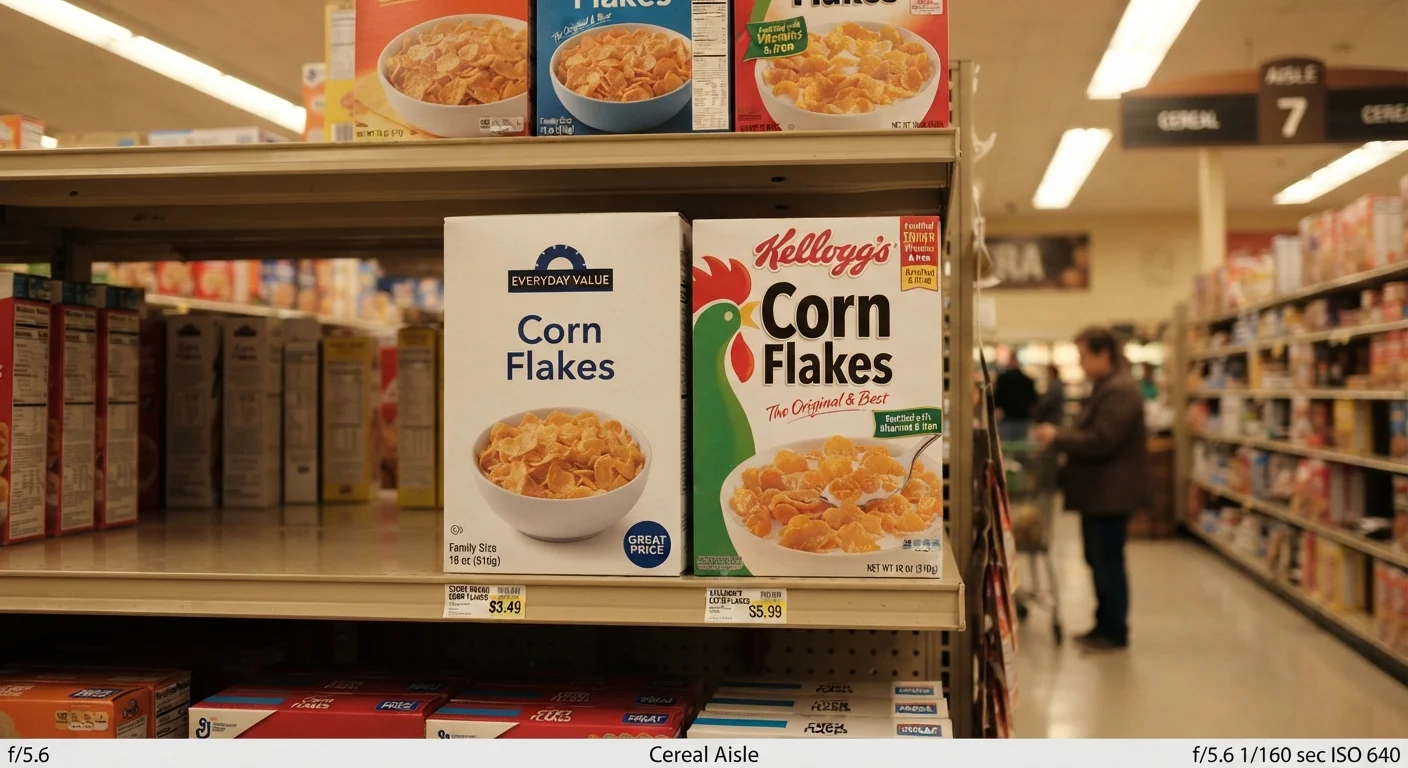
When you pick up a name-brand product, you're paying for more than what's inside the package. National brands invest heavily in television commercials, digital advertising, slotting fees (the cost to secure prominent shelf placement), and coupon programs. These costs are built into the retail price - often accounting for a substantial portion of the premium over store-brand equivalents.
Store brands, also called private-label products, skip most of that overhead. Retailers develop them under their own label, negotiate directly with manufacturers, and rarely run national ad campaigns. That structural difference is the primary driver of the price gap - not a difference in raw materials or production standards.
It's worth knowing that many store-brand products are produced by the same contract manufacturers that supply name-brand lines. A factory may run national-brand cereal on one shift and a retailer's private-label version on the next, using nearly identical formulas. This isn't universal, but it's common enough across grocery, personal care, and household cleaning categories to be worth factoring into your decisions.
| Criterion | Name Brands | Store Brands |
|---|---|---|
| Price | Higher (includes ad spend) | Lower (less overhead) |
| OTC Drug Equivalence | FDA-regulated standard | Same FDA standard required |
| Ingredient Transparency | Varies by product | Varies by product |
| Manufacturing Source | Brand-owned or contracted | Often same contract factories |
| Marketing Investment | High (built into price) | Minimal |
| Specialty Formulations | More common | Less common |
| Shelf Variety | Multiple SKUs and sizes | Typically fewer options |
| Warranty / Support (electronics) | Established infrastructure | Varies widely |
Categories Where Store Brands Consistently Hold Up
Not every aisle is equal when it comes to store-brand reliability. The strongest cases are categories where the product is essentially a commodity - where formulation is simple, regulated, or straightforward to replicate.
- Over-the-counter medications: Generic OTC drugs (pain relievers, antacids, allergy tablets) must meet the same FDA standards as name brands for active ingredient identity, strength, and dosage. The inactive ingredients may differ slightly, but the therapeutic component is equivalent by regulatory requirement.
- Pantry staples: All-purpose flour, white sugar, salt, canned tomatoes, dried beans - these products have little room for meaningful variation. Store brands in this category are a straightforward swap.
- Paper goods and cleaning supplies: Performance varies by specific product, but store-brand dish soap, paper towels, and trash bags are frequently competitive with name-brand versions on core function.
- Frozen vegetables: Nutritional content and quality are largely determined by the freezing process, not the label. Store brands in this category are generally on par.
For a deeper look at how to evaluate what's actually in a product, reading an ingredient list can help you compare labels directly rather than relying on brand reputation.
~20-25%
Typical store-brand price discount vs. name brands
Industry analyses of grocery retail consistently find private-label products priced roughly 20-25% lower than national brand equivalents on average.
~40%
Share of U.S. grocery units sold as private label
Private Label Manufacturers Association data has shown store brands accounting for roughly four in ten units sold across U.S. grocery channels.
Same active ingredient
Generic OTC drug requirement under FDA rules
The FDA requires generic over-the-counter drugs to contain the same active ingredient, strength, and dosage form as their brand-name counterparts.
When the Name Brand May Actually Matter
There are categories where the name-brand premium reflects something tangible - proprietary processes, tightly controlled sourcing, or formulations that are genuinely harder to replicate at lower cost.
- Specialty or imported foods: A regional cheese, a specific hot sauce, or an artisan condiment may have no true store-brand equivalent. Here, the name brand isn't just marketing - it's the product.
- Personal care with active ingredients: Some dermatologist-recommended skin care products use patented delivery systems or clinically studied concentrations of active compounds. A store-brand lookalike may use the same ingredient at a lower concentration or in a less effective vehicle.
- Complex electronics and appliances: For higher-stakes purchases, warranty coverage, parts availability, and long-term reliability become part of the value equation - and established brands often have more accountable support infrastructure.
- Infant formula: Store-brand formulas must meet FDA nutritional requirements, but the formulation details can vary. Parents should consult a pediatrician before switching a baby's formula.
The honest rule of thumb: the more a product relies on a unique process, clinically validated formulation, or long-term durability, the more worth evaluating whether the name-brand version delivers something the store brand can't.
Understanding how pricing signals are constructed also helps here. What 'Sale' actually means explores how reference pricing works - useful context for evaluating whether a name-brand markdown truly closes the gap with store alternatives.
A Note on 'Premium' Store Brands
Many large retailers now offer tiered private-label lines - a budget tier, a standard tier, and a premium or 'natural' tier. The premium store-brand line may be priced close to, or even above, some name-brand products. The same ingredient-comparison logic applies: check the label, not just the price point, before assuming a premium private-label product is the better value.
Building a Smarter Mixed Strategy
The most practical approach isn't store brand always or name brand always - it's category-by-category judgment informed by what you actually know about each product type.
Start by identifying your highest-volume, highest-frequency purchases. Household staples you buy every week are where selective switching pays off most. Then use the ingredient list as your benchmark: if the active or primary ingredients match, the case for spending more is thin.
Unit pricing is another tool that changes the calculus - it lets you compare true cost per ounce or per unit across both store and name-brand options, stripping out package-size distortions.
For high-volume categories where you're considering buying larger quantities, buying in bulk pairs naturally with store-brand switching - but only when the product has a long shelf life and you're confident in the quality.
Finally, recognize that brand loyalty built up over years is partly a function of familiarity, not verified superiority. Many shoppers who try store-brand equivalents find they notice no difference at all - the adjustment period is usually shorter than expected.
This article is for general informational purposes only. For decisions involving medications, infant nutrition, or personal health products, consult a qualified healthcare professional.