

Key Takeaways
Option A
Actual Cash Value (ACV)
The depreciation-adjusted payout option.
Best for: Policyholders willing to accept lower claim payouts in exchange for lower monthly premiums.
Option B
Replacement Cost Value (RCV)
The full-replacement payout option.
Best for: Homeowners and renters who want to fully restore their property after a loss without covering a depreciation gap out of pocket.
If you want to minimize monthly premium costs
Actual Cash Value (ACV)
ACV policies generally carry lower premiums, making them a budget-friendlier option if you can absorb a larger out-of-pocket cost after a loss.
If you want to fully restore your home or belongings after a covered loss
Replacement Cost Value (RCV)
RCV coverage closes the depreciation gap, meaning you receive enough to buy a comparable new item rather than being left to fund the difference yourself.
If your property is older or heavily depreciated
Replacement Cost Value (RCV)
Older items carry steep depreciation, so an ACV payout on aging appliances, a roof, or electronics may cover only a fraction of what replacement actually costs.
If you are insuring lower-value personal property with short useful life
Actual Cash Value (ACV)
For items you plan to replace anyway or that hold minimal residual value, the premium savings from ACV coverage may outweigh the smaller payout difference.
What Actual Cash Value Means in Practice
Actual Cash Value (ACV) is a loss valuation method that factors in depreciation - the reduction in an item's value over time due to age, wear, and obsolescence. When you file a claim under an ACV policy, your insurer estimates what the damaged or destroyed property was worth just before the loss occurred, not what it would cost to replace it today.
For example, if a five-year-old television is destroyed in a covered event, the insurer does not pay for a brand-new equivalent. Instead, it calculates the original value minus depreciation for those five years. Depending on the depreciation schedule applied, you might receive a fraction of what a replacement actually costs at a store today.
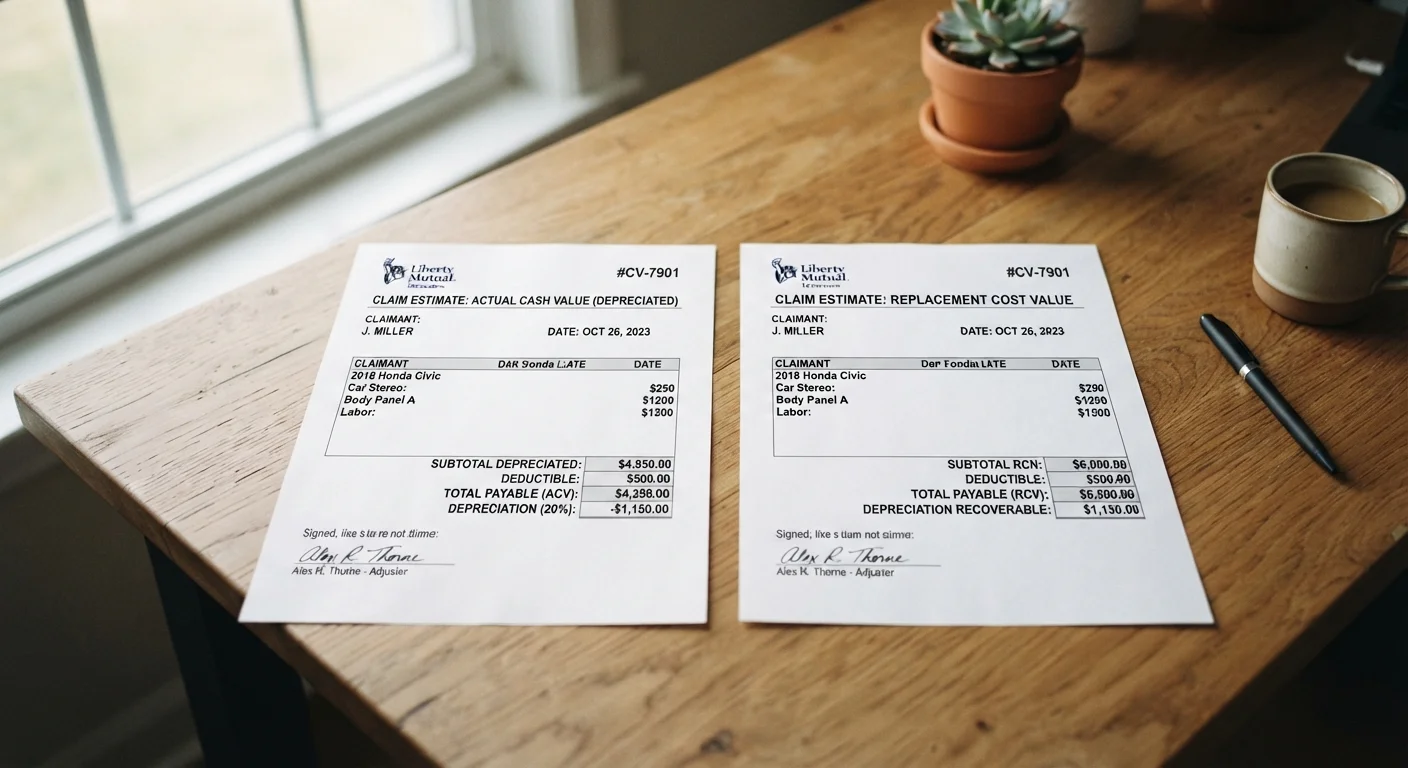
ACV is commonly the default valuation method in many standard policies, particularly for personal property coverage within homeowners and renters insurance. It also appears frequently in auto insurance, where a totaled vehicle is reimbursed at its fair market value - not dealer replacement price. See the depreciation and payout breakdown for a closer look at how these calculations work on specific claim types.
Depreciation Is Not Standardized Across Insurers
Different insurers use different depreciation schedules and calculation methods, which means two ACV policies can produce different payouts for the identical loss. Factors like property age, condition, and category all influence the depreciation rate applied. When reviewing or comparing policies, ask specifically how depreciation is calculated for the property types most important to you.
What Replacement Cost Value Means in Practice
Replacement Cost Value (RCV) covers the cost to repair or replace damaged property with a new item of similar kind and quality - at today's prices, without deducting for depreciation. If that same five-year-old television is destroyed, an RCV policy pays what a comparable new model costs right now.
This method better protects your ability to return to your pre-loss situation without contributing extra money out of pocket. For homeowners, RCV is especially significant on structural components like roofs, HVAC systems, and flooring, where depreciation can be substantial and replacement costs high.
RCV coverage typically comes with a higher premium than ACV because the insurer's maximum exposure per claim is greater. Some policies also include a provision where the insurer initially pays ACV and then releases the remaining depreciation amount - called the recoverable depreciation - once you provide receipts showing the replacement has been made. Understanding this distinction matters significantly when filing a claim for the first time.
~20-40%
Typical depreciation on a 10-year-old roof
Insurance industry depreciation schedules commonly reduce claim payouts on aging roofs by 20-40%, illustrating the gap ACV policyholders may face.
Varies widely
Premium difference between ACV and RCV
The cost difference between ACV and RCV coverage depends on property type, age, and insurer; policyholders should request quotes for both to compare actual figures.
Comparing ACV and RCV Side by Side
The table below contrasts the two valuation methods across the criteria that most directly affect your financial outcome after a covered loss. Both approaches are legitimate; the right choice depends on your property's age, your premium budget, and your capacity to absorb an out-of-pocket gap if a loss occurs.
| Criterion | Actual Cash Value (ACV) | Replacement Cost Value (RCV) |
|---|---|---|
| Payout basis | Depreciated value at time of loss | Cost to replace with new equivalent today |
| Depreciation deducted | Yes - reduces claim payout | No - full replacement covered |
| Typical premium cost | Lower | Higher |
| Out-of-pocket gap after loss | Potentially significant | Minimal to none |
| Best for older property | No - depreciation gap widens with age | Yes - full replacement regardless of age |
| Common policy types | Standard home, renters, auto | Enhanced home and renters policies |
For a broader view of how valuation choices fit into overall policy decisions, the guide on evaluating insurance value covers how coverage depth, cost, and trade-offs interact across policy types.
Choosing the Right Method for Your Situation
Neither ACV nor RCV is universally superior - the better option depends on your specific financial situation and risk tolerance. If your property is relatively new and high in value, the premium difference for RCV coverage may be well worth the added protection. If your belongings are already significantly depreciated or you carry a robust emergency fund, ACV's lower premium may be the more efficient choice.
Check your existing policy declarations page for the exact language used - terms like "replacement cost," "actual cash value," or "fair market value" signal which method applies. If the language is unclear, ask your insurer or a licensed insurance agent for a plain-language explanation before a loss makes the difference urgent.
This decision also intersects with your overall coverage strategy. The article on weighing lower premiums against risk exposure provides a useful framework for thinking through these cost-versus-protection trade-offs across your full insurance picture.
This article is for general informational and educational purposes only and does not constitute personalized insurance, financial, or legal advice. Coverage terms, valuations, and eligibility vary by insurer and state. Always review your actual policy documents and consult a licensed insurance professional before making coverage decisions.