

Key Takeaways
Our Verdict
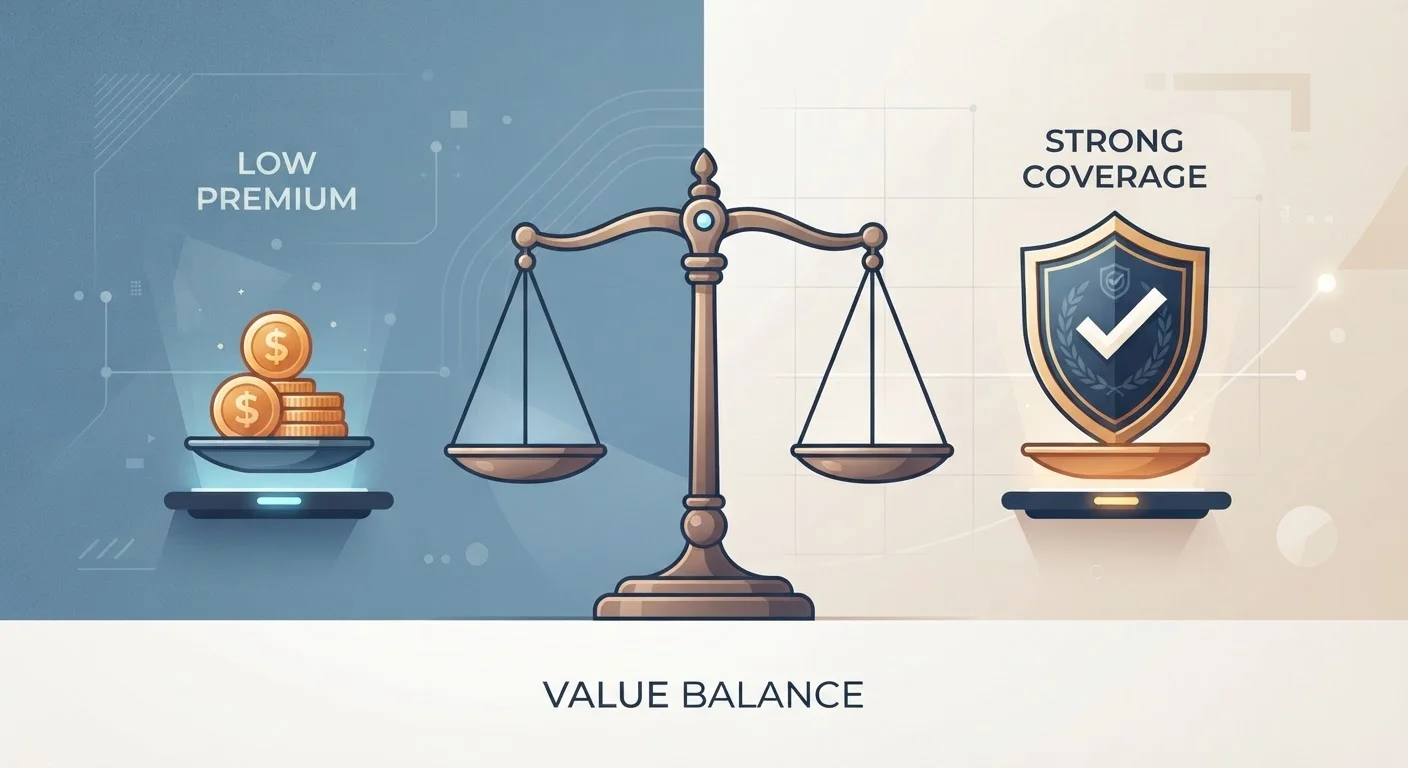
Neither a low-premium nor a high-premium policy is universally better - the right choice depends entirely on your financial resilience and the likelihood of a claim. Consumers with robust emergency savings and low asset exposure can often afford to carry more risk. Those with significant assets, dependents, or limited liquid savings generally benefit from broader coverage, even at a higher monthly cost.
| Best for | Recommended |
|---|---|
| Healthy individuals with substantial emergency savings and low asset exposure | Lower premium, higher deductible approach |
| Homeowners, families, or those with significant assets to protect | Higher premium, broader coverage approach |
| Those in transitional life stages reassessing coverage needs | Annual policy review with a licensed insurance agent |
The Core Trade-Off: What You Pay Now vs. What You Owe Later
Every insurance policy is essentially a contract about who absorbs financial risk. When you pay a higher premium, you're transferring more risk to the insurer. When you lower your premium - by raising your deductible, reducing coverage limits, or choosing a stripped-down policy - you're keeping more of that risk yourself. Neither arrangement is wrong. What matters is whether the risk you're retaining is one you can actually absorb financially.
Think of it this way: a lower premium feels like savings every month, but it only stays that way if you never file a claim. The moment something goes wrong - a car accident, a burst pipe, a medical emergency - the gap between what your policy covers and what you owe out-of-pocket becomes very real. For a deeper look at how gaps in coverage translate to dollar losses, see the real cost of a cheap insurance policy.
| Lower Premium Approach | Higher Premium Approach | |
|---|---|---|
| Monthly cost | Lower, predictable savings | Higher, ongoing expense |
| Out-of-pocket at claim time | Higher deductibles or uncovered losses | Lower due to broader coverage |
| Best suited for | Strong savings, low asset exposure | Significant assets or dependents |
| Coverage limits | Often reduced to cut costs | Maintained at protective levels |
| Risk of financial shortfall after claim | Higher if claim is large | Lower; insurer absorbs more |
| Requires emergency fund buffer | Yes - essential to this approach | Less critical, but still advisable |
The Three Levers That Lower Your Premium - and What Each One Costs You
Understanding where premium savings actually come from helps you make sharper decisions. There are three primary mechanisms insurers use, and each shifts risk back to you in a distinct way.
- Higher deductibles: A deductible is the amount you pay out-of-pocket before your insurer steps in. Raising your deductible from $500 to $2,000 on an auto or homeowners policy can meaningfully reduce your premium - but it means you absorb the first $2,000 of any covered loss. If your emergency fund can't cover that gap comfortably, the savings may be illusory. See who high-deductible plans actually suit for a full breakdown.
- Lower coverage limits: Reducing the maximum your policy will pay - say, dropping liability limits on an auto policy - lowers your premium but leaves you exposed if a claim exceeds that cap. In a serious accident, the gap between your limit and the actual damages becomes your personal liability.
- Actual cash value vs. replacement cost: Choosing actual cash value (ACV) coverage instead of replacement cost coverage cuts your premium but means a claim payout reflects depreciation, not what it costs to replace the item today. A ten-year-old roof replaced under ACV coverage may receive far less than a new roof costs. Actual cash value vs. replacement cost coverage explains how this affects real claim outcomes.
Run Your Own Worst-Case Scenario
Before finalizing any policy, calculate the maximum you could owe out-of-pocket if you filed a large claim tomorrow. Add your deductible to any uncovered costs given your current limits. Then compare that number to your liquid savings. If the math doesn't work, the premium savings may not be worth it.
How to Size the Risk You Can Actually Afford to Keep
The central question isn't which policy is cheaper - it's how much financial exposure you can absorb without derailing your stability. A practical starting point: identify your worst-case out-of-pocket scenario for each policy you hold, then compare that number to your liquid savings.
If your emergency fund covers three to six months of expenses and your maximum deductible, carrying a higher deductible is usually manageable. If a single large claim would force you to borrow money or liquidate investments, that's a sign your coverage limits may be too low for your actual financial position.
Your risk exposure also shifts over time. Younger renters with few assets are in a very different position than homeowners approaching retirement with equity to protect. Evaluating insurance value offers a useful framework for reassessing that balance at different life stages. To understand how insurers calculate your rate in the first place, see how insurers determine risk and what that means for your rate.
40%
Americans who couldn't cover a $400 emergency
Federal Reserve surveys have consistently found that a significant share of U.S. adults would struggle to cover a modest unexpected expense - underscoring why deductible size matters.
2-3x
Typical deductible-to-savings gap for underinsured households
Consumer financial research suggests many households carry deductibles that exceed their available liquid savings, leaving them exposed in the event of a mid-sized claim.
When the Lower Premium Is the Smarter Choice - and When It Isn't
There are genuine situations where accepting more risk in exchange for a lower premium makes financial sense. If you have strong liquid savings, a low-asset profile, and a statistically lower likelihood of filing a claim, keeping more risk yourself can be a rational decision - particularly if the premium savings are redirected into an emergency fund or other financial buffer.
However, the lower-premium path tends to backfire for several profiles: those with significant assets (home equity, investments, business property) that could be reached in a liability claim; families with dependents who rely on uninterrupted income; and anyone whose savings couldn't absorb the maximum deductible without financial strain. In these cases, the monthly savings rarely justify the potential exposure.
It's also worth considering that some policies can be adjusted without simply gutting coverage. Bundling home and auto policies, for instance, can lower combined premiums without reducing individual coverage limits - how bundling affects your total coverage picture covers both the advantages and the concentration risk that comes with it.
This article provides general insurance education and is not personalized financial or insurance advice. Coverage terms, eligibility, and pricing vary by insurer, policy type, and state. Consult a licensed insurance agent or adviser to evaluate options appropriate to your specific situation.