

Key Takeaways
Option A
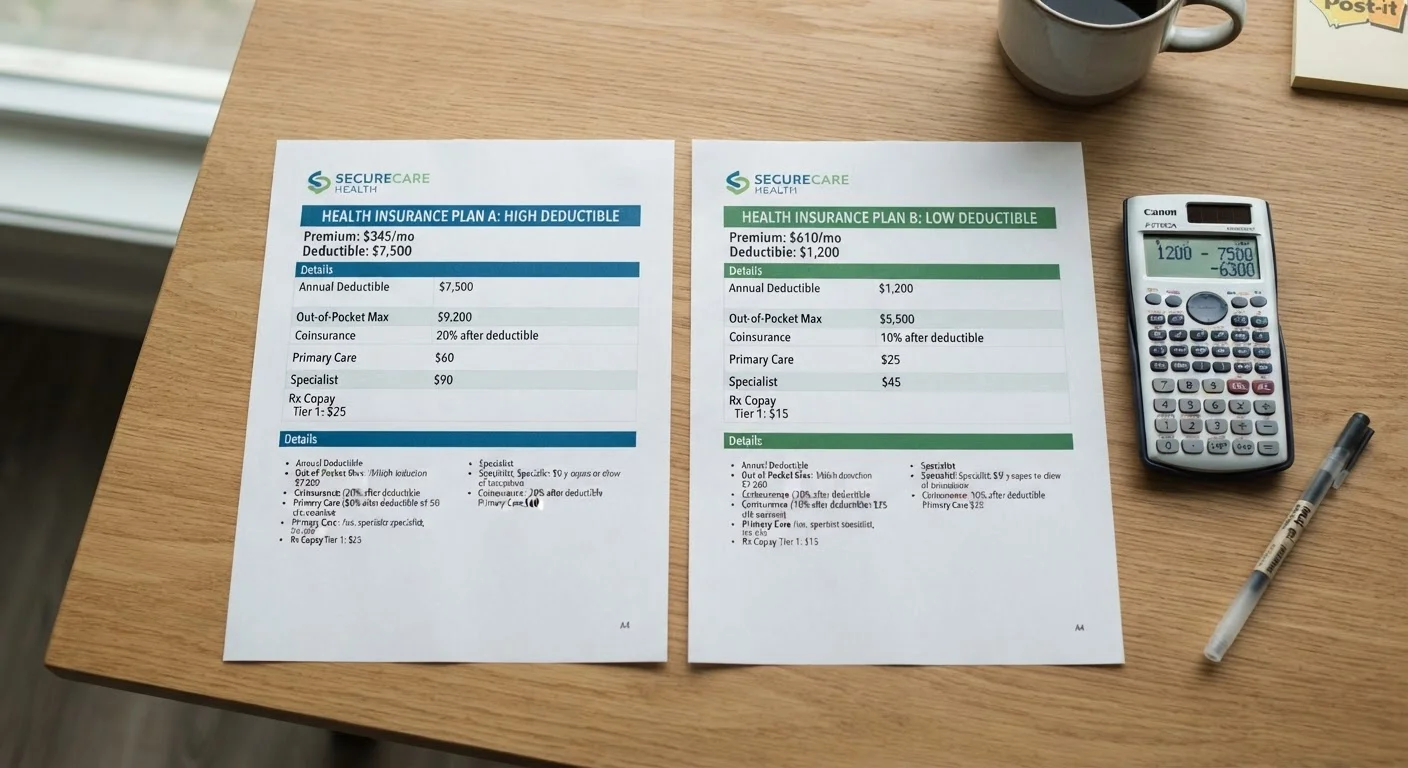
High-Deductible Health Plan (HDHP)
Lower monthly premiums, higher out-of-pocket costs before coverage kicks in.
Best for: Generally healthy individuals who want to lower monthly costs and can absorb higher expenses if an unexpected medical need arises.
Option B
Low-Deductible Health Plan
Higher monthly premiums, but insurance covers costs sooner.
Best for: People with ongoing medical needs, prescriptions, or dependents who want more predictable and immediate cost-sharing from their insurer.
If you rarely visit the doctor and have stable finances
High-Deductible Health Plan (HDHP)
You'll save on monthly premiums and can use an HSA to build a tax-advantaged reserve for future medical costs.
If you manage a chronic condition or take regular prescriptions
Low-Deductible Health Plan
Frequent healthcare use means your insurer will start sharing costs sooner, reducing the total you pay across the year.
If you have children or a family with varied health needs
Low-Deductible Health Plan
Families tend to use healthcare more often; a lower deductible limits cumulative out-of-pocket costs across multiple members.
If you want to build long-term healthcare savings
High-Deductible Health Plan (HDHP)
Only HDHPs allow HSA contributions, which grow tax-free and can be used for qualified medical expenses now or in retirement.
If you have limited emergency savings and worry about unexpected bills
Low-Deductible Health Plan
A large unexpected deductible can cause serious financial strain; paying more monthly may be the safer trade-off for your budget.
What a Deductible Actually Does
A deductible is the dollar amount you must pay for covered healthcare services before your insurance company begins sharing costs. If your deductible is $1,500, you pay the first $1,500 of eligible medical expenses each plan year - then your insurer steps in, typically covering a percentage of costs alongside your copay or coinsurance obligations.
Understanding this mechanic is foundational. As our guide on premiums, deductibles, and copays explains, these three numbers together determine what you actually pay - not just what your plan appears to cost on paper.
Deductibles reset at the start of each plan year, meaning the clock starts over regardless of how much you paid the year before. Most preventive services - annual physicals, screenings - are typically covered before you meet your deductible, but treatment for illness or injury usually is not.
| Criterion | High-Deductible Plan (HDHP) | Low-Deductible Plan |
|---|---|---|
| Monthly premium | Lower | Higher |
| Deductible amount | Higher (e.g., $1,600-$5,000+) | Lower (e.g., $250-$1,000) |
| When insurer shares costs | After higher threshold is met | Sooner, after lower threshold |
| HSA eligibility | Yes, if IRS-qualified | No |
| Best for infrequent care users | Yes | Less so |
| Best for chronic conditions | Potentially costly | Often more cost-effective |
| Financial risk if hospitalized | Higher out-of-pocket exposure | Lower out-of-pocket exposure |
| Predictability of costs | Less predictable | More predictable |
The Core Trade-Off: Premium vs. Risk
Choosing between a high and low deductible is fundamentally a bet on how much healthcare you'll use. The relationship is inverse: the higher your deductible, the lower your monthly premium tends to be, and vice versa. This is the central tension covered in detail in our article on the deductible vs. premium trade-off.
~55%
Workers enrolled in high-deductible plans
According to KFF's Employer Health Benefits Survey, roughly 55% of covered workers were enrolled in a plan with a general annual deductible of $1,000 or more for single coverage.
$1,735
Average single deductible for HDHP enrollees
KFF data shows that average deductibles for workers in high-deductible plans with a savings option have risen steadily over the past decade.
3-in-10
Adults report difficulty affording unexpected medical bill
A KFF Health Care Debt Survey found that a significant share of U.S. adults struggle with unexpected healthcare costs, underscoring the importance of deductible planning.
A high-deductible plan shifts financial risk to you. If you stay healthy and rarely need care beyond preventive visits, you come out ahead - you've paid less in premiums and haven't triggered significant out-of-pocket costs. But if you face a hospitalization, surgery, or ongoing treatment, you're responsible for a larger share before coverage activates.
A low-deductible plan does the opposite: you pay more every month in exchange for the insurer sharing costs sooner. For someone with predictable recurring medical expenses, this often produces a lower total annual cost despite the higher premium. See how low premiums can mask high out-of-pocket exposure for a fuller picture of that calculation.
The HSA Advantage: A Feature Exclusive to HDHPs
One meaningful benefit of a qualifying high-deductible plan is HSA eligibility. A Health Savings Account (HSA) lets you contribute pre-tax dollars that can be used for qualified medical expenses - and unlike a Flexible Spending Account (FSA), unused HSA funds roll over indefinitely and can even be invested.
For the IRS to classify your plan as an HDHP and make you HSA-eligible, your deductible must meet minimum thresholds that are adjusted periodically. Because HSA contributions reduce your taxable income and withdrawals for medical expenses are tax-free, they can meaningfully offset the higher out-of-pocket exposure of an HDHP over time.
HSA Contribution Limits Change Annually
The IRS sets HSA contribution limits each year, along with the minimum deductible and maximum out-of-pocket thresholds a plan must have to qualify. These figures are updated periodically for inflation. Before assuming your plan qualifies, verify its deductible meets the current IRS threshold for HDHP designation. A licensed benefits adviser or your plan documents can confirm eligibility.
This triple tax advantage - contributions go in pre-tax, grow tax-free, and come out tax-free for medical use - makes HSAs one of the more efficient tools available for managing healthcare costs. If you're exploring how this fits into broader financial planning, our hub on saving and debt offers relevant context.
How to Decide Which Plan Fits Your Situation
The most useful question isn't which plan is cheaper on paper - it's which plan costs less given how you actually use healthcare. Start by estimating your typical annual medical expenses: prescription costs, specialist visits, any procedures you anticipate. Then compare your total annual cost under each plan type by adding premiums to expected out-of-pocket spending.
Your savings buffer matters just as much as your health history. If you don't have an emergency fund capable of covering a $3,000 or $5,000 deductible, a high-deductible plan carries real financial risk - even if your health is generally good. The premium vs. risk trade-off isn't purely medical; it's also a question of financial resilience. Our budgeting basics hub can help you assess where your finances stand before committing to a plan.
For a fuller understanding of how all these pieces fit together - networks, copays, out-of-pocket maximums - health insurance explained walks through the complete picture.
This article is for general informational purposes only and does not constitute personalized financial, insurance, or medical advice. Coverage terms, deductible thresholds, and eligibility rules vary by plan and provider. Always review your actual policy documents and consult a licensed insurance professional before making coverage decisions.