

Key Takeaways
Risk-Return Tradeoff
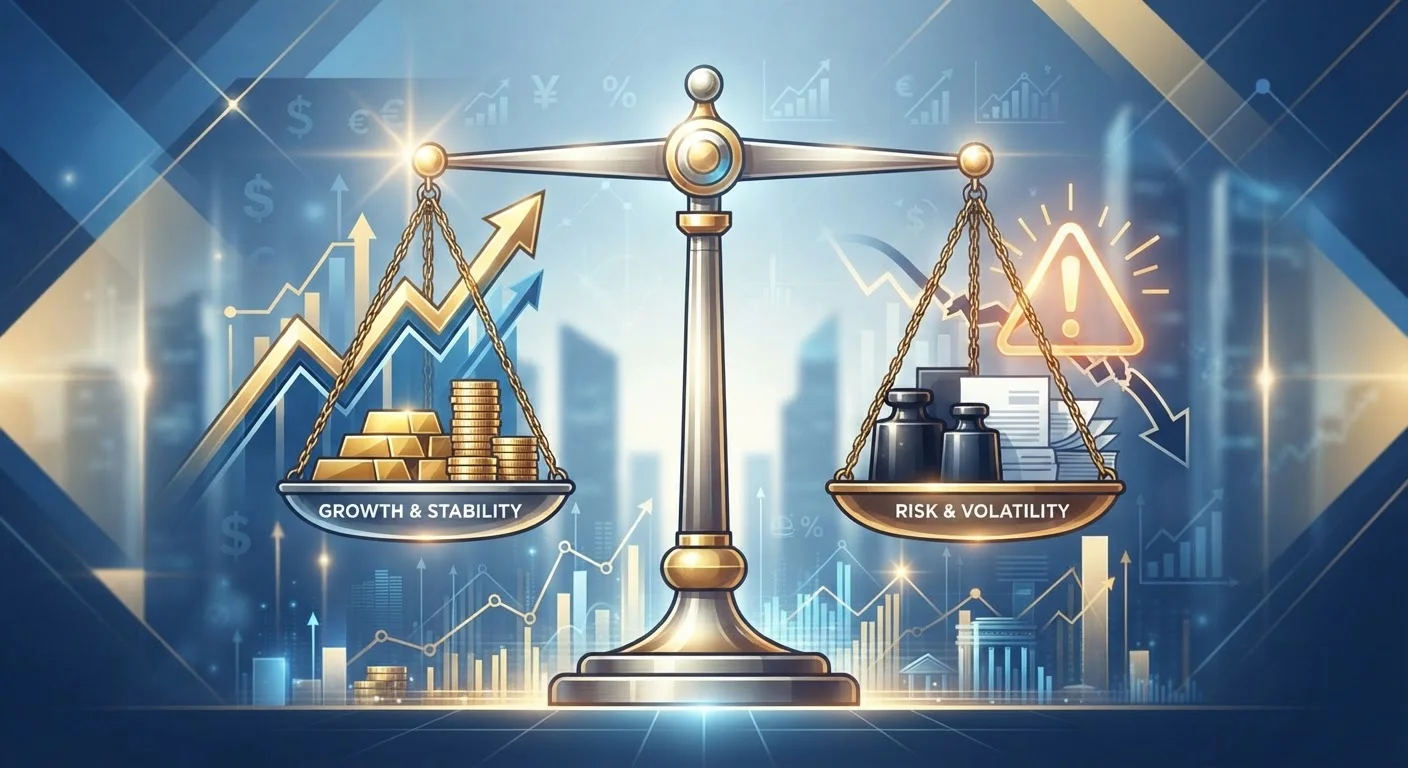
The risk-return tradeoff is the principle that higher potential investment returns come with higher potential for loss. In other words, to earn more, you generally have to accept more uncertainty. This relationship is one of the most fundamental concepts in personal finance and investing.
In portfolio theory, this relationship is often quantified using metrics like standard deviation (a measure of volatility) and the Sharpe ratio, which evaluates return relative to risk taken.
The Core Principle: No Free Lunch in Investing
One of the oldest and most reliable truths in finance is that risk and return move together. When someone promises high returns with little or no risk, that's a warning sign - not an opportunity. The relationship between the two is not a flaw in the system; it's how the system functions.
At its simplest: the more uncertain an investment's outcome, the more potential return it must offer to attract investors. A U.S. Treasury bond is considered very low risk because the federal government is highly unlikely to default - so it pays a modest interest rate. A startup company's stock, by contrast, could double in value or become worthless, so investors expect the possibility of much larger gains to justify holding it.
This isn't a theory reserved for Wall Street analysts. It's a practical reality that every investor - from someone opening their first brokerage account to a retiree reviewing a 401(k) - navigates constantly. See our overview of stocks, bonds, and mutual funds for a look at how different asset classes sit along the risk-return spectrum.
~10%
Average annual U.S. stock market return (historical)
The broad U.S. stock market has historically averaged roughly 10% annually before inflation - but with significant year-to-year swings, illustrating that higher average returns come with higher variability.
3%-5%
Typical long-term U.S. Treasury bond yield range
Government bonds historically offer lower returns than stocks, reflecting their lower default risk - a textbook illustration of the risk-return tradeoff across asset classes.
Types of Risk Every Investor Should Recognize
Risk isn't a single, uniform concept. Several distinct types of risk can affect an investment's performance:
- Market risk: The overall market declines, pulling most investments down with it - a broad economic recession is a classic driver.
- Inflation risk: Your returns fail to outpace inflation, meaning your money loses purchasing power even if the account balance grows nominally.
- Concentration risk: Too much of your money is tied up in one company, sector, or asset class - if it underperforms, the damage to your portfolio is amplified.
- Liquidity risk: An investment cannot easily be converted to cash when needed, potentially forcing a sale at an unfavorable price.
- Default risk: A company or government borrower fails to repay bondholders as promised.
Understanding which types of risk apply to your holdings gives you a clearer picture of what you're actually taking on. Diversification is one of the primary tools investors use to manage concentration risk in particular.
Match Your Risk Level to Your Timeline
Before accepting any level of investment risk, ask yourself: when will I need this money? Funds needed within one to three years generally call for lower-risk, more stable placements. Money set aside for long-term goals like retirement may be better positioned to weather the volatility that often accompanies higher-return assets.
Time Horizon Changes the Equation
One of the most important variables in managing the risk-return relationship is time. An investor with 30 years until retirement can afford to ride out short-term market volatility in a way that someone retiring in two years simply cannot.
Historically, longer holding periods have tended to smooth out the peaks and valleys of volatile asset classes like stocks. That's not a guarantee - past performance does not predict future results - but it reflects why financial education consistently emphasizes aligning your investment mix with your timeline and goals, not just your appetite for excitement.
This is also why compound interest and long-term investing are so closely linked: time allows returns to build on themselves, which is most powerful when investors stay invested through periods of volatility rather than reacting to short-term swings.
“The desire for more income or a higher rate of return means the investor must seek out either longer maturities, lower-grade bonds, or stocks with more speculative characteristics - all of which carry greater risk.”
— Benjamin Graham, Author of 'The Intelligent Investor' and foundational figure in value investing
Applying the Risk-Return Principle to Your Own Decisions
Understanding this relationship in the abstract is useful. Applying it practically is where it counts. A few frameworks worth keeping in mind:
- Match risk to purpose. Money you may need within one to two years - an emergency fund, a down payment - generally belongs in lower-risk, more liquid holdings. Long-term goals like retirement can typically tolerate more volatility.
- Don't chase yield blindly. If an investment's return looks unusually high compared with alternatives carrying similar apparent risk, examine what risk you might be overlooking - not just the potential reward.
- Think in portfolios, not individual picks. The risk of any single investment matters less than how your overall collection of assets behaves together. A single high-risk holding in a diversified portfolio affects you very differently than the same holding representing your entire savings.
Risk-return thinking also extends beyond investing. For example, insurance decisions involve a similar cost-risk tradeoff - you can explore how that logic applies in weighing a lower premium against higher risk exposure.
This article is for general informational and educational purposes only and does not constitute personalized financial or investment advice. Consult a licensed financial adviser before making investment decisions based on your individual circumstances.