

Key Takeaways
How Minimum Payments Are Actually Calculated
Most credit card issuers calculate the minimum payment as either a flat dollar amount (commonly $25-$35) or a small percentage of your outstanding balance - typically 1% to 2% - plus any interest and fees accrued that month. Whichever figure is higher generally becomes your minimum due.
The catch is structural: as your balance declines, so does your minimum payment. This means you're never paying a stable, accelerating amount toward principal - you're on a declining treadmill. Each month your required payment shrinks alongside your balance, which sounds appealing but dramatically slows payoff. To understand why this matters in your broader financial picture, see our breakdown of how carrying a balance accumulates cost over time.
The Math That Makes Minimum Payments So Costly
Consider a concrete scenario: a $3,000 credit card balance at a 20% annual percentage rate (APR). If the minimum payment is set at 2% of the balance (or $25, whichever is greater), a borrower paying only that minimum would take approximately 15 to 17 years to pay off the balance - and would pay roughly $3,000 to $4,000 in interest alone, effectively doubling the original debt.
~17 years
Estimated payoff time on minimums alone
A $3,000 balance at 20% APR paid at a 2%-of-balance minimum takes roughly 15-17 years to eliminate, based on standard amortization calculations.
20%+
Average credit card APR in recent years
Federal Reserve data has shown average credit card interest rates exceeding 20% in recent periods, making minimum-only repayment especially costly.
~$1 in $3
Principal reduction in early minimum payments
In the early months of minimum-only repayment at high APRs, only a small fraction of each payment reduces principal - the rest covers interest charges.
This isn't a worst-case projection. It reflects how compound interest operates on revolving balances: interest accrues daily on the outstanding principal, and when only a fraction of that interest is being covered by the minimum, the remaining interest is added back to the balance. The mechanics of compounding on high-interest debt explain exactly why even a short delay in aggressive repayment has outsized consequences.
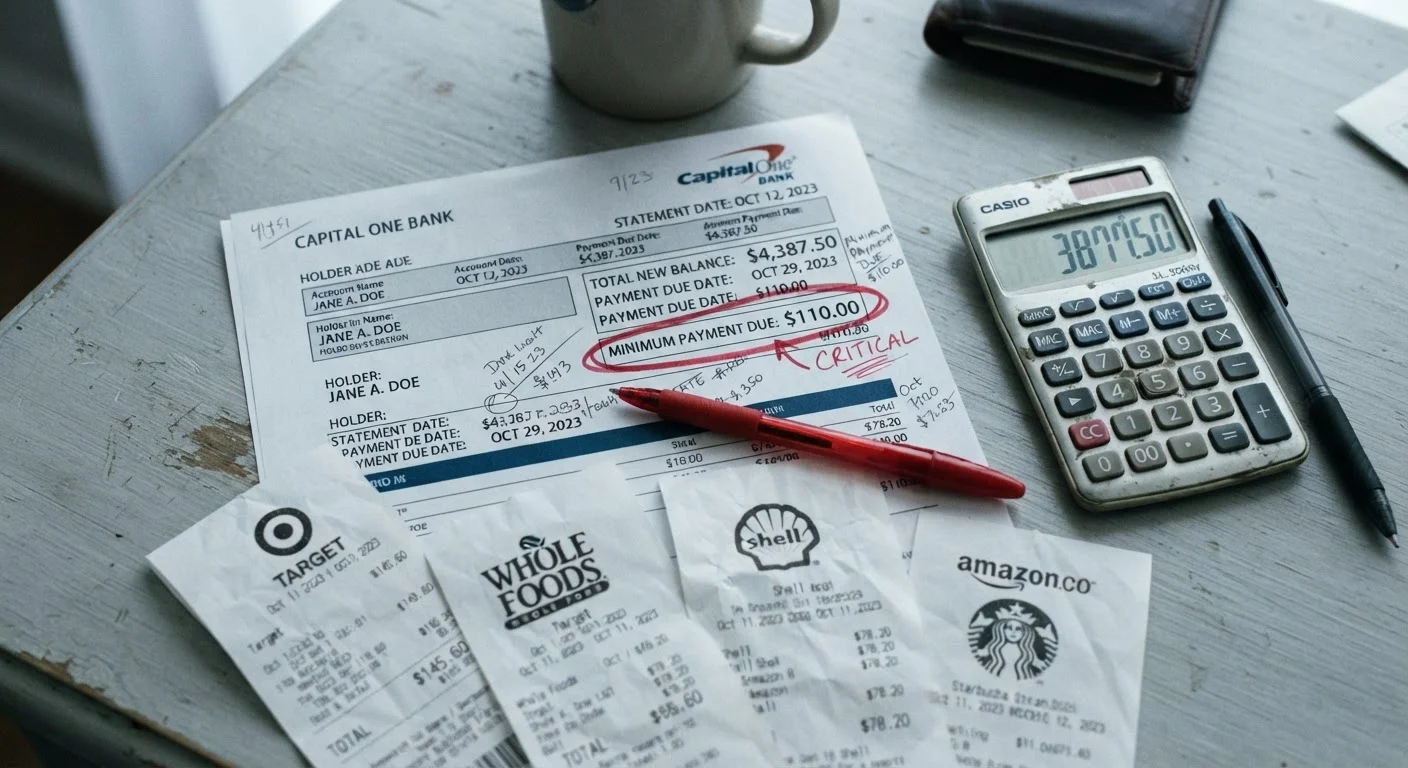
Under the Credit CARD Act of 2009, issuers are required to print a "minimum payment warning" on every statement showing how long repayment will take and the total interest paid if you only ever make the minimum. Most people overlook it - but it's one of the most useful numbers on the page.
Check Your Statement's Payoff Disclosure
Federal law requires credit card issuers to include a minimum payment warning on every statement. This box tells you exactly how many years it will take to pay off your balance making only minimum payments, and the total interest you will pay. Reviewing this figure each month is one of the most direct ways to stay motivated to pay more than the minimum.
Common Mistakes That Keep Borrowers Stuck
Understanding the math is one thing; recognizing the behavioral and situational errors that trap people in minimum-payment cycles is equally important.
Treating the minimum payment as the "right" payment amount.
Why it happens: The minimum is prominently displayed on statements, which leads many borrowers to interpret it as a recommended or sufficient amount rather than a lender-set floor.
Continuing to charge new purchases while making minimum payments on an existing balance.
Why it happens: Many cardholders compartmentalize - they feel the minimum "covers" the old balance while new spending is treated as separate, when in reality both compound together.
Ignoring the APR when deciding which balance to pay down first.
Why it happens: People naturally focus on the largest balance or the card with the most emotional weight, rather than the one accruing interest fastest.
Equating making payments on time with making financial progress.
Why it happens: On-time payment is rightly associated with good credit behavior, so it can create a false sense that the debt situation is under control even when the balance barely moves.
Deprioritizing debt repayment entirely in favor of saving.
Why it happens: The general advice to "always save" sometimes leads people to contribute to savings accounts earning 4% to 5% while carrying credit card debt at 20% or more - a net loss.
For those ready to move past minimums, choosing a structured payoff method can make a significant difference. Our guide to the debt avalanche vs. debt snowball walks through which approach may suit different financial situations. And if you're questioning assumptions you've held about debt, common debt myths corrected addresses several misconceptions that often prolong repayment unnecessarily.
For a comprehensive view of how debt cycles form and how to escape them, Your Complete Guide to Understanding and Escaping the Debt Cycle provides an end-to-end resource worth bookmarking.
This article is for general informational and educational purposes only and does not constitute personalized financial or legal advice. Consult a qualified financial professional regarding your specific circumstances.