

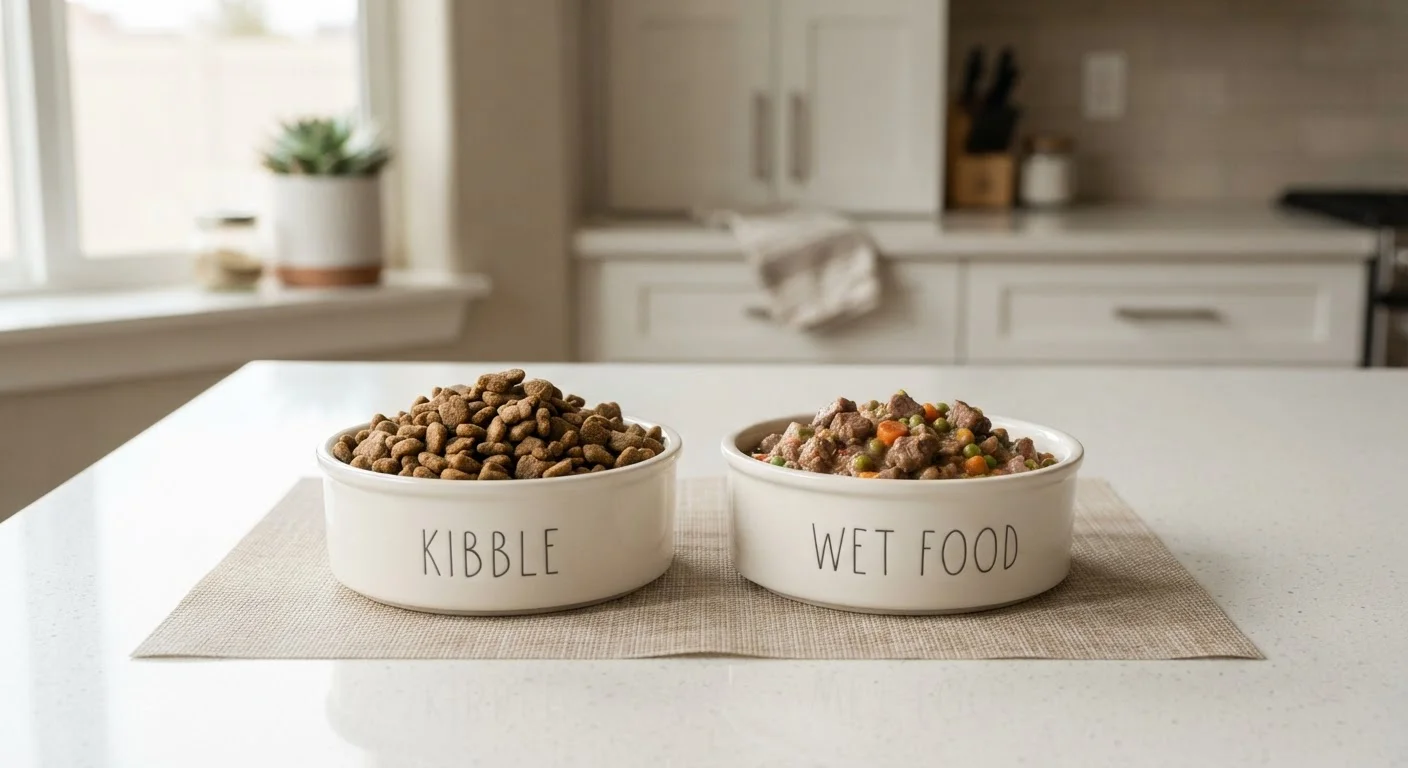
Key Takeaways
Option A
Dry Kibble
The convenient, calorie-dense everyday staple.
Best for: Pet owners seeking an affordable, shelf-stable option that supports dental abrasion and easy portion control.
Option B
Wet Food
The moisture-rich, palatable alternative.
Best for: Pets that need extra hydration, have dental problems, or require higher protein with lower carbohydrate content.
If your cat drinks very little water on its own
Wet Food
Cats have a low thirst drive by nature, and wet food's high moisture content significantly supports urinary tract health and overall hydration.
If you need an affordable, easy-to-store daily diet for a healthy adult dog
Dry Kibble
Dry kibble is cost-effective, shelf-stable, and easy to portion accurately - all practical advantages for everyday feeding routines.
If your pet is a senior with reduced appetite or dental discomfort
Wet Food
Wet food's soft texture and stronger aroma make it easier and more appealing for older pets with tooth sensitivity or declining appetite.
If weight management is a primary concern
Dry Kibble
Dry kibble's caloric density is easier to measure precisely, making consistent portioning more straightforward for calorie-controlled feeding plans.
If you want to maximize nutritional variety without switching diets entirely
Wet Food
Adding wet food as a topper or supplement to a dry kibble base introduces variety in texture, palatability, and moisture without major dietary disruption.
Moisture Content: The Biggest Nutritional Difference
The most significant difference between dry and wet pet food isn't protein or fat - it's water. Wet food typically contains 70-80% moisture, while dry kibble usually falls between 8-12%. That gap has real consequences for your pet's health, especially for cats.
Cats evolved as desert animals with a naturally low thirst drive. In the wild, they obtained most of their water from prey. Domestic cats fed exclusively on dry kibble may chronically consume less water than they need, which veterinary professionals associate with a higher risk of urinary tract disease and kidney problems over time. For a deeper look at how water intake affects your pet day-to-day, see our article on pet hydration and why water intake matters.
Dogs are generally better at self-regulating water intake through drinking, but pets with kidney disease, urinary crystals, or constipation may benefit from the added moisture wet food provides.
| Criterion | Dry Kibble | Wet Food |
|---|---|---|
| Moisture content | 8-12% | 70-80% |
| Caloric density (per gram) | Higher | Lower |
| Shelf stability | Months (sealed bag) | Days once opened |
| Cost per feeding | Generally lower | Generally higher |
| Dental abrasion benefit | Mild mechanical scraping | Minimal |
| Palatability for picky eaters | Moderate | Higher |
| Supports hydration | Relies on drinking water | Contributes directly |
| Suitable for seniors/dental issues | Can be challenging | Easier to chew |
Calories, Macronutrients, and Weight Considerations
Dry kibble is calorie-dense. Because water has been removed during processing, more nutrients are packed into a smaller volume. A cup of dry kibble can contain two to four times more calories than an equivalent volume of wet food. This makes dry food practical for portioning, but easy to overfeed if measurements aren't precise.
Wet food, by contrast, provides fewer calories per gram, which can help pets feel fuller on smaller caloric intake - a property that may support healthy weight maintenance in less active animals. However, it's important not to assume wet food is automatically lower in fat or protein. Macronutrient content varies widely by product and brand, so comparing guaranteed analysis figures on the label - ideally on a dry matter basis - gives a more accurate picture than volume alone.
Excess weight is one of the most common and consequential health issues in domestic pets. Our overview on obesity in pets and its health impact explains how extra body weight affects joints, organ function, and lifespan in dogs and cats.
70-80%
Moisture in typical wet pet food
Compared to just 8-12% in dry kibble, this difference directly affects a pet's daily fluid intake and urinary health.
~59%
US pets estimated to be overweight or obese
According to the Association for Pet Obesity Prevention's surveys, excess weight is one of the most prevalent preventable conditions in domestic cats and dogs.
2-4x
Calorie density of kibble vs. wet food by volume
Because moisture is removed during kibble manufacturing, dry food packs significantly more calories into the same physical volume as wet food.
Dental Health: A Frequently Misunderstood Trade-off
One of the most common arguments for dry kibble is dental health. The mechanical abrasion of crunching kibble does provide some degree of plaque reduction compared to wet food, which leaves more residue on tooth surfaces. However, veterinary dental specialists generally agree that kibble alone is not a substitute for active dental care - including tooth brushing or professionally recommended dental chews.
Wet food does not inherently cause more dental disease on its own; dental health in pets is shaped by genetics, anatomy, age, and the consistency of dental hygiene routines. Flat-faced breeds like Bulldogs and Persians are prone to dental crowding regardless of food format.
If dental health is a specific concern for your pet, speaking with your veterinarian about a structured dental care plan - rather than relying solely on food format - is the more effective approach.
Digestibility, Palatability, and Special Needs
Both dry and wet foods can be nutritionally complete when formulated to meet established standards. What differs is how each format suits specific health conditions and life stages.
Wet food is generally more palatable, meaning pets tend to find it more appealing. This matters for animals recovering from illness, undergoing medication, or experiencing appetite loss. The stronger aroma and softer texture also make it a better fit for senior pets with reduced olfactory sensitivity or dental discomfort.
Dry food travels and stores more easily, tolerates room temperature without spoiling (within reasonable limits), and is typically less expensive per calorie. For multi-pet households or owners managing tight budgets, these practical advantages are meaningful.
Many veterinarians suggest a mixed feeding approach - dry kibble as the daily base with periodic wet food additions - as a way to capture benefits from both formats. If you're exploring ways to add variety without switching diets entirely, our guide on treats, toppers, and supplements in a pet's diet covers how dietary additions work in practice.
When evaluating any food, look carefully at the label. Understanding what guaranteed analysis figures and AAFCO statements actually mean can prevent costly misreads. Our article on reading a pet food label walks through each section clearly.
This article is for general informational and educational purposes only and is not a substitute for professional veterinary advice. Consult your veterinarian before making significant changes to your pet's diet, especially if your pet has existing health conditions.