

Key Takeaways
Why Pet Food Labels Are Worth the Effort
Pet food packaging is designed to sell - bold claims, appealing photography, and ingredient buzzwords compete for attention. The actual nutritional data, however, lives in the fine print: the guaranteed analysis, the AAFCO statement, and the ingredient list. These three sections are regulated and standardized in ways that the front-of-bag marketing is not.
Understanding how to read them takes only a few minutes, but it shifts you from being a passive consumer to an informed advocate for your pet's health. If you're also navigating human nutrition labels, our explainer on Nutrition Facts panels covers similar ground for people food.
Front-of-Bag Claims Are Not Regulated
Terms like "premium," "holistic," "natural," and "human-grade" have no standardized legal definitions under AAFCO or FDA regulations for pet food. These words are marketing language, not nutritional certifications. Rely on the back-panel data - the guaranteed analysis, ingredient list, and AAFCO statement - for factual information.
Before diving into the steps, gather what you need.
What you will need
Step-by-Step: Reading Every Section of the Label
Follow these steps in order the first time you evaluate a new food. Once the structure is familiar, the process takes under five minutes per product. For context on how different food formats compare nutritionally, see our overview of dry kibble versus wet food.
Find the Product Name and Species Designation
Start at the very top: the product name and the species it is formulated for. AAFCO (the Association of American Feed Control Officials) regulates how animal ingredients can be named on the front panel. A product called "Chicken Dog Food" must contain at least 95% chicken (excluding water). If it says "Chicken Dinner" or "Chicken Entrée," that percentage drops to 25%. A label reading "with Chicken" requires only 3% chicken content.
These naming rules are specific and meaningful - they tell you how prominently a featured ingredient actually features in the recipe before you even flip the bag over.
Read the AAFCO Nutritional Adequacy Statement
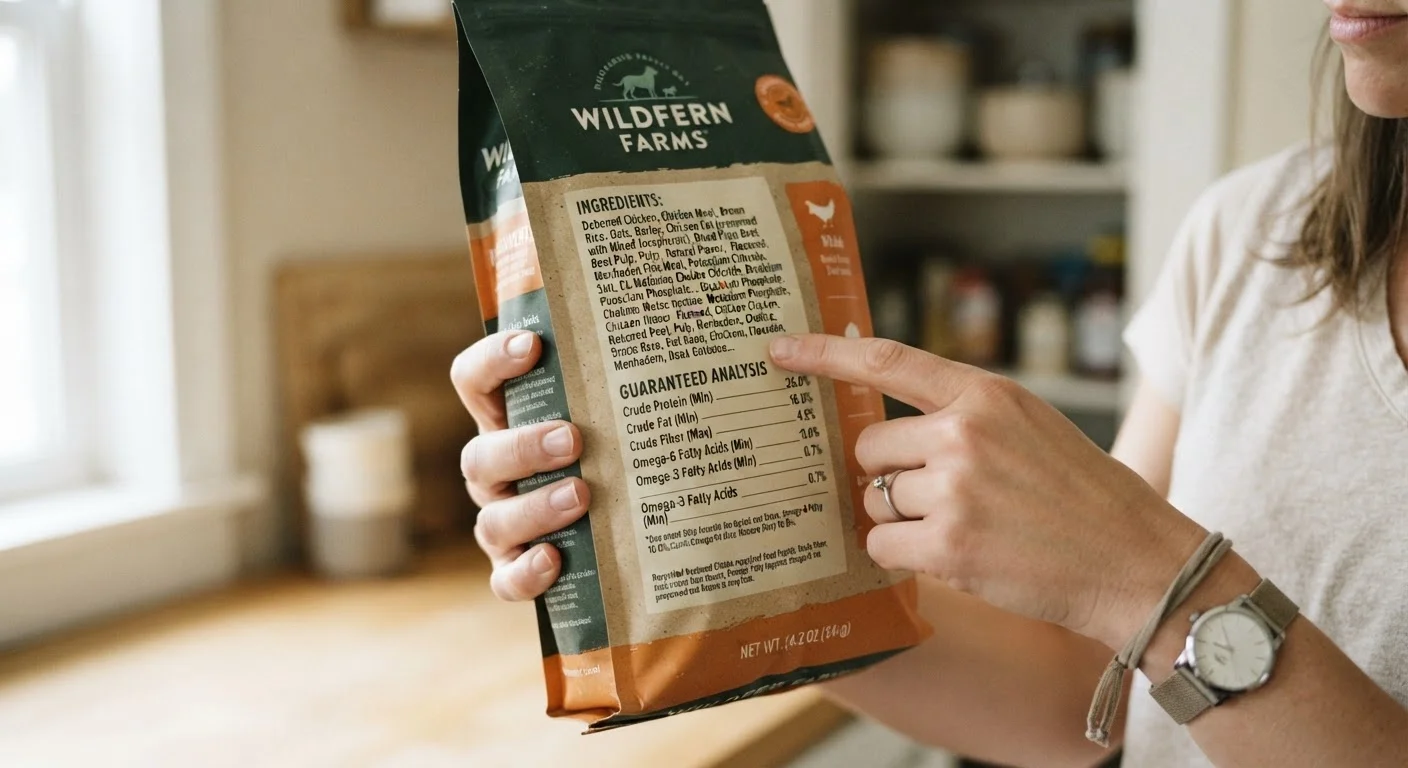
This is often the single most important sentence on the label. The AAFCO statement tells you whether the food meets established minimum nutritional standards - and how that was determined. Look for one of two formulations:
- Formulated to meet AAFCO nutrient profiles: The recipe was calculated against AAFCO's nutrient standards on paper but was not feeding-tested on live animals.
- Substantiated by feeding trials: The food was tested on animals according to AAFCO protocols, offering a higher level of real-world validation.
The statement also specifies life stage: growth (puppies/kittens), maintenance (adults), all life stages, or supplemental only - the last of which means the food is not nutritionally complete on its own.
Interpret the Guaranteed Analysis Panel
The guaranteed analysis lists four values required by law: minimum crude protein, minimum crude fat, maximum crude fiber, and maximum moisture. Some manufacturers voluntarily add more nutrients to this panel.
Key points to understand:
- These are minimums and maximums, not exact values - actual content may differ.
- Moisture content varies dramatically between wet food (~75-82%) and dry kibble (~10-12%), which makes direct comparisons misleading without adjustment.
- "Crude" refers to the measurement method, not quality - crude protein, for example, measures nitrogen content rather than the actual amino acid profile your pet absorbs.
Decode the Ingredient List
Ingredients are listed in descending order by pre-cooking weight. This matters because water is heavy: a fresh chicken listing at the top may contribute far less actual protein after moisture evaporates during processing than a concentrated chicken meal listed third or fourth.
Watch for these common patterns:
- Ingredient splitting: A single ingredient (e.g., corn) may appear as "ground corn," "corn gluten meal," and "corn bran" - spread across the list to make it appear less dominant.
- Named vs. unnamed protein meals: "Chicken meal" is a specific, named source. "Meat meal" or "poultry by-product meal" is less specific about origin.
- Preservatives and additives: Mixed tocopherols (vitamin E) are a common natural preservative; ethoxyquin, BHA, and BHT are synthetic options whose long-term safety in pets is a topic of ongoing discussion among researchers.
For a deeper look at parsing ingredient lists, see our guide to reading ingredient lists.
Check Feeding Guidelines and Caloric Content
Feeding guidelines on the label provide a starting reference based on body weight, but they are general estimates - not prescriptions. Caloric density (expressed as kcal/kg or kcal/cup) is the more precise figure for calculating daily portions, especially if your pet is overweight, underweight, or very active.
Note that caloric content is not always prominently displayed, but manufacturers are required to provide it upon request, and many include it voluntarily on the label or their website.
Note the Manufacturer Contact Information and Lot Code
Every compliant pet food label must include the manufacturer's name, address, and net weight. Most also carry a production lot code and best-by date - critical details if a recall is ever issued. Keep a photo of the lot code from any bag or can you use regularly, so you can quickly check against recall databases if needed.
If you have specific questions about formulation or sourcing, the manufacturer contact information on the label is where to start. Many companies now publish sourcing and quality-control details on their websites.
Use Dry Matter Basis for Fair Comparisons
When comparing wet and dry foods, moisture content skews the guaranteed analysis numbers significantly. Ask your veterinarian about converting nutrient percentages to a "dry matter basis" - this removes moisture from the equation so protein, fat, and fiber levels can be compared accurately across food formats.
Labels Don't Replace Veterinary Guidance
Pet food labels provide useful nutritional information, but they cannot account for your individual animal's health history, breed-specific needs, or medical conditions. Always consult your veterinarian before making significant changes to your pet's diet, especially if your pet has a chronic illness, is a senior animal, or is pregnant or nursing.
Putting It All Together
No single label section tells the whole story. A food can have an impressive ingredient list but an AAFCO statement showing it was only formula-validated, not feeding-tested. Another product may list a named protein as the first ingredient yet have a guaranteed analysis showing modest protein levels. Reading all sections together gives you a more complete picture.
Pet food labels also can't capture everything. Digestibility - how much of a nutrient a pet actually absorbs - isn't required on labels, and palatability varies widely between individual animals. For extras beyond the main food, our guide to treats, toppers, and supplements explains where those additions fit in. And for common misconceptions about what pets should and shouldn't eat, see common myths about pet nutrition.
This article provides general educational information about pet food labeling and is not a substitute for personalized veterinary advice. Consult your veterinarian for guidance tailored to your specific pet's health, age, and nutritional needs.