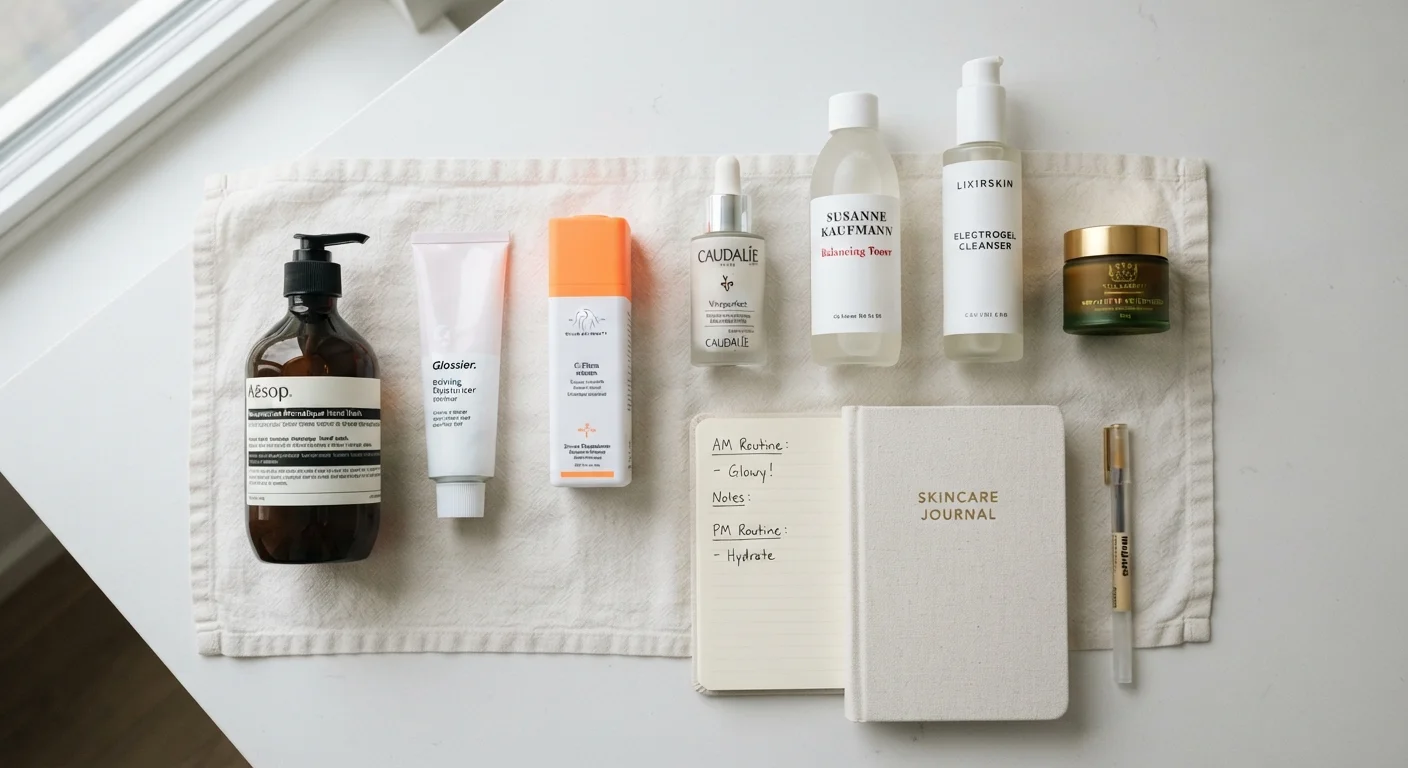
Auditing your current routine before adding products prevents redundancy, wasted spending, and ingredient conflicts.
Many skin concerns stem from routine gaps or lifestyle factors rather than a missing product.
Ingredient compatibility matters - some actives should not be layered together.
A smaller, well-understood routine typically outperforms a large, patchwork one.
Expiration dates and texture changes signal when it's time to retire a product, not replace it immediately.
20–45 min
Summary
22 items · 20-45 minutes
Why Auditing Beats Adding
The average American household holds far more skincare products than anyone actually uses consistently. Before you reach for something new, taking stock of what you already own - and how it's actually working - is one of the most practical moves you can make for both your skin and your wallet.
A routine audit isn't about stripping everything back to zero. It's about getting honest with yourself: Are your products doing what you think they're doing? Are any of them working against each other? And are the real culprits behind your skin concerns actually products at all? Research consistently shows that lifestyle factors like sleep, hydration, and stress can affect skin just as significantly as anything on your shelf.
This checklist walks you through the audit in four logical stages. Grab your products, a notebook, and about 30 minutes.
Required
Notebook or notes app
Track your audit findings, ingredient lists, and decisions in one place.
Required
All current skincare products
Gather everything you own so nothing is accidentally overlooked in the audit.
Optional
Reliable ingredient glossary or database
Look up unfamiliar ingredient names and known compatibility concerns.
Optional
A dermatologist or licensed esthetician
Consult a professional if you're dealing with persistent skin concerns that don't respond to routine adjustments.
The Routine Audit Checklist
Work through each group in order. Be honest - the goal is clarity, not self-criticism.
Inventory & Expiration
Gather every skincare product you own in one place - including backups, travel sizes, and anything tucked in a drawer.Must
Check each product's period-after-opening (PAO) symbol (the open jar icon with a number) and discard anything past its use-by window.Must
Look for signs of product degradation: separation, unusual smell, changed texture, or discoloration.Must
Note which products you've actually used in the past 30 days versus ones you keep "just in case."Should
Purpose & Redundancy
Write down the stated purpose of each product (e.g., hydration, exfoliation, brightening) and check for overlap.Must
Identify any step where you're using two or more products that do essentially the same thing - keep the one that performs better.Must
Confirm you have the basics covered: a gentle cleanser, a moisturizer appropriate for your skin type, and a broad-spectrum SPF for daytime.Must
Flag any product you've been holding onto out of guilt about the cost rather than because it actually works for you.Should
Ingredient Compatibility
List the key active ingredients in each product you use (retinoids, AHAs, BHAs, vitamin C, niacinamide, benzoyl peroxide, etc.).Must
Research whether any of your actives are known to cause irritation or reduced efficacy when applied together or in close sequence.Must
Confirm that high-strength exfoliating acids and retinoids are not being used simultaneously in the same routine step.Must
Check whether any products advise against use with specific other ingredients on their packaging or instructions.Should
Consider whether you're over-exfoliating - using more than one exfoliant (physical or chemical) across your routine.Should
Performance Honest Check
For each active product, ask: has my skin actually changed since I started using this, or am I hoping it will eventually work?Must
Identify any product that consistently causes redness, breakouts, tightness, or stinging - note it for removal regardless of cost or hype.Must
Evaluate whether your skin concerns could be related to lifestyle factors (diet, hydration, sleep, stress) rather than product gaps.Should
Determine if any new concerns appeared after you added a recent product - correlation isn't causation, but it's worth investigating.Should
Budget & Sustainability Check
Total up your approximate monthly spend on skincare products to get a clear picture of your current investment.Should
Consider whether any product you're purchasing regularly delivers enough noticeable benefit to justify its cost - general financial wellbeing applies here too. For deeper budgeting strategies, explore budgeting basics.Should
Assess whether your shopping habits (impulse buys, trend-chasing) are driving your routine, rather than your actual skin needs.Nice to have
Apply smart shopping principles before replacing anything you're retiring - ask whether a new purchase would genuinely fill a gap.Nice to have
Don't Diagnose Your Skin Alone
A routine audit is a helpful self-assessment tool, not a substitute for professional guidance. If you're experiencing persistent breakouts, irritation, unusual changes in your skin, or reactions to products, a dermatologist is the right next step. This checklist is general educational information - it is not medical advice, and it cannot account for your individual skin health history.
Once you've completed the audit, resist the urge to immediately purchase replacements for every gap you find. Some gaps are worth filling; others resolve on their own when redundant products are removed and your skin rebalances. A trimmed-down routine has real advantages - and understanding those trade-offs helps you add intentionally rather than reflexively.
When you're ready to build or rebuild after your audit, a consistent, simple routine will serve you far better than an elaborate one you can't maintain. And if you're starting closer to scratch, building from the ground up with intention beats inheriting a chaotic shelf full of half-used products.
Patch Test Before Reintroducing Products
If your audit leads you to restart a product you'd paused, or to layer actives in a new way, always patch test first. Apply a small amount to the inside of your wrist or behind your ear for a few days before using it on your face. Skin can become sensitized over time, and a product that once worked without issue may behave differently now.
Style & Beauty Editorial Team is the collective byline for our editorial team and contributor network. Articles published under this byline or an editorial pen name are researched, written, and reviewed according to our editorial standards for clarity, consistency, and independence before publication.
Disclaimer: The content on this site is for informational purposes only and is not a substitute for professional advice. Always consult a qualified professional for guidance specific to your situation.