

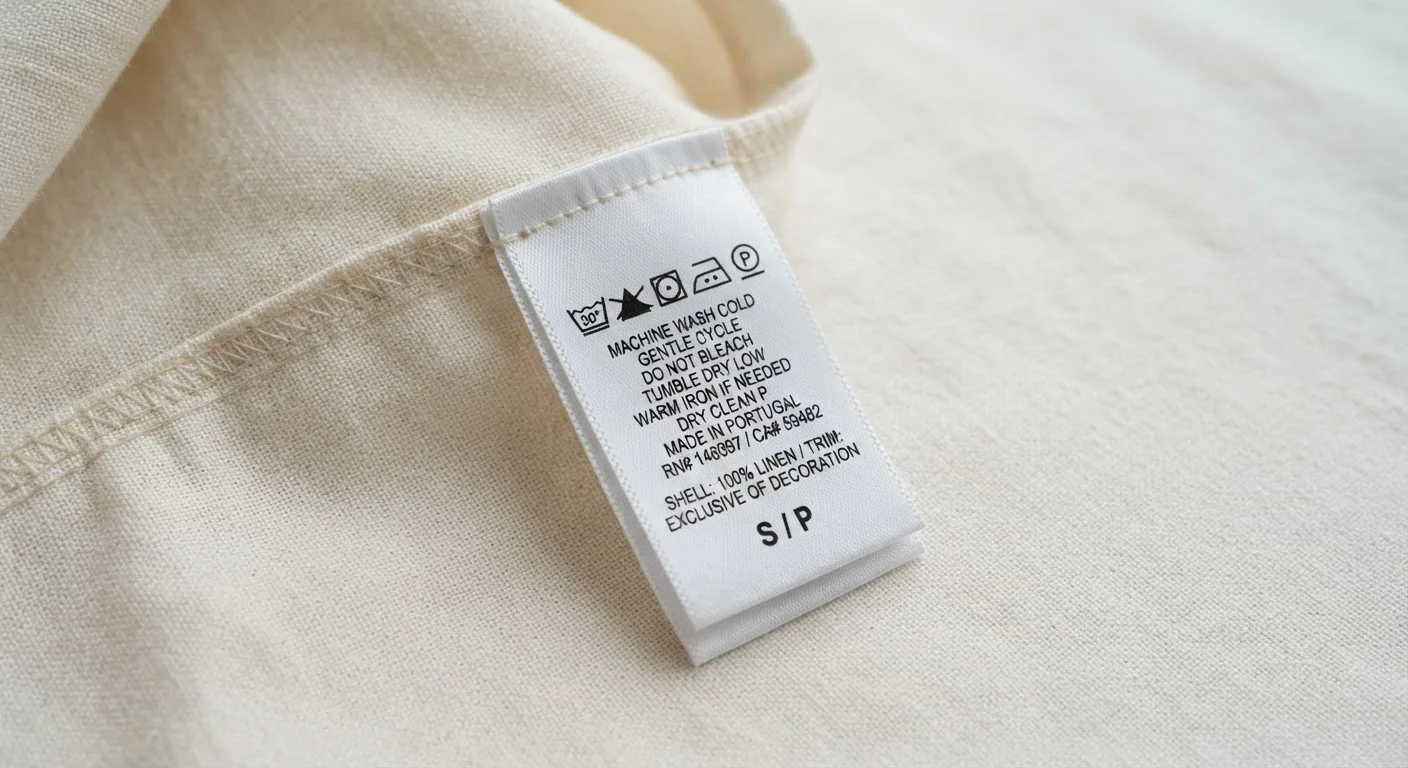
| Standard governing U.S. care labels | ASTM D5489 (aligned with ISO 3758) (ASTM International) |
| Five core symbol categories | Washing, Bleaching, Drying, Ironing, Dry Cleaning |
| Universal 'do not' modifier | An X overlaid on any symbol (ISO 3758 / ASTM D5489) |
| Number of wash temperature dots | 1 dot = cold, 2 = warm, 3 = hot |
| Required on U.S. garments since | 1971 (FTC Care Labeling Rule) (U.S. Federal Trade Commission) |
| Permanent press indicator | Single line under the wash or dry symbol |
Why Care Labels Exist - and Why They're Worth Reading
The small sewn-in tag you usually tuck back into your collar isn't arbitrary. Since 1971, the U.S. Federal Trade Commission's Care Labeling Rule has required most textile clothing sold in the United States to carry permanent, legible care instructions. The symbols follow ASTM D5489, which mirrors the international ISO 3758 standard - so a care label on a garment made abroad uses the same visual language.
Ignoring these instructions is one of the most common reasons clothes shrink, fade, or lose their shape prematurely. Once you know the five symbol categories and the logic behind the modifiers, reading a care label takes about five seconds. For a broader look at decoding product labels across categories, see our guide to reading product labels.
| Standard governing U.S. care labels | ASTM D5489 (aligned with ISO 3758) (ASTM International) |
| Five core symbol categories | Washing, Bleaching, Drying, Ironing, Dry Cleaning |
| Universal 'do not' modifier | An X overlaid on any symbol (ISO 3758 / ASTM D5489) |
| Number of wash temperature dots | 1 dot = cold, 2 = warm, 3 = hot |
| Required on U.S. garments since | 1971 (FTC Care Labeling Rule) (U.S. Federal Trade Commission) |
| Permanent press indicator | Single line under the wash or dry symbol |
The Five Symbol Categories - Decoded
Every care symbol falls into one of five categories. Understanding the shape tells you the category; the details inside tell you the instruction.
1. Washing (Tub with Water)
A basin shape indicates machine or hand washing. Dots inside indicate temperature: one dot for cold (up to 85°F), two for warm (up to 105°F), three for hot (up to 120°F). A hand dipping into the basin means hand wash only. An X over the tub means do not wash with water at all.
2. Bleaching (Triangle)
An empty triangle means any bleach is safe. A triangle with two diagonal lines means use only non-chlorine (oxygen) bleach. An X through the triangle means do not bleach under any circumstances - common on dark or structured garments.
3. Drying (Square)
A circle inside the square means tumble dry; dots inside the circle indicate heat level (one = low, two = medium, three = high). A horizontal line inside the square means dry flat. Diagonal lines in the upper corner mean dry in the shade. An X over a dripping square means do not wring.
4. Ironing (Iron Shape)
The iron symbol uses the same dot system for heat: one dot for low (synthetics), two for medium (wool), three for high (cotton and linen). Crossed lines beneath the iron mean do not steam. An X over the iron means do not iron - typical for beaded, printed, or heat-sensitive fabrics.
5. Professional Textile Care (Circle)
A plain circle means dry clean. Letters inside (like P or F) indicate which solvents are safe for the dry cleaner to use - this is information for the professional, not for you to act on at home. An X over the circle is an unambiguous do not dry clean.
ASTM D5489
The American standard that governs care labeling symbols used in the U.S. It aligns closely with the international ISO 3758 standard, ensuring symbols are consistent across most garments sold domestically.
Permanent press
A wash or dry cycle setting designed for synthetic and blended fabrics. It uses a cool-down period to reduce wrinkles without the heat that can damage man-made fibers.
Delicate / gentle cycle
A low-agitation, low-speed washing machine cycle intended for fragile fabrics like wool, silk, and lace that can stretch or pill under normal wash action.
Dry clean only
A care instruction indicating the garment should not be machine or hand washed. A professional dry cleaner uses chemical solvents rather than water to remove soil without damaging the fabric or construction.
Tumble dry
Drying a garment in a mechanical dryer using heat and rotation. The symbol's interior dots indicate the temperature level: one dot for low, two dots for medium, three dots for high.
Flat dry
Laying a damp garment horizontally on a clean surface to dry, rather than hanging it. Used for knits and other fabrics that can stretch out of shape under their own wet weight.
Modifier Lines and What They Change
Two underlines beneath a wash or dry symbol aren't decoration - they carry real meaning.
- No line: Normal cycle. Full agitation and standard spin speed.
- Single underline: Permanent press. Reduced spin, cool-down rinse. Good for polyester blends and dress shirts.
- Double underline: Delicate or gentle cycle. Low agitation, slow spin. Use for wool, silk, cashmere, and lace.
These modifiers appear under both the wash tub and the tumble dry square, so check both symbols when assessing an item's full cycle needs. For a parallel look at symbol-based reference systems in a completely different context, our guide to dashboard warning symbols shows how the same visual logic applies to your car.
When Labels List Both Symbols and Words
Some garments include written instructions alongside symbols, which can help when you're still learning. The FTC's Care Labeling Rule allows either symbols or words, or both. If your label has only symbols, the visual guide in this article covers the most common ones. For comprehensive symbol lookup, the FTC publishes a free reference chart on their website.
Common Mistakes - and How to Avoid Them
Even once you know the symbols, a few consistent errors trip people up:
- Assuming warm is always safe. Many synthetics and dark-dyed fabrics specify cold water specifically to prevent dye loss or heat damage. Default to the label, not habit.
- Skipping the drying symbol. A garment may be fine to machine wash but require flat drying. High dryer heat is responsible for most shrinkage - especially in cotton and wool blends.
- Treating "dry clean" and "dry clean only" as identical. "Dry clean" is a recommendation. "Dry clean only" - or an X over a wash tub - means water will damage the fabric or construction. Structured jackets, suits, and heavily beaded pieces fall here.
- Ironing over prints or embellishments. If the iron symbol has an X, the restriction often exists to protect surface decoration, not just the base fabric.
Building the habit of checking the label before the first wash - rather than after something goes wrong - is the single most effective change most people can make. The same careful attention to detail that helps with reading a skincare ingredient label pays off just as well in the laundry room. For a deeper dive into every symbol variation, see our complete care label reference.
5
Core care label symbol categories
All international garment care symbols fall into washing, bleaching, drying, ironing, or professional textile care - per ISO 3758.
1971
Year U.S. care labels became mandatory
The FTC's Care Labeling Rule has required permanent, legible care instructions on textile wearing apparel sold in the United States since 1971.