

Key Takeaways
Why Care Labels Actually Matter
That tiny sewn-in tag isn't just there to itch you. Care labels are federally required by the Federal Trade Commission (FTC) for most garments sold in the United States, and they carry specific instructions from the manufacturer about how to keep a garment in its best condition. Ignoring them isn't just risky - it's genuinely the most common reason clothes shrink, fade, warp, or fall apart prematurely.
For anyone building a wardrobe that goes the distance, reading care labels is one of the simplest high-leverage habits you can develop. As we explore in our guide to cost-per-wear, the true cost of a garment includes how long it survives in your closet. Proper care dramatically extends that lifespan.
Snap the Label Before You Snip It
Many people cut out care labels because they're itchy or uncomfortable. Before you do, take a photo of the label with your phone. Store it in an album labeled 'Clothing Care' so you always have the instructions available when wash day comes around.
The Five Symbol Categories Explained
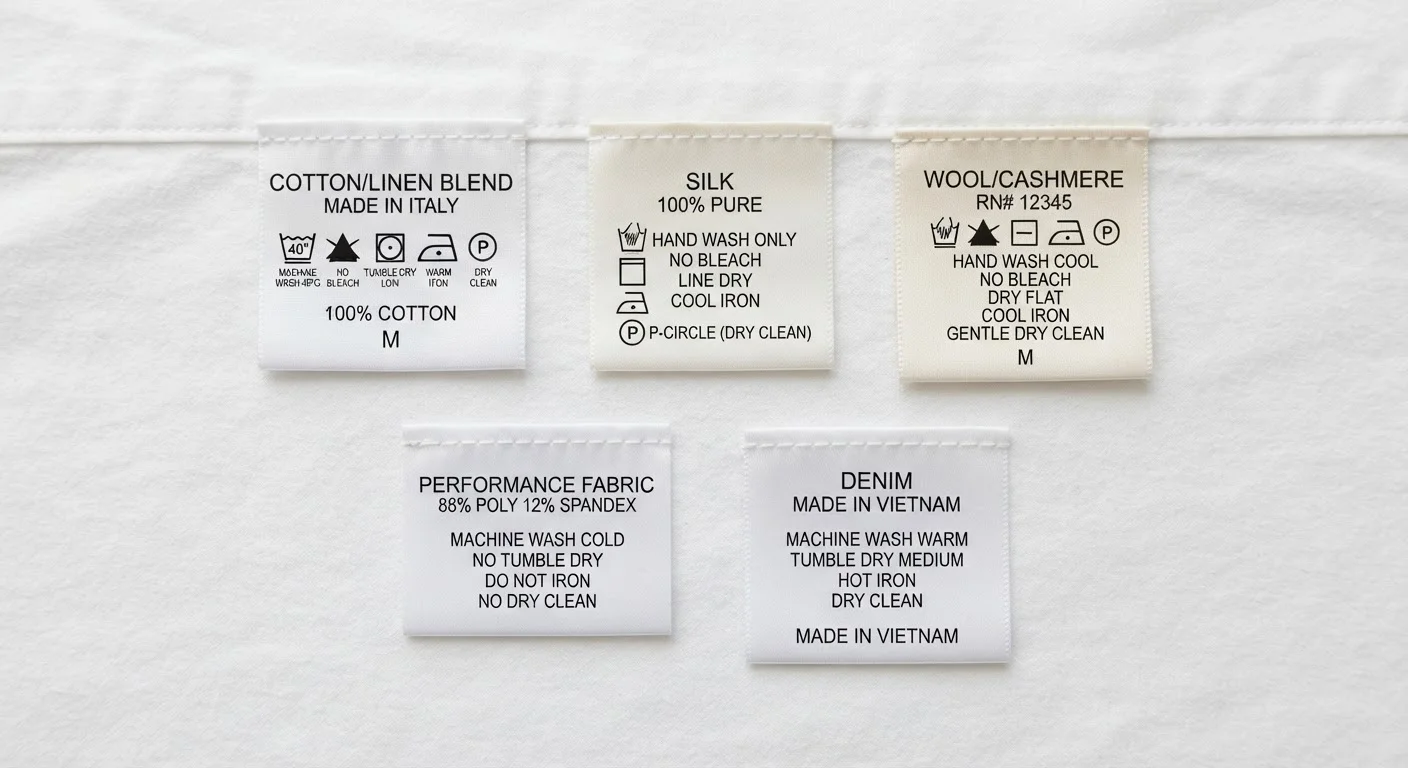
International care symbols are organized into five distinct categories. Once you recognize the base shape for each category, everything else is a variation on that theme.
- Washing (tub with water): Indicates whether machine or hand washing is appropriate and at what water temperature.
- Bleaching (triangle): Tells you whether bleach of any kind is safe to use on the fabric.
- Drying (square): Covers both tumble drying and flat or line drying options.
- Ironing (iron silhouette): Specifies whether ironing is safe and at what heat setting.
- Professional/Dry Cleaning (circle): Indicates whether the item requires dry cleaning and what solvents are safe for use.
Learning to spot these five base shapes is all it takes to orient yourself on any label, anywhere in the world - the symbols are internationally standardized through ASTM International and ISO norms.
5
Standardized care symbol categories on all U.S. garments
The FTC requires care labels on most clothing sold in the United States, using internationally recognized ASTM/ISO symbol categories.
~30°C
Temperature indicated by a single dot in washing symbols
One dot inside the washtub symbol generally corresponds to a cold or delicate wash - ideal for most synthetic fabrics and bright colors.
Dots, Lines, and Xs: Decoding the Details
Once you know the base symbols, the modifiers do all the nuanced work.
Dots = Temperature
Inside washing tubs and drying squares, dots represent heat intensity. One dot signals low heat (typically around 86°F/30°C for washing), two dots indicate medium heat, and three dots mean high heat is acceptable. The same logic applies inside the iron symbol - one dot means low, three means you can press with higher heat.
Lines = Drying Method
Lines inside or beneath the drying square indicate how to dry without a machine. A single horizontal line inside the square means dry flat (essential for knits and woolens that could stretch). Vertical lines inside mean drip dry. Lines beneath the square indicate line drying.
The X = Do Not
An X drawn over any symbol means that method is off-limits entirely. An X over the tub means do not wash at home. An X over the triangle means no bleach of any kind. An X over the circle means dry cleaning is not safe. When you see an X, take it seriously - these prohibitions protect the fabric's structure, dye, or finish.
For a comparable experience decoding symbol-based systems in another product category, see how our team tackles reading product labels across categories.
When in doubt about a garment's care, always default to the coldest water temperature and the gentlest cycle available. You can't un-shrink a wool sweater, but you can always re-wash something that came out less than perfectly clean.
Heat and agitation are the two biggest culprits in fabric damage. Erring on the side of gentleness preserves fiber integrity, especially for natural fabrics like wool, silk, and linen.
Keep a small photo on your phone of the care label for any garment you're unsure about - especially items you send to the dry cleaner or store seasonally.
Labels can fade or get cut out over time, and having a reference photo ensures you never have to guess when the garment comes back into rotation.
Special Instructions and Written Text
Not everything fits neatly into a symbol. Many care labels - especially on higher-quality or imported garments - include written instructions in English and sometimes additional languages. Phrases like wash inside out, use mild detergent, reshape while damp, or do not wring are common and carry real consequences if ignored.
Don't Assume 'Dry Clean Only' Is Optional
Some garments marked 'dry clean only' use construction techniques - like unlined structured interiors or fused interfacing - that genuinely cannot survive water immersion. Washing these at home can cause bubbling, warping, or irreversible shape loss. When the label says only, treat it as a firm boundary rather than a suggestion.
Written instructions are also where fabric-specific guidance often lives. Silk labels might say cold water only. Structured blazers might say dry clean recommended rather than required - meaning machine washing at gentle settings may be tolerable, but the garment's shape is best preserved professionally. Understanding this distinction gives you flexibility without guesswork.
If you enjoy decoding label language across product types, you'll find similar patterns in beauty: reading a skincare ingredient label follows a surprisingly similar logic of symbols, abbreviations, and hidden meaning.
Building Better Laundry Habits
The practical goal here isn't memorizing every symbol in the book - it's developing a quick pre-wash check habit. Before tossing anything into the machine, spend five seconds glancing at the label. Look for Xs (prohibitions), dot count (temperature guidance), and any written notes. That quick scan protects fabrics, colors, and construction details you paid for.
Sort your laundry not just by color but by care requirements. Grouping items by wash temperature is one of the most underrated laundry habits - it prevents accidental hot-water shrinkage of delicates mixed in with towels. Similarly, checking dryer guidance before you load saves you from discovering that your favorite sweater is now doll-sized.
For a focused symbol-by-symbol reference you can bookmark, our care label symbol guide serves as a handy companion to this overview.
Care labels are one of the few places where the garment itself tells you exactly what it needs. Listening to that information is one of the simplest, most cost-effective things you can do for your wardrobe.
This article is for general informational purposes only. Care label regulations and symbol standards may vary for imported garments; always defer to the label instructions provided with your specific item.