

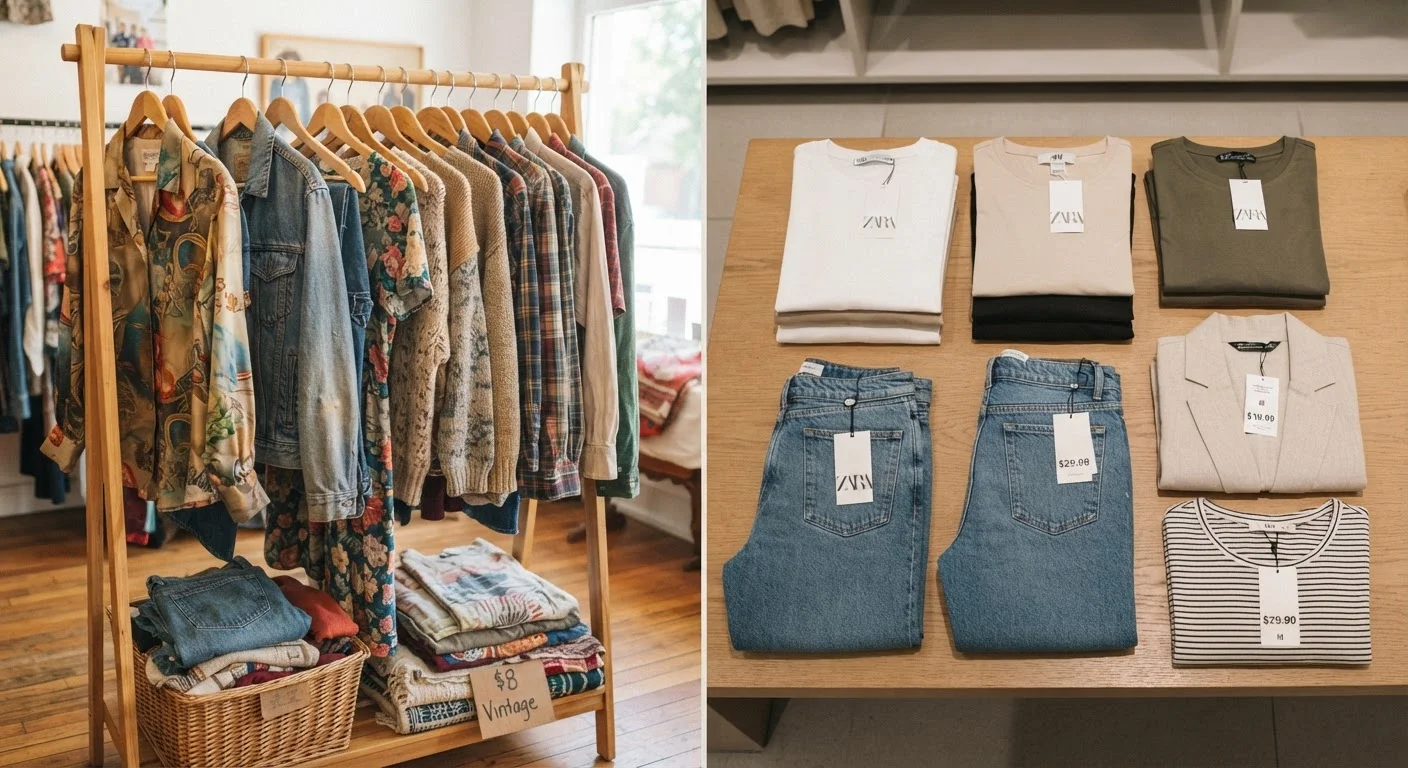
Key Takeaways
Option A
Thrift Store Shopping
The sustainable, serendipitous secondhand experience.
Best for: Shoppers who enjoy the hunt, want lower environmental impact, and are building a unique wardrobe on a flexible timeline.
Option B
Fast Fashion
The convenient, on-trend, high-volume approach.
Best for: Shoppers who need specific items quickly, follow current trends closely, and prioritize immediate availability and predictable sizing.
If you're shopping on a tight budget and have flexible time
Thrift Store Shopping
Per-item prices at thrift stores are typically far lower, and patient shoppers can find quality pieces that would cost much more new.
If you need a specific item quickly in a guaranteed size
Fast Fashion
Fast fashion retailers offer predictable inventory, consistent sizing, and immediate availability - thrift stores can't reliably match that.
If reducing your environmental footprint is a top priority
Thrift Store Shopping
Buying secondhand extends existing garments' lives and reduces demand for new production, lowering your overall clothing footprint.
If you need workwear or uniforms in a specific style
Fast Fashion
Consistent cuts, colors, and sizing across a retailer's line make it easier to build a cohesive, professional wardrobe without relying on chance finds.
If you want to develop a distinctive, non-generic personal style
Thrift Store Shopping
Secondhand racks surface one-of-a-kind and vintage pieces that fast fashion retailers simply don't replicate, giving your wardrobe real individuality.
The Real Cost Comparison
Price is usually the first thing people reach for in this debate, and thrift stores do win on raw sticker cost - often dramatically. A secondhand blazer that would retail for $60-$80 new might go for $8-$15 at a thrift store. But sticker price isn't the whole story.
Fast fashion keeps individual item prices low through high-volume manufacturing, which makes it feel budget-friendly. The catch is that lower construction quality means items may need replacing sooner. The concept of cost-per-wear - dividing what you paid by how many times you actually wear something - is a useful lens here. A $12 fast fashion top you wear four times before it pills costs $3 per wear. A $10 thrifted blouse in sturdy fabric that you wear 40 times costs $0.25 per wear. Cost-per-wear thinking can shift how you evaluate both options entirely.
There's also a hidden cost in thrift shopping: time. Sourcing specific items secondhand takes browsing, patience, and sometimes multiple trips. That's a real trade-off, especially for people with demanding schedules.
~$18
Average U.S. thrift store item price
ThredUp's annual resale reports consistently show secondhand prices well below comparable new retail pricing.
92M tons
Textile waste generated globally per year
The United Nations Environment Programme estimates the global fashion industry produces roughly 92 million tons of textile waste annually.
3x
Faster clothing consumption vs. 15 years ago
The Ellen MacArthur Foundation has reported that consumers, on average, buy 60% more clothing than 15 years ago and keep it for half as long.
Quality, Durability, and What You're Actually Bringing Home
Thrift store inventory is wide-ranging - you might find a well-constructed vintage denim jacket from an era when garment quality was higher, or you might grab something that was already tired when it was donated. Condition varies, and inspection skills matter. Check seams, zippers, and fabric weight before buying.
Fast fashion garments are produced to a predictable (if modest) quality standard. You know roughly what you're getting, and sizing is consistent across a retailer's line. That reliability has genuine value, especially for basics like T-shirts, leggings, or workwear staples where fit consistency matters.
| Criterion | Thrift Store Shopping | Fast Fashion |
|---|---|---|
| Average item cost | Very low; highly variable | Low to moderate; predictable |
| Sizing consistency | Inconsistent; varies by era and donor | Consistent within a retailer's line |
| Item availability | Unpredictable; requires patience | High; specific items reliably stocked |
| Garment durability | Variable; older items often more durable | Often lower; built for trend cycles |
| Environmental footprint | Lower; extends existing garment life | Higher; drives new production volume |
| Style uniqueness | High; one-of-a-kind finds common | Lower; mass-produced trend items |
| Time investment | High; browsing-intensive | Low; quick and targeted |
The broader wardrobe-building question - whether secondhand or new shapes your style differently over time - is worth considering too. How each approach affects your wardrobe development is a genuinely different conversation from simple price comparison.
Environmental Impact: What the Research Generally Shows
The fashion industry is widely cited as a significant contributor to textile waste and water pollution, though exact figures vary by source and methodology. What's broadly agreed upon: extending the life of an existing garment - by buying it secondhand - reduces the environmental cost of producing a new one. Thrift shopping keeps clothing out of landfills longer.
Fast fashion's model, by contrast, is built on high turnover. Lower prices encourage frequent purchasing, which accelerates the cycle of wear-and-discard. That volume compounds environmental impact even when individual items seem inexpensive.
That said, environmental calculus isn't perfectly simple. Shipping secondhand items ordered online has its own footprint, and not all fast fashion brands operate identically. Why the "buy less" advice is harder than it sounds is a fair read for anyone who finds sustainability messaging frustratingly out of touch with real shopping constraints.
Thrifting Isn't Equally Accessible to Everyone
It's worth acknowledging that secondhand shopping - particularly the leisure thrifting popularized on social media - requires disposable time that not everyone has. For people working multiple jobs or managing caregiving responsibilities, fast fashion's speed and predictability can be a genuine necessity, not a thoughtless choice. Wardrobe decisions are shaped by real-world constraints, and any framing that ignores that is incomplete.
Building a Wardrobe That Actually Works for You
For most everyday Americans, the practical answer isn't a binary one. Many people shop both channels depending on the item: thrift stores for statement pieces, vintage finds, and high-quality basics that show up secondhand; fast fashion for essentials where sizing precision and immediate availability matter more.
If you're exploring secondhand shopping beyond physical stores, it's worth knowing that the experience differs meaningfully depending on format. What changes between online and in-store thrifting can help you figure out which approach fits your shopping style before you commit the time.
The goal is a wardrobe that fits your actual life - budget, schedule, values, and style preferences all included. That rarely looks like a purist stance in either direction, and that's completely fine.