

Key Takeaways
Option A
Capsule Wardrobe
The streamlined, constraint-driven approach to dressing.
Best for: People who want to reduce decision fatigue, minimize clutter, and build a reliable daily uniform.
Option B
Curated Wardrobe
The expressive, intentional approach built around personal aesthetic.
Best for: People who want variety and self-expression while still keeping their closet purposeful and cohesive.
If decision fatigue is your biggest daily frustration
Capsule Wardrobe
A strict, limited wardrobe removes the paradox of choice from your morning routine, making every piece interchangeable and every outfit reliable.
If personal style and self-expression are central to your identity
Curated Wardrobe
A curated approach allows for variety, creativity, and evolution while still keeping your closet intentional and free of pieces that don't serve you.
If you're just starting to build a more intentional closet
Capsule Wardrobe
The capsule framework's clear constraints give beginners a concrete, actionable structure that's easier to follow than the more open-ended curation process.
If your style shifts across seasons, moods, or occasions
Curated Wardrobe
Curation accommodates natural style evolution and a wider range of contexts without forcing you to stick to a fixed, interchangeable core.
The Core Philosophy Behind Each Approach
Both the capsule wardrobe and the curated wardrobe share a foundational belief: your closet should work for you, not against you. But the paths they prescribe to get there diverge pretty significantly.
The capsule wardrobe is rooted in constraint. The idea, popularized in the 1970s by London boutique owner Susie Faux, is that a small collection of high-quality, versatile basics - typically somewhere in the range of 30-40 pieces - can cover every occasion when chosen thoughtfully. The emphasis is on interchangeability: every item should work with multiple others. For a deeper look at how this concept functions in practice, see what a capsule wardrobe actually is and whether it works.
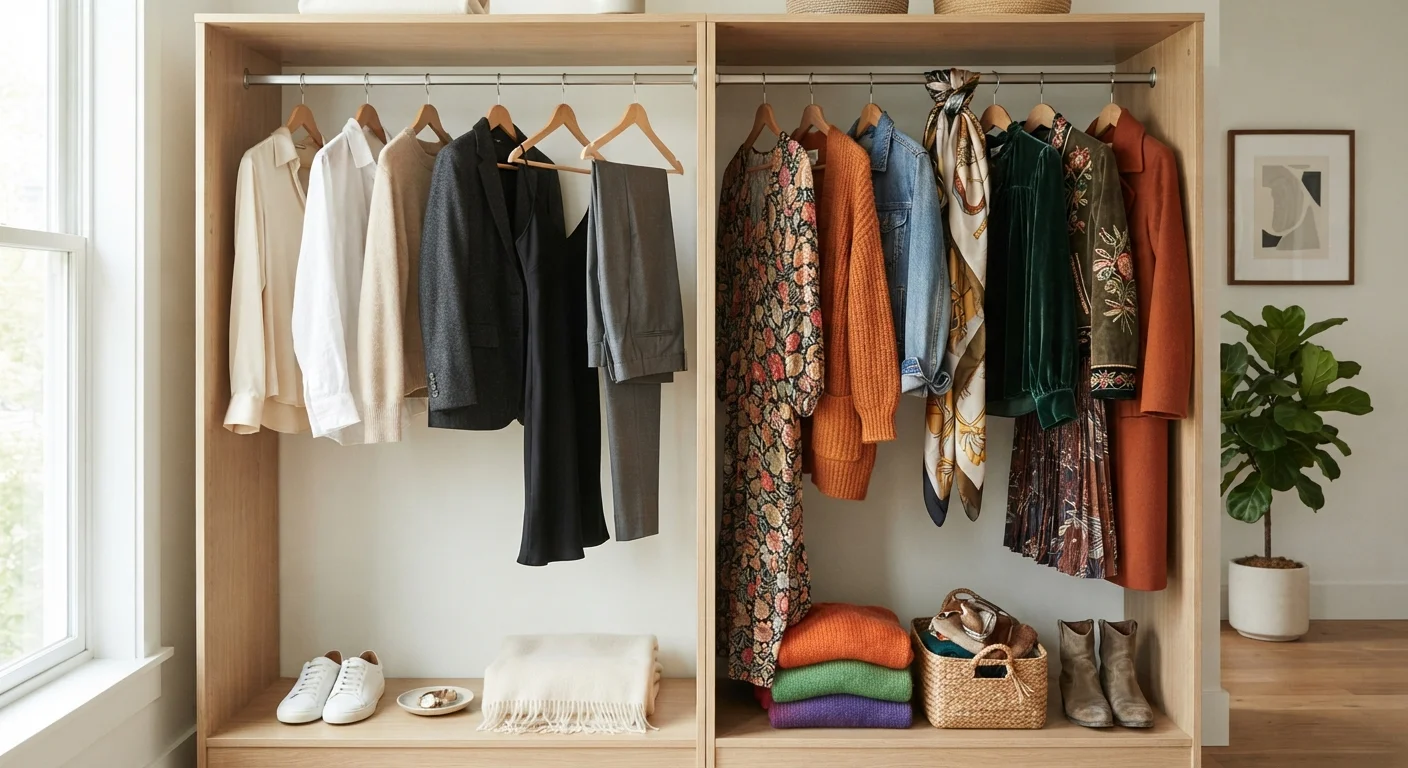
The curated wardrobe, by contrast, isn't defined by a number. It's defined by intention. A curated closet can contain 80 pieces or 150 - what matters is that each one was chosen deliberately, reflects your genuine aesthetic, and earns its place. Think of it like a personal gallery: quality over quantity, yes, but also coherence over minimalism for its own sake.
| Criterion | Capsule Wardrobe | Curated Wardrobe |
|---|---|---|
| Defining principle | Strict item limits for maximum versatility | Intentional selection aligned with personal aesthetic |
| Typical size | ~30-40 pieces (core wardrobe) | No fixed count; varies by lifestyle |
| Primary benefit | Reduces decision fatigue | Supports self-expression and variety |
| Style flexibility | Limited - favors a consistent uniform | High - accommodates evolving tastes |
| Learning curve | Lower - clear rules to follow | Higher - requires strong style self-awareness |
| Best starting point | Great for beginners or those overwhelmed by choice | Better for those with a defined personal style |
| Relationship with trends | Trend-resistant by design | Can incorporate trends selectively |
How Each Approach Shapes Your Daily Routine
The practical day-to-day experience of these two wardrobes is noticeably different, and that difference often determines which philosophy suits a person better.
With a capsule wardrobe, mornings become almost frictionless. Because every piece is designed to coordinate with every other, the mental lift of getting dressed drops dramatically. This is sometimes called reducing decision fatigue - a real psychological phenomenon where an overload of choices leads to poorer decisions or avoidance altogether. If you've ever stood in front of a full closet feeling like you have nothing to wear, the capsule approach speaks directly to that experience. Capsule wardrobe fundamentals go deeper on how to build that interchangeable core.
A curated wardrobe asks a little more of you in the morning - but for many people, that engagement is the point. Choosing between a few genuinely loved options that reflect your mood or occasion is a different kind of experience than choosing from a sea of mediocre pieces. The reward is a closet that feels like you, not a uniform.
85%
Of owned clothing rarely or never worn
Research by consumer behavior analysts and closet organizers consistently finds that most people wear only a fraction of what they own, regardless of wardrobe size.
~35,000
Decisions the average adult makes daily
Cognitive load studies suggest that routine choices like getting dressed contribute meaningfully to overall daily decision fatigue.
Where the Two Philosophies Overlap - and Where They Don't
It's worth noting that both approaches share significant common ground. Neither champions mindless accumulation. Both push back against fast-fashion impulse purchases. Both require you to develop clarity about what you actually need and wear - a process that starts with honest self-assessment. The wardrobe style audit is a useful tool for either path.
Where they diverge is in how much they value variety. Capsule thinking sees variety as potential noise - a distraction from a reliable, functional core. Curated thinking sees variety as a feature, not a bug, as long as each piece is purposeful.
There's also a difference in how each approach handles personal evolution. Curated wardrobes tend to accommodate style shifts more fluidly, since there's no strict count to maintain. Capsule wardrobes require more discipline when you want to add something new - ideally, something comes out when something goes in.
For readers who want to blend both, intentional dressing principles can help you find your own middle ground, honoring structure without sacrificing self-expression.
You Don't Have to Choose Sides
Many people find that a hybrid model serves them best - maintaining a reliable core of interchangeable basics (the capsule influence) while leaving room for expressive accent pieces that shift seasonally or reflect evolving taste (the curation influence). The goal of both philosophies is a wardrobe that feels intentional and genuinely useful, and there's more than one path to get there.
Choosing the Right Framework for Your Life
The honest answer is that neither philosophy is universally better. The capsule wardrobe is an excellent framework for people who want clear rules, less decision-making overhead, and a tightly functional closet. The curated wardrobe suits people whose relationship with clothing is more expressive, who have varied lifestyle demands, or who find rigid limits creatively stifling.
A useful starting point is to ask: What role does clothing play in your daily life? Is it a tool - something efficient that gets you out the door and looking polished? Or is it a medium - a way you communicate identity, mood, or creativity? Neither answer is more valid than the other.
Once you have a sense of your own orientation, a structured wardrobe audit can help you put either philosophy into action - clearing out what doesn't serve you and building a clearer picture of what does.