
Minimalist vs. Maximalist Dressing: Understanding Two Distinct Style Philosophies

Key Takeaways
Our Verdict
Minimalism and maximalism aren't opposing camps that demand loyalty - they're two articulate style languages, each with real strengths. Minimalism rewards those who find clarity and freedom in simplicity, while maximalism empowers those who communicate most vividly through visual richness. Knowing what each philosophy is actually about gives you the vocabulary to build a wardrobe that feels genuinely like yours.
| Best for | Recommended |
|---|---|
| Those who find freedom in simplicity and easy outfit decisions | Minimalist dressing |
| Readers who want clothing to be a bold extension of personality and mood | Maximalist dressing |
| Anyone who doesn't fit neatly into one camp | A personal hybrid approach |
What Each Philosophy Actually Stands For
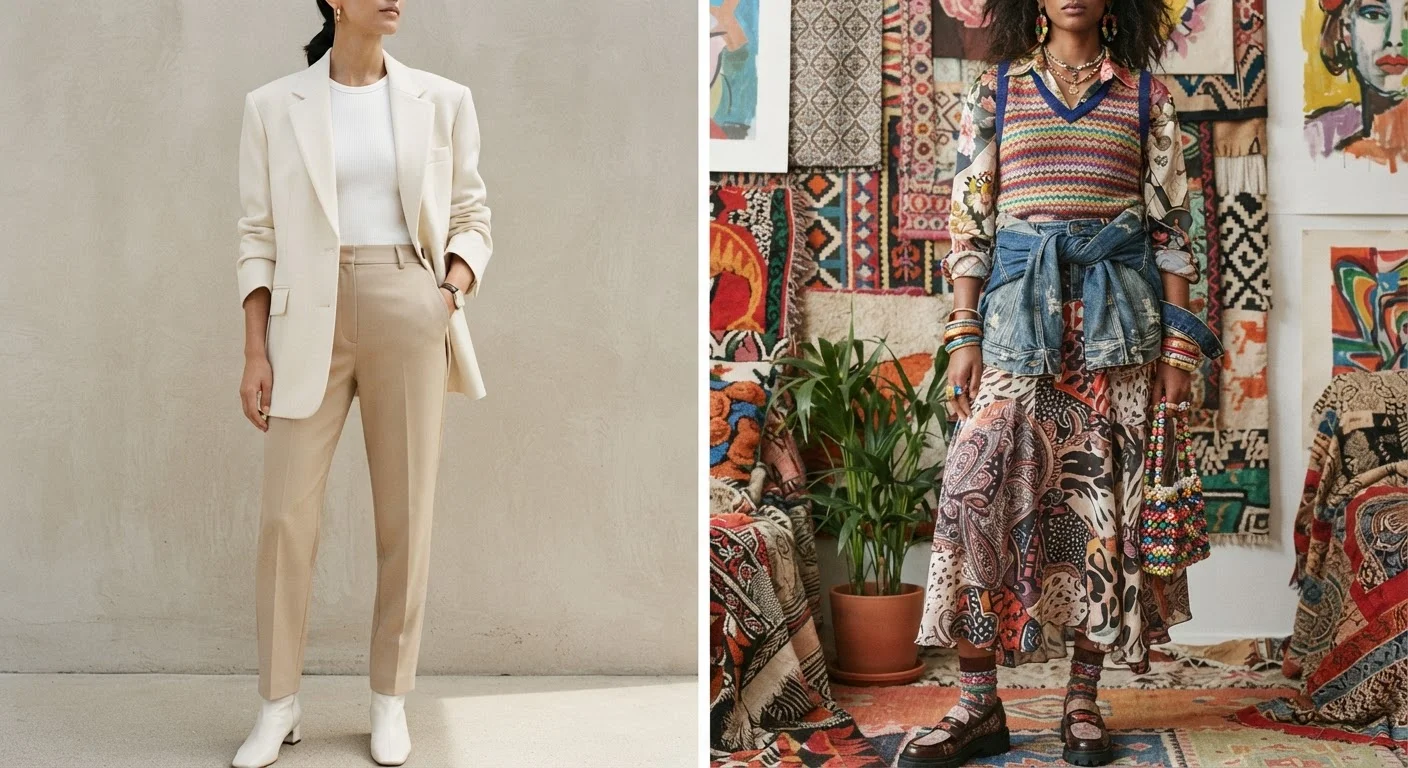
Minimalist dressing is rooted in the idea that restraint is a form of intention. It's not simply about owning fewer clothes - it's about choosing each piece deliberately, prioritizing clean lines, neutral palettes, and versatile silhouettes that work across many contexts. The goal is a wardrobe where everything earns its place and outfit-building feels effortless rather than exhausting.
Maximalist dressing operates from the opposite premise: more is more, and clothing is a canvas. Bold prints, layered textures, clashing patterns, and accumulated accessories are features, not flaws. Maximalism treats getting dressed as a creative act, where personality is communicated loudly and visually - think statement jewelry stacked with patterned fabric stacked with unexpected color combinations.
Importantly, neither approach is about price point or volume alone. A maximalist wardrobe can be thoughtfully curated; a minimalist one can still hold plenty of pieces. The difference lives in the philosophy behind each choice. For a broader look at how different style frameworks intersect, see our guide on body-shape versus personality-led dressing.
| Minimalist Dressing | Maximalist Dressing | |
|---|---|---|
| Core philosophy | Intentional restraint and simplicity | Expressive abundance and visual richness |
| Palette approach | Neutral, cohesive, limited range | Bold, varied, often clashing intentionally |
| Outfit complexity | Few pieces, clean silhouettes | Layered textures, patterns, accessories |
| Daily decision-making | Streamlined and fast | Creative but more involved |
| Learning curve | Curating versatile, quality basics | Balancing bold elements cohesively |
| Self-expression style | Subtle, through fit and texture | Loud, through color and layering |
The Practical Reality of Living in Each Aesthetic
Minimalism tends to simplify daily decisions. When your wardrobe is built on a coherent palette and multipurpose pieces, getting dressed becomes faster. This can feel liberating for people who find too many choices draining. The trade-off: the aesthetic can feel restrictive if your mood shifts, and building a truly versatile minimalist wardrobe requires upfront thoughtfulness about what actually works together.
Maximalism offers expressive freedom but demands a different kind of skill - knowing how to balance competing visual elements so an outfit reads as intentional rather than chaotic. Learning to mix patterns confidently, for example, takes practice. Our pattern mixing and layering guide breaks down exactly those techniques in approachable terms.
Try the 'One Statement Rule'
If you're curious about maximalism but find it overwhelming, start by adding one bold, intentional element - a printed scarf, a stacked bracelet set, or a patterned bag - to an otherwise simple outfit. Conversely, if you're exploring minimalism, try stripping one layer or accessory from your usual look and see how it changes how you feel. Small experiments reveal a lot about your genuine preferences without requiring a full wardrobe overhaul.
Most people, if they're honest, aren't purely one or the other. Someone might maintain a largely simple wardrobe but reach for maximalist energy through accessories or one statement piece per outfit. That hybridity is neither a failure nor a compromise - it's personal style doing its actual job.
How to Identify Where You Actually Fall
A useful starting point: look at what you're drawn to when you have no practical constraints. When browsing, window-shopping, or saving outfit inspiration, notice whether clean, uncluttered looks catch your eye first - or whether rich, layered, visually dense ensembles excite you. Your instinctive attraction often tells you more than any style quiz.
It also helps to examine when you feel most like yourself. Some people report feeling powerful and visible in a maximalist outfit; others feel distracted by their own clothes and prefer the background hum of a simple, well-fitting look. Neither reaction is more sophisticated - they reflect genuinely different relationships with clothing as communication.
If you're working through how to translate that self-knowledge into actual wardrobe habits, the principles for intentional dressing are a practical next step regardless of which direction you lean.
Moving Beyond the Binary
The minimalist/maximalist framing is genuinely useful for understanding style philosophy, but it shouldn't become a box. Personal style is allowed to evolve, contradict itself, and resist neat categorization. The pressure to settle on a single cohesive aesthetic can actually work against building a wardrobe that serves your real life across real contexts.
We dig into exactly that tension in our piece on myths around personal style - including why the idea that your look should be instantly recognizable is more cultural myth than practical wisdom.
The more empowering question isn't "Am I a minimalist or a maximalist?" It's "What do I want my clothes to do for me?" Sometimes the answer is clean and calm. Sometimes it's loud and joyful. A wardrobe that can serve both of those needs - even on different days - is a successful one. For practical guidance on maintaining stylistic consistency across different settings, explore our guide to dressing across contexts.