

Key Takeaways
Why Tires Deserve More Attention Than They Get
Your tires are the only part of the vehicle actually touching the road. Every braking force, every cornering load, every mile of traction runs through roughly the size of a hand's worth of rubber per tire. Despite this, tire maintenance is one of the most routinely neglected areas of everyday car ownership.
Neglect has real consequences. The National Highway Traffic Safety Administration (NHTSA) links thousands of crashes each year to tire-related failures, with underinflation and worn tread among the leading contributing factors. The good news is that the three core habits - monitoring pressure, checking tread depth, and rotating on schedule - are straightforward enough for any driver to manage. This guide walks through each one clearly. For context on where tire care fits within broader upkeep, see your car's full maintenance schedule.
Tire Pressure: What the Numbers Mean and How to Check
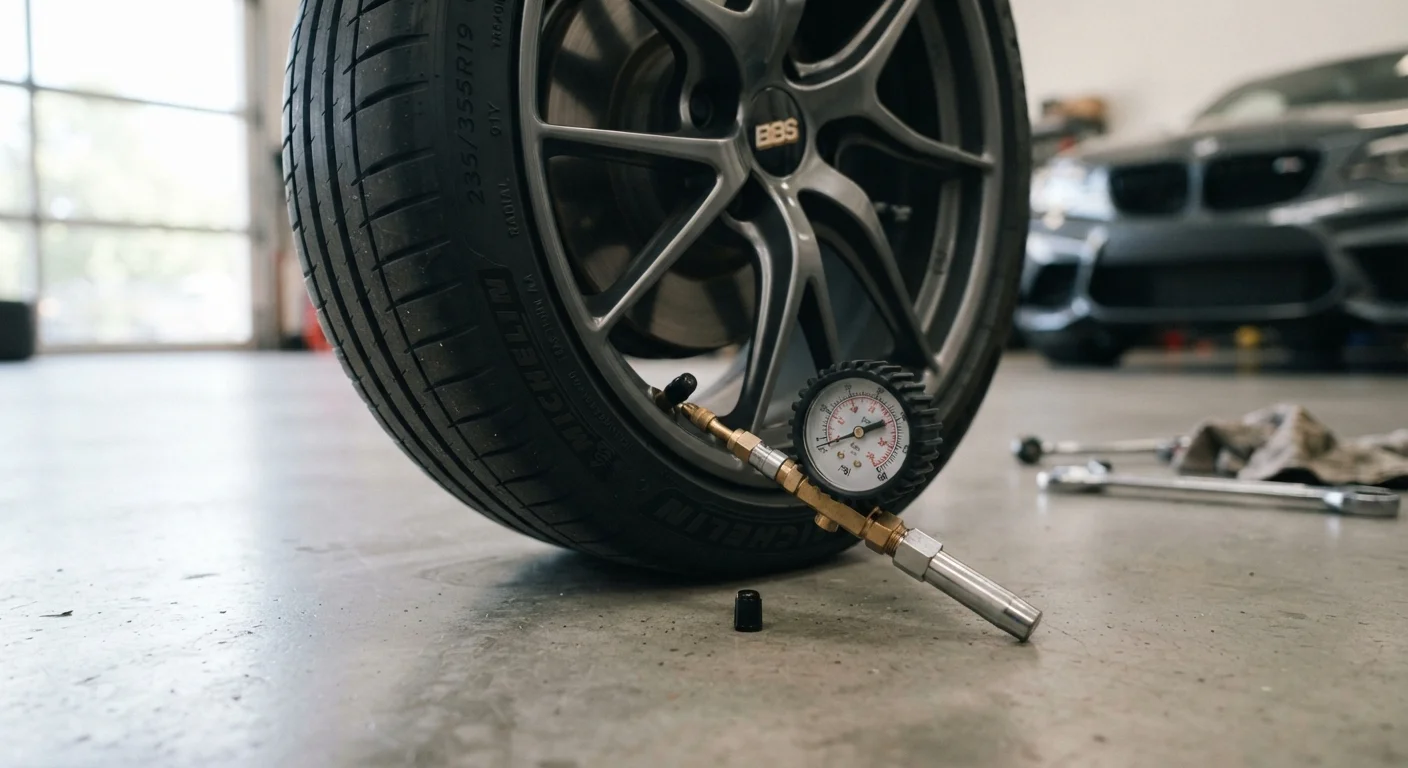
Tire pressure is measured in PSI (pounds per square inch). Most passenger cars run between 30 and 35 PSI; light trucks and SUVs can run higher. The critical point: the number printed on the tire sidewall is the maximum pressure the tire can safely hold - not the recommended operating pressure. The figure you should actually use is on the sticker inside the driver's door jamb, or in your owner's manual.
Never inflate tires to the pressure listed on the tire sidewall - that's the maximum, not the target. Always use the placard number on your driver's door jamb, which is specific to your vehicle's load and handling setup.
Overinflation based on sidewall figures is a common mistake that reduces the tire's contact patch, hardens the ride, and increases the risk of blowout from road hazards.
When you buy new tires, ask the shop to mark the rotation direction and date with a paint pen on the inner sidewall. It makes tracking wear history and rotation intervals much easier over the tire's life.
Tracking individual tire wear history helps identify recurring alignment or suspension issues before they cause premature replacement across the whole set.
How to Check Pressure Correctly
- Check when tires are cold. Driving heats the air inside tires, raising pressure by 4-8 PSI. Take readings first thing in the morning or after the car has sat for at least three hours.
- Use a quality gauge. Stick gauges are inexpensive and accurate enough. Digital gauges are easier to read. Avoid relying solely on gas station air machines, which can have uncalibrated gauges.
- Check all four tires - and the spare. Spare tires are frequently forgotten and may be dangerously underinflated when needed.
- Add or release air as needed. Most gas stations have air compressors. Some have free-to-use nitrogen fill stations, though standard air is perfectly adequate for most drivers.
Don't Rely Solely on Your TPMS Light
The TPMS warning light is a last-resort alert, not a routine pressure monitor. A tire can lose significant pressure - reducing fuel efficiency and handling - without triggering the light. Monthly manual checks with a gauge are the only reliable way to stay on top of inflation between service visits.
Modern vehicles with a Tire Pressure Monitoring System (TPMS) will alert you when a tire drops roughly 25% below recommended pressure. That's a useful backup - but don't treat it as a substitute for monthly manual checks. A tire can be meaningfully underinflated well before the TPMS warning light triggers.
Reading Tread Depth: The Penny Test and Beyond
Tread depth is measured in 32nds of an inch. New tires typically start at 10/32" to 11/32" of tread. The legal minimum in most U.S. states is 2/32". Many safety organizations recommend replacing tires at 4/32", particularly if you drive in wet or wintry conditions, because wet-road stopping distance increases sharply as tread wears below that mark.
2/32"
Legal minimum tread depth in most U.S. states
The U.S. Department of Transportation uses this threshold as the standard safety floor for tire replacement.
~25%
PSI drop required to trigger TPMS warning
NHTSA standards require TPMS systems to alert drivers when pressure falls roughly 25% below the vehicle manufacturer's recommended level.
5,000-7,500 mi
Recommended tire rotation interval
Most vehicle manufacturers and tire industry guidelines suggest this range, though always confirm with your owner's manual.
Quick Tread Checks You Can Do Yourself
- The Penny Test: Insert a penny into the tread groove with Lincoln's head pointing down. If you can see the top of Lincoln's head, you're at or below 2/32" - replace immediately.
- The Quarter Test: Same method using a quarter. If you can see the top of Washington's head, you're at approximately 4/32" - consider planning for replacement soon, especially if winter driving is a factor.
- Wear Indicator Bars: Most tires have molded wear bars running across the tread grooves. When the tread surface is flush with these bars, you've reached 2/32".
What Uneven Wear Tells You
Wear concentrated on the center of the tread suggests chronic overinflation. Wear on both outer edges points to underinflation. Wear on one edge often signals a wheel alignment problem. Cupping or scalloping can indicate worn shocks or struts. These patterns are worth noting - they frequently flag mechanical issues that tires are absorbing silently. Poor traction also affects how your car handles in adverse weather; see how wet and wintry conditions change driving demands for the full picture.
Tire Rotation: When, Why, and What Happens If You Skip It
Front and rear tires wear differently because they carry different loads and perform different tasks. On a front-wheel-drive vehicle, front tires handle both propulsion and steering, so they wear faster. Rotating tires - moving them to different positions on the vehicle - redistributes that wear so all four tires degrade at roughly the same rate, extending the full set's useful life.
General interval: Every 5,000-7,500 miles, or roughly every other oil change. Check your owner's manual for the manufacturer's specific recommendation for your vehicle.
Common Rotation Patterns
- Forward cross: Rear tires move straight to the front; front tires cross to opposite rear positions. Common for front-wheel-drive vehicles.
- Rearward cross: Front tires move straight to the rear; rear tires cross to opposite front positions. Common for rear-wheel and all-wheel-drive vehicles.
- X-pattern: All four tires cross to opposite axle and side simultaneously. Used in some specific wear situations.
Directional tires (those with a tread pattern designed to rotate in one direction only) can only be moved front-to-rear on the same side - not side-to-side - unless dismounted and remounted. Your tire or service professional can advise on your specific tire type. Tire rotation pairs naturally with other routine upkeep; the seasonal maintenance checklist is a useful prompt to stay on schedule.
Putting It All Together: A Simple Tire Care Routine
None of these tasks requires special mechanical skill. Together they take less than ten minutes per month and cost little or nothing between service visits. Here's a practical cadence:
- Monthly: Check all four tire pressures (and the spare) when cold. Visually inspect for obvious damage - cuts, bulges, embedded objects.
- Every 5,000-7,500 miles: Schedule a rotation. Many service centers include rotation with oil changes.
- Every few months or seasonally: Run the quarter or penny tread test and scan the wear pattern for any irregularities.
- Before long trips: Do a full check of pressure, tread, and visible condition on all tires.
If you notice unusual vibration, pulling to one side, or a sudden drop in pressure, have the vehicle inspected promptly - those are signs that something beyond routine maintenance may be happening. For a broader look at what you can safely inspect yourself between shop visits, see maintenance tasks that are easier than most drivers assume. And since tire condition affects braking directly, it's worth pairing this knowledge with an understanding of brake pad wear warning signs - the two systems work together to keep you stopped safely.
Consistent tire care is one of the highest-return habits in all of vehicle ownership: modest effort, meaningful safety benefit, and real savings on premature replacement costs.