

Key Takeaways
Personal Aesthetic
A personal aesthetic is the consistent visual language you express through your clothing choices - the combination of colors, prints, and shapes that feel unmistakably like you. It isn't a rigid rulebook, but a set of recurring preferences that give your outfits a recognizable point of view. Learning to identify your instincts around color, pattern, and silhouette is the most direct path to dressing with intention.
In fashion theory, these three elements are sometimes called the primary 'visual variables' of dress - they operate independently but interact to produce the overall impression an outfit makes.
Why These Three Levers Matter
Every outfit you've ever admired - or worn and loved - succeeded because of how it handled three things: color, pattern, and silhouette. Strip away the brand names, the price tags, and the trend context, and these are the fundamental variables that determine whether a look feels cohesive, striking, or flat. They're the levers behind every style decision, whether you're making them consciously or not.
Most people develop default settings for all three categories without realizing it. You might always reach for muted tones without thinking about it, avoid prints instinctively, or consistently gravitate toward relaxed, oversized shapes. Those patterns aren't accidents - they're the raw material of your aesthetic. The goal of this piece is to make those instincts legible so you can use them deliberately. For a broader foundation, the complete personal style framework covers every dimension of developing an authentic look.
3
Core visual variables in any outfit
Fashion educators and stylists consistently identify color, pattern, and silhouette as the primary variables that determine how a look reads - all other details are secondary.
~7 seconds
Time it takes to form a visual first impression
Research in social psychology suggests people form visual impressions within seconds - meaning color and silhouette register before any detail-level observation occurs.
Color: The First Thing Anyone Sees
Color registers before anything else - faster than fit, faster than fabric, faster than details. It sets the emotional temperature of an outfit and does significant work in communicating your personal sensibility. Someone who consistently wears a palette of warm camel, rust, and ivory reads very differently from someone who lives in high-contrast black and white, even if both are wearing comparable silhouettes.
Your color instincts are worth examining on two axes: temperature (warm tones versus cool ones) and saturation (muted or neutral versus vivid and saturated). Most people find they have a strong pull toward one end of each axis. Understanding your skin's undertone - whether it runs warm, cool, or neutral - can sharpen those instincts further, since certain hues tend to harmonize more naturally with different complexions. Our explainer on skin undertones is a useful companion read.
You don't need a perfectly curated five-color capsule palette. You need enough self-awareness to know which colors you consistently reach for and why - and which ones feel borrowed from someone else's wardrobe every time you try them.
Start With Your Instinctive Reach
Before overanalyzing your color preferences, spend a week noticing what you actually pull off the hanger without thinking. The colors you reach for on a random Tuesday morning - not when you're trying to look impressive - are your truest palette data. Your gut choices reveal your defaults far more honestly than any style quiz.
Pattern: Volume, Repetition, and Visual Energy
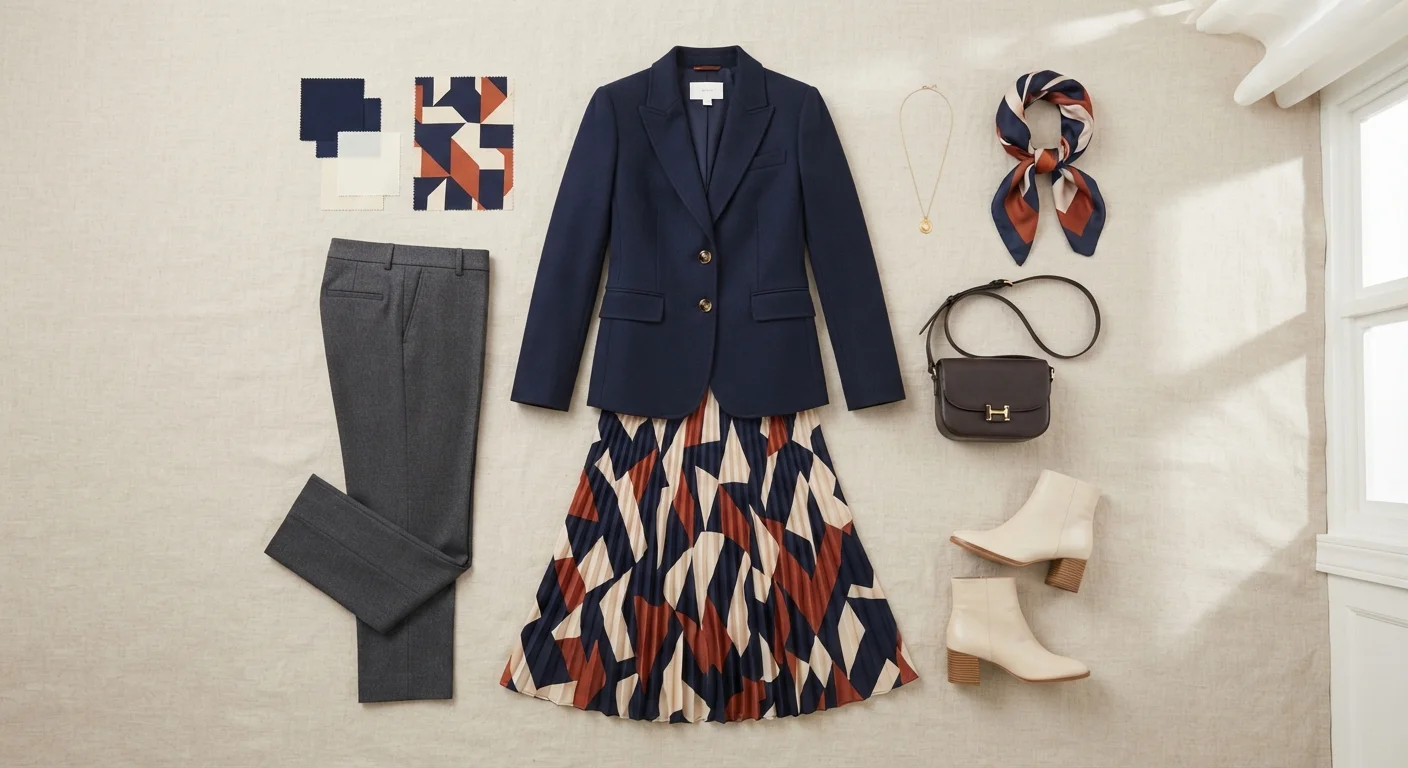
Pattern introduces rhythm and energy into an outfit. It can be overt - graphic florals, bold geometric prints, maximalist clashing - or almost invisible, like a subtle tonal texture or a fine stripe. Where color sets mood, pattern controls visual weight and movement.
Think about pattern on a spectrum from none (solid colors only) to one dominant print to layered mixed patterns. Where do you naturally land? Some people feel most like themselves in the quiet confidence of a single solid; others need the vitality of print to feel fully expressed. Neither position is more sophisticated - they're just different aesthetic vocabularies.
Pattern also interacts with color: a floral in muted, earthy tones reads completely differently than the same scale floral in saturated primaries. Changing the color palette of a print effectively changes its personality. When you're ready to experiment with combining patterns intentionally, our guide on pattern mixing and monochrome dressing walks through the practical techniques.
Silhouette: The Shape That Frames Everything
Silhouette is the architecture of an outfit - the overall shape your clothes create around your body. It's arguably the most structural of the three levers because it determines proportion, and proportion determines how balanced or intentional a look feels at a glance.
There are a few recurring silhouette principles worth knowing. The volume contrast principle - pairing something relaxed on top with something fitted on the bottom, or vice versa - creates visual balance and prevents an outfit from reading as shapeless or overly severe. The proportion break - where a garment's hem hits relative to your height - affects how leggy, elongated, or grounded a look feels overall.
Beyond these mechanics, silhouette is deeply tied to personality. Structured, tailored shapes communicate precision and authority. Draped, oversized pieces often read as relaxed or artistic. A deliberately exaggerated silhouette - a balloon sleeve, a voluminous skirt - signals confidence and intentionality. Knowing which end of the fitted-to-oversized spectrum you gravitate toward, and why, is one of the most revealing pieces of self-knowledge in style. For more on identifying your style archetypes, see style archetypes explained.
Using All Three Together
The real fluency comes from understanding how color, pattern, and silhouette interact. Adjusting any single lever changes the entire read of an outfit. A structured blazer in a quiet neutral reads professional and understated. The same blazer in a vivid color immediately shifts the energy. Add a bold print and it becomes a statement piece. Each lever multiplies the effect of the others.
A useful exercise: look at your existing outfits and identify what you've defaulted to across all three categories. That default combination is your current aesthetic fingerprint. From there, you can either reinforce it - doubling down on what already works - or deliberately introduce contrast in one lever to push your look in a new direction without abandoning what already feels like you. For practical guidance on building from what you already own, building a signature look without starting over is an excellent next step.
Style inspiration can accelerate this process too. Looking beyond social media - at film costumes, art, subcultures, or travel - often surfaces more authentic reference points than algorithm-driven feeds. Our piece on style inspiration sources beyond social media offers a range of places to look.
“Style is a way to say who you are without having to speak.”
— Rachel Zoe, Fashion designer and stylist